

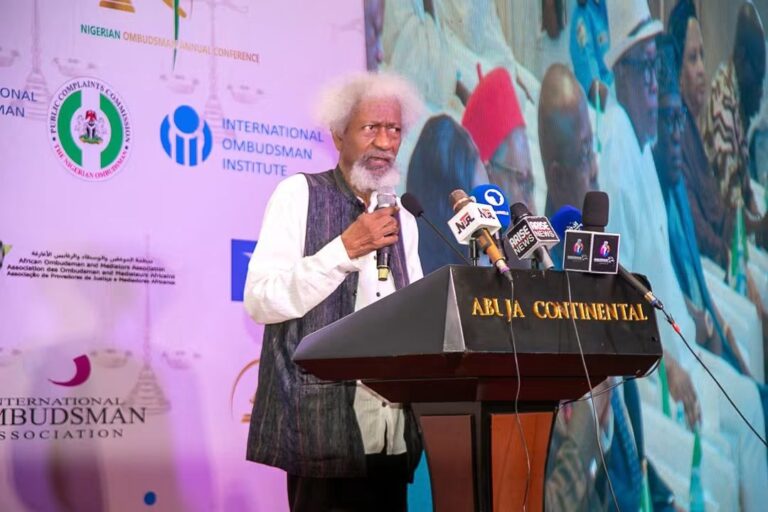
News Investigators/ Nobel Laureate, Wole Soyinka, has urged the Public Complaints Commission (PCC) to prioritise enforcement of court judgments to bridge the gap between justice delivery and implementation.
Prof. Soyinka made the call in a goodwill message at the inaugural Nigerian Ombudsman Annual Conference organised by the PCC in Abuja on Thursday.
The conference has the theme: ‘System Building and Compliance: A Key Factor to Good Governance’.
Prof. Soyinka decried delays in implementing court judgments, warning that victims sometimes died without benefiting from decisions secured through years of legal battles.
“Why is it that we cannot guarantee the implementation of the declaration of a judgment between the plaintiff, between the judgment itself, between the judges, the structure of justice and the victim?” he asked.
He questioned why court decisions were ignored by government agencies in spite of being delivered publicly by competent courts.
“Why is it that people we know have actually died without seeing the fruits of their endeavours for justice?” he asked.
Prof. Soyinka cited cases where citizens waited years for government agencies to comply with court orders, including directives to return confiscated passports.
He described such delays as “medicine after death” and challenged the PCC to make closing the enforcement gap a primary responsibility.
The Nobel Laureate said addressing the problem would help restore public confidence in Nigeria’s justice system.
“If you can solve that for me, believe me, I will die happy,” he said.
Responding, the Emir of Lafia and Chairman of the Nasarawa State Council of Chiefs, Sidi Bage Muhammad I, attributed the problem to indiscipline and poor leadership.
The retired Supreme Court Justice said enforcement rules already existed, but public officials should not require repeated reminders to obey court orders.
He described those in authority as the “real culprits who would not respect court orders and decisions of court”.
Mr Bage said leaders must set an example by complying with judicial decisions if they expected ordinary citizens to do the same.
“You do not need, after a pronouncement is made by court, to be reminded again that you are to comply with the decision of our courts,” he said.
In his keynote address, PCC Chief Commissioner, Bashir Abubakar, described the conference as historic, marking the first such gathering in the Commission’s 51-year history.
He said the event followed the Commission’s Golden Jubilee celebrations a year earlier and focused on building institutions that deliver justice beyond the personalities occupying public offices.
Mr Abubakar disclosed that the Commission received 1,281,984 complaints in the last two years and resolved 716,688.
He said the figures reflected growing public confidence in the Ombudsman institution but also highlighted the substantial volume of unresolved complaints.
Describing the PCC as more than a complaints office, he called it “the conscience of democracy”, restoring public trust when institutions failed to follow their own rules.
Mr Abubakar said the Commission had introduced reforms, including improved budgetary allocation, full implementation of the CONLESS salary structure, biometric staff verification and the creation of new directorates.
He called on the Executive, Legislature, Judiciary, private sector and civil society to work together to promote compliance and make administrative justice accessible and predictable.
Former Commonwealth Secretary-General, Emeka Anyaoku, congratulated Abubakar on his leadership and for convening the inaugural conference.
Mr Anyaoku called for greater public awareness of the PCC’s services, describing the Ombudsman as a less expensive and less cumbersome alternative to litigation.
He said many Nigerians experienced non-payment of gratuities and pensions, alongside unsatisfactory medical care in public and private institutions, without knowing where to seek redress.
He expressed confidence that the conference would strengthen the Ombudsman institution and improve access to its services.
The Secretary to the Government of the Federation, George Akume, described the conference as timely and commended the PCC leadership for the initiative.
Mr Akume, represented by the Permanent Secretary, Political and Economic Affairs, Mrs Augusta Beke, said the Commission was established in 1975 to address maladministration and provide accessible avenues for redress.
He said complaints should be treated not merely as criticism of government but as valuable information for identifying institutional weaknesses and preventing systemic failures.
Mr Akume said good governance required strong systems, clear procedures, competent personnel and a culture of compliance rather than reliance on individual goodwill.
He added that President Bola Tinubu’s Renewed Hope Agenda prioritised institutional reform, accountability and improved service delivery, areas complemented by the PCC’s work.
Also speaking, Neda Imasuen, Chairman of the Senate Committee on Ethics, Privileges and Public Petitions, called for a shift from personality-driven to system-driven institutions.
Mr Imasuen, who represented the Senate President and the House of Representatives, said establishing systems was only part of the solution.
He warned that laws and policies could not deliver results if public officials routinely disregarded them without consequences.
Mr Imasuen said the PCC provided citizens with a channel to challenge unlawful and unfair administrative actions, while complaint patterns could expose institutional weaknesses requiring reform.
He urged participants to develop practical recommendations for strengthening institutional capacity, improving compliance monitoring and translating lessons from complaints into measurable reforms.
NAN