

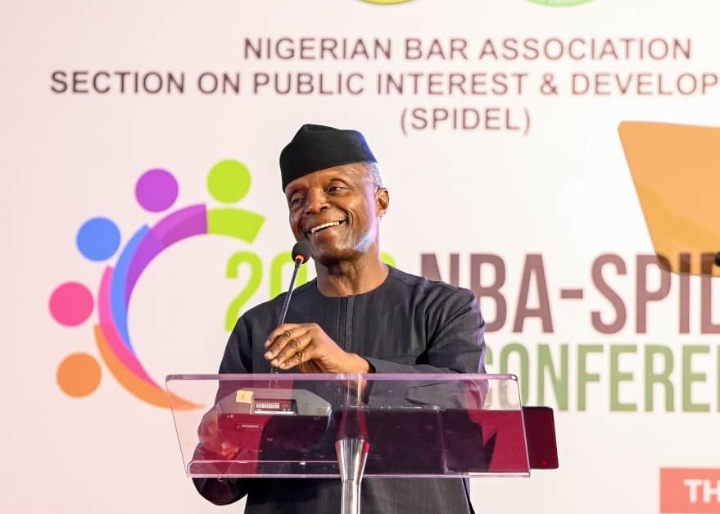
News Investigators/ Former Vice-President, Yemi Osinbajo, has urged lawyers to champion public interest beyond litigation, insisting that democracy must deliver justice and improve citizens’ welfare.
Prof. Osinbajo made the call on Tuesday in Umuahia at the opening of the 2026 Nigerian Bar Association Section on Public Interest and Development Law (NBA-SPIDEL) conference.
The five-day conference has the theme: ‘In Public Interest: Advancing Justice, Democracy and Development’.
He said lawyers, as social engineers, must examine how laws and public institutions affected people’s lives, particularly disadvantaged citizens.
He urged them to promote access to justice, protect livelihoods and advance human welfare through effective legal advocacy.
Prof. Osinbajo said democracy should be assessed beyond elections and constitutional processes, particularly by its capacity to provide jobs, food, healthcare and security.
“Democracy must connect more firmly with human welfare, to jobs, to food, to healthcare, to justice and the security of lives and livelihoods,” he said.
The former vice-president expressed concern over declining public confidence in democratic institutions across Africa, citing Afrobarometer findings on dissatisfaction with government performance.
He identified poor job creation and inadequate efforts to improve living standards as factors contributing to public disillusionment.
He warned that corruption, weak institutions and declining youth participation in electoral politics could further undermine confidence in democracy.
Prof. Osinbajo, however, cautioned against viewing authoritarian or military rule as alternatives, stressing the need for accountable leadership and competent public institutions.
On access to justice, he advocated affordable legal services and recalled reforms introduced during his tenure as Lagos State Attorney-General between 1999 and 2007.
He said the reforms included the Directorate for Citizens’ Rights, Office of the Public Defender and Citizens’ Mediation Centres.
According to him, the initiatives provided free legal assistance and alternative dispute resolution mechanisms for citizens.
He said the mediation centres resolved more than 8,000 disputes in their first year, compared with fewer than 2,000 handled by magistrates’ courts.
Prof. Osinbajo said people-centred justice required accessible mechanisms for obtaining redress, protecting rights and securing remedies, particularly for disadvantaged citizens.
He urged lawyers to scrutinise government budgets and expenditure, challenge administrative failures and collaborate with communities to improve public services.
He identified prolonged court proceedings, judicial corruption and widespread impunity as challenges undermining confidence in the justice system and impeding development.
On Artificial Intelligence (AI), Prof. Osinbajo warned that the technology could significantly disrupt several professional careers, including legal practice, accounting, engineering and banking.
He urged lawyers to acquire negotiation and conflict-resolution skills, understand emerging technologies and verify AI-generated information to remain relevant.
He also encouraged practitioners to deploy AI to make legal services more affordable while supporting regulations that protect citizens without stifling innovation.
Prof. Osinbajo said the legal profession must prepare young lawyers for a future in which machines could perform many preliminary tasks traditionally assigned to junior practitioners.
In his remarks, Abia State Governor, Alex Otti of Abia urged lawyers to prioritise vulnerable and indigent citizens, stressing that the profession should not focus exclusively on financial gains.
Mr Otti challenged practitioners to deploy their knowledge and skills in helping people unable to afford legal representation or defend their rights.
He said his administration had intervened in cases involving people allegedly detained unjustly since assuming office in 2023.
The governor recalled directing the Attorney-General to work with the Chief Judge to review such cases.
He said those found to have no legal justification for continued detention were released before the end of 2023.
Mr Otti also announced plans to commission 10 new courthouses equipped with renewable energy, digital court records and internet connectivity.
He said two additional court complexes in Umuahia and Aba would be flagged off before the end of November.
In her address, Nigerian Bar Association (NBA) President, Oyinkansola Badejo-Okusanya, called for credible investigations into recent political violence.
She urged authorities to prosecute those found culpable, condemning attacks on political supporters and convoys in Asaba, Ekiti and Calabar.
Mrs Badejo-Okusanya insisted that citizens must participate in lawful political activities without intimidation or assault.
She also urged the NBA to collaborate with relevant institutions to strengthen safeguards in detention facilities.
Her call followed reported deaths in Nigeria Security and Civil Defence Corps (NSCDC) custody in Minna.
She advocated improved detention conditions, access to legal assistance, prompt medical attention and appropriate treatment of children in conflict with the law.
The NBA president directed SPIDEL to submit a proposed work plan on detention conditions and child protection within 30 days. She also requested a progress report within 90 days.
Mrs Badejo-Okusanya said the association would examine concerns over conflicting judicial decisions, alleged disregard for superior court orders and judicial misconduct.
She stressed the need for proper investigations into such concerns.
Earlier, NBA-SPIDEL Chair, Uju Agomoh, urged lawyers to confront injustice, challenge abuses of power and promote access to justice for vulnerable Nigerians.
Prof. Agomoh said legal practitioners must extend their responsibilities beyond courtrooms by contributing to public policy, institutional reforms and democratic governance.
She challenged the profession to assess whether laws and democratic institutions worked effectively for citizens and adequately protected their rights.
Prof. Agomoh said the conference would produce an Umuahia Declaration containing practical and measurable commitments arising from its deliberations.
She expressed confidence that the declaration would strengthen public interest law and advance justice, democracy and development in Nigeria and across Africa.
NAN