
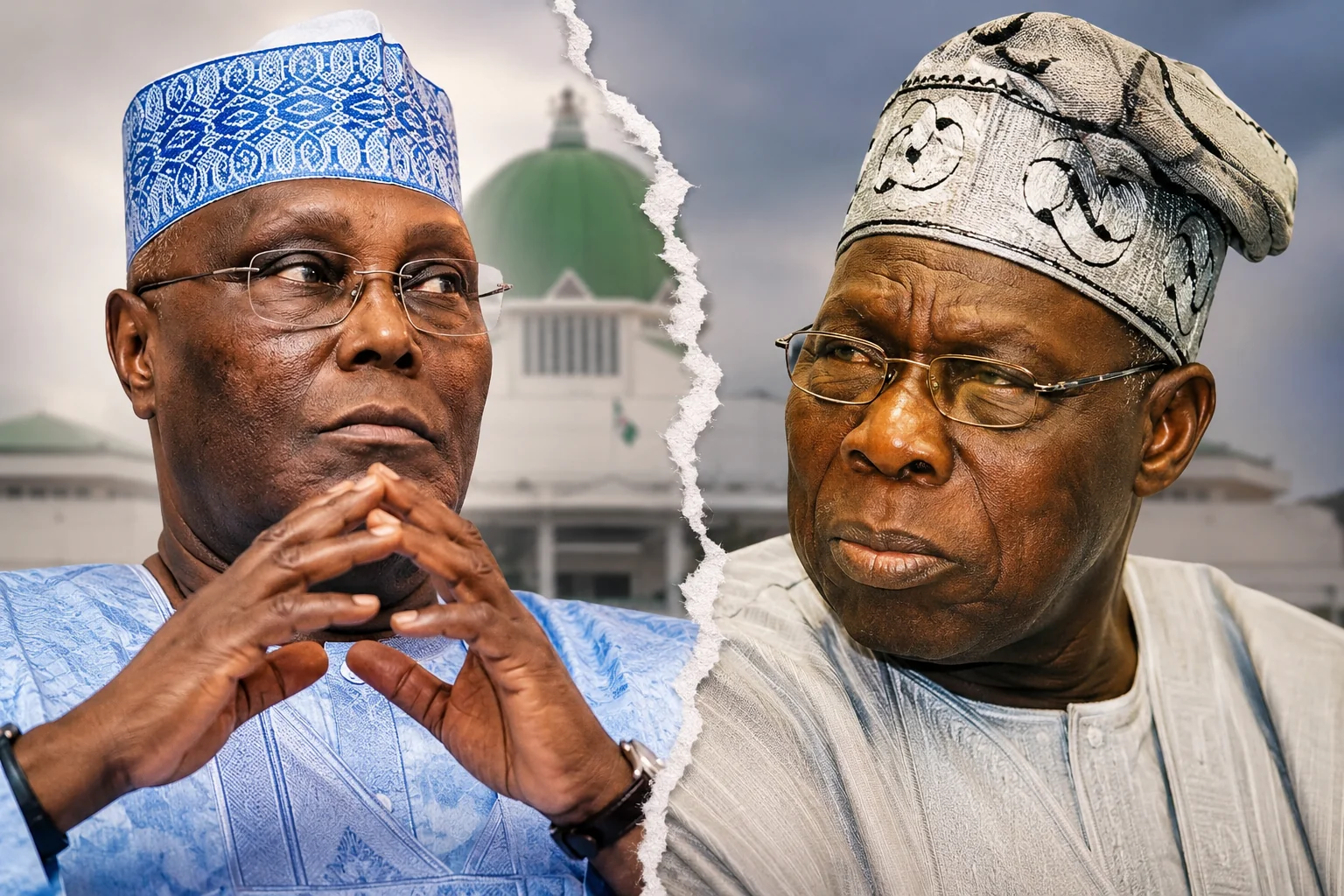
News Investigators/ The Presidential candidate of the African Democratic Congress and Nigeria’s former vice president, Atiku Abubakar has said that that the political relevance of his former boss President Olusegun Obasanjo in the south west should not be overstated.
Mr. Atiku who spoke through his senior political assistant, Demola Olarewaju on Monday during an interview on Frontline, a current affairs programme on Eagle 102.5 FM, Ilese-Ijebu, Ogun State, observed that the lingering disagreement between him and Mr. Obasanjo is political and not personal.
Mr. Olarewaju said that Obasanjo’s political influence in the south-west should not be overstated, particularly in terms of his ability to determine electoral outcomes.
He said Mr. Atiku’s offence against his former boss was his opposition to Obasanjo’s aborted third-term bid, noting that the ADC candidate has since done his utmost to mend fences with him.
Despite the former president’s opposition to Atiku, Olarewaju said supporters of the former vice president remained determined to pursue his political ambition. “We are determined that this opposition won’t affect Atiku’s campaign,” he said.
Recall that the political differences between Obasanjo and Atiku dated back to their second term in office between 2003 and 2007 when Mr. Atiku allegedly worked against the interest of his boss.
The dispute recently intensified after Mr. Obasanjo described his decision to choose Atiku as his running mate in 1999 as the “biggest mistake” of his political life, while also alleging that the former vice president was involved in a plot to impeach him in 2003.
Mr. Obasanjo alleged that Atiku paid ₦5 million to the late Speaker of the House of Representatives, Ghali Umar Na’Abba, to initiate the impeachment process.
Mr. Atiku, through his media aides, rejected the allegations, describing them as part of what he called a long-running campaign of “lies, deceit and historical distortion” by the former president.
The former vice president also argued that the root of Obasanjo’s resentment was his refusal to support the former president’s bid for a third term in office. Atiku maintained that he chose the Constitution and Nigeria’s democratic interests over personal loyalty.
He also denied the alleged payment to Na’Abba, who died in 2023, questioning the decision to rely on a deceased former lawmaker who could no longer respond to the allegation.
Atiku’s camp has further cited accounts from political figures who served during the period, including former House Chief Whip Abubakar Bawa Bwari and former Abia State Governor Orji Uzor Kalu, in disputing Obasanjo’s account of events.
The renewed dispute comes as Atiku remains active in opposition politics ahead of the 2027 presidential election, with his supporters insisting that the disagreement with Obasanjo will not derail his political ambitions.
According to Mr. Olarewaju, Atiku still holds Obasanjo in high esteem despite their political differences, adding that there was no personal grievance between the two former leaders.
“The relationship between the former President Obasanjo and Atiku, in my view as a Nigerian who witnessed the administration and the post-administration, is the fact that they do not seem to have a personal issue. It is clear from how Atiku holds Obasanjo in high esteem,” he said.
Mr. Olarewaju, however, alleged that the disagreement between the former president and his former deputy was rooted in politics, claiming that Obasanjo does not want Atiku to become president.
“The issue between them is political and, for reasons best known to Obasanjo, it is very clear and obvious that he does not want Atiku Abubakar to ever be President of the Federal Republic,” he said.
He also questioned what he described as Obasanjo’s belief that no other leader could match his achievements or govern Nigeria better than he did.
“I think another thing that has become very clear is his instability about the opinion that Obasanjo holds that nobody can meet up with his achievement and nobody can govern Nigeria better than him,” Mr. Olarewaju said.
Speaking on Obasanjo’s political posture since leaving office in 2007, Olarewaju described it as a “journey of redemption,” arguing that the former president had, over the years, sought to rebuild his relationship with the Yoruba people.
He linked this to Obasanjo’s role during the Nigerian Civil War and suggested that the former president’s subsequent political interventions could partly be viewed within the context of his relationship with the South-West.
Mr. Olarewaju also compared Obasanjo’s approach to successive administrations, arguing that the former president had been more critical of the administrations of former Presidents Goodluck Jonathan and Muhammadu Buhari than he has been of the administration of President Bola Tinubu.
He further argued that Obasanjo’s political influence in the South-West should not be overstated, particularly in terms of his ability to determine electoral outcomes.
Despite the former president’s opposition to Atiku, Olarewaju said supporters of the former vice president remained determined to pursue his political ambition. “We are determined that this opposition won’t affect Atiku’s campaign,” he said.
On concerns over Atiku’s age, with the former vice president now 79, Olarewaju argued that the debate should focus beyond age and examine the structural problems confronting Nigeria.
He maintained that Nigeria’s federal system was overly centralised, with too much power concentrated in Abuja.
“One of the biggest problems that we have in Nigeria is that the Federal Republic of Nigeria is not actually federal. That’s why we have so much power concentrated on Abuja, and over time it has continued to be a problem,” he said.
Mr. Olarewaju also challenged the perception that successive Nigerian leaders had simply been corrupt or wicked, arguing that the country’s political structure itself needed fundamental reform.
“I know a lot of Nigerians want to believe that anybody that has governed Nigeria since 1960 has always been corrupt or wicked. But if we look at it from another dimension, I have a model that we are wrong. It’s not the way Nigeria was supposed to run,” he said.
He added that changing the occupant of the presidency without addressing the underlying structure of governance would not resolve the country’s problems.
“Anybody you put there, unless they go back to fixing the fundamentals, they will continue; we will continue to have the same problem,” he said.