

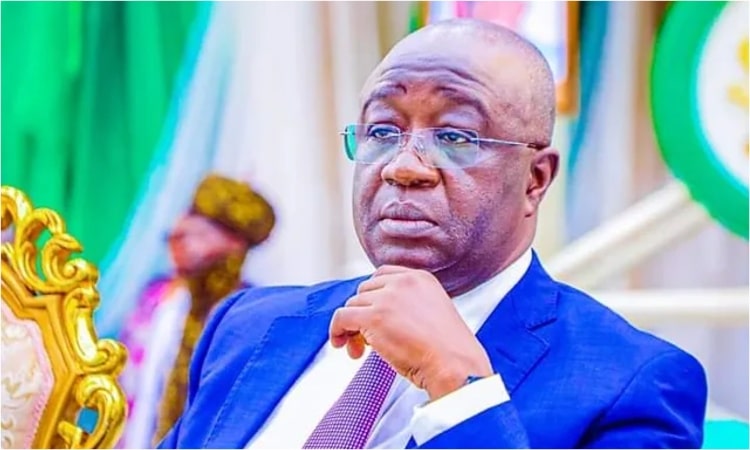
News Investigators/ The Nasarawa State government says it is strengthening healthcare delivery through the establishment of a medical school, specialist hospital and trauma centre.
The government said it was also adopting measures to improve the retention of medical personnel in the state.
Emmanuel Akabe, Deputy Governor of Nasarawa state, disclosed this on Wednesday in Abuja, at the 51st Annual General Meeting and Scientific Conference of the Ophthalmological Society of Nigeria (OSN).
Mr Akabe, who is also an ophthalmologist, said the state government was also working towards establishing a second National Eye Centre in collaboration with relevant stakeholders.
“I now want to collaborate with the state and the National Assembly to ensure that this second National Eye Centre becomes a reality,” he said.
He said the establishment of the centre would strengthen specialist eye-care services and contribute to the development of ophthalmology in the country.
He said the state was also developing a specialist hospital and trauma centre in Akwanga as part of its efforts to expand access to specialised medical services.
According to him, billions of Naira have been committed to the project, with work already ongoing and completion expected before the end of 2026.
He said the state was also taking steps to improve the remuneration of doctors, particularly those working in specialist hospitals, by ensuring that their salaries were comparable with those of their federal counterparts.
He said the measure was intended to reduce the migration of doctors from the state in search of better opportunities elsewhere.
“We train them, they run away. So let us encourage them and give them something,” he said.
The deputy governor further announced plans to place medical and other health students on salary from the commencement of their clinical training.
According to him, the initiative will begin in October and is aimed at encouraging students to remain in the state and eventually contribute to its health workforce.
He said the state government was also planning to establish a medical school at the Nasarawa State University.
He said the Federal Medical Centre, Keffi, had been made available to the state to serve as a teaching hospital for the proposed medical school.
“A memorandum of understanding has recently been signed on the arrangement.
“The development of the state’s health sector was part of the government’s broader effort to improve healthcare infrastructure and retain skilled personnel, ” he said.
He urged medical professionals to support government at national and sub-national levels, stressing that doctors should be partners in the development of the health sector.
“We should be partners in progress, because we can not develop the health sector without the medical professionals,” he said.
Mr Akabe also commended OSN for bringing ophthalmologists and other stakeholders together to deliberate on the future of eye care.
He described the conference theme, “Reimagining Eye Care in the Digital Era”, as timely, saying medical practitioners must adapt to technological changes in order to improve healthcare delivery.
Also speaking, Brig.-Gen. Innocent Enwuchola, Commander, Nigerian Army Medical Corps, said the Nigerian military was strengthening its eye-care capacity through infrastructure upgrades and specialist training.
Enwuchola, who delivered a goodwill message on behalf of the Armed Forces, said the Nigerian Army Medical Corps and other military medical services had established modern and technologically equipped eye centres in military hospitals.
He said the eye department at the 44 Nigerian Army Reference Hospital had recently been upgraded.
According to him, the facilities serve military personnel and their families, while also providing services to neighbouring civilian communities.
He said the military had also prioritised advanced training and specialisation of personnel in ophthalmology through residency sponsorship and subspecialty training.
“With this, we ensure the continuous delivery of high-quality eye care services across our medical units and formations,” Enwuchola said.
Fatima Kyari, Registrar and Chief Executive Officer of the Medical and Dental Council of Nigeria (MDCN), said the council was updating its master register of medical and dental practitioners.
Prof. Kyari urged specialists to register their additional qualifications with the council to ensure that they were formally recognised.
She said MDCN had provided a registration facility at the conference venue to enable medical specialists to update their records.
Prof. Kyari, who also serves as Chair of the International Agency for the Prevention of Blindness (IAPB) Africa, said Nigeria had continued to play a role in global efforts to improve eye health.
She expressed appreciation to the Federal Government for agreeing to co-host the Global Summit on Eye Health scheduled for November.
She said the summit would provide Nigeria with an opportunity to demonstrate its experience in eye health and encourage other countries to strengthen access to eye-care services.
NAN