

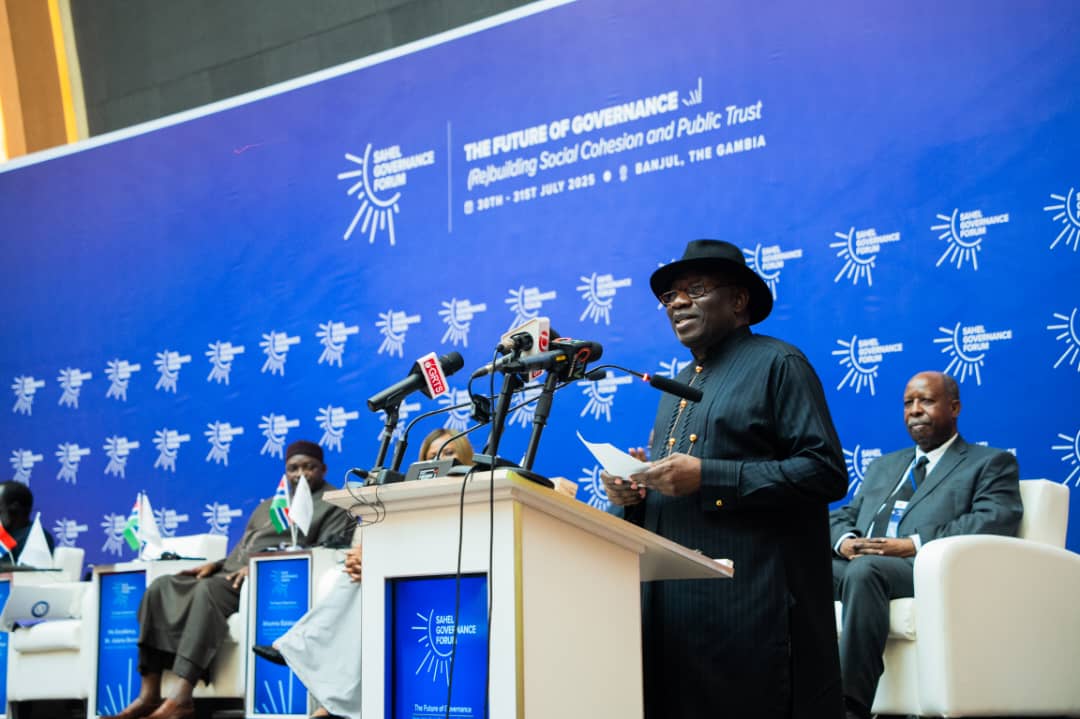
News Investigators/ The Former President, Goodluck Jonathan, has called for a major reform of global governance structures, particularly the United Nations Security Council (UNSC), to reflect contemporary world realities and maintain global peace.
Mr Jonathan, who is the Chairman ISCP-Africa, made the call while speaking virtually at the International Summit Council for Peace (ISCP) conference held in Manila, Philippines.
In his remarks obtained by the News Agency of Nigeria (NAN) on Friday in Abuja, the former president said the future of the rules-based world order would not be secured by power alone but by collective commitment to fairness, dialogue, accountability and human dignity.
He noted that the rules-based international order had contributed significantly to global stability, economic progress and cooperation among nations.
Mr Jonathan, however, said that like all human institutions, the order must evolve to reflect changing realities and rising expectations.
He said that for the system to retain the confidence of all peoples and nations, its principles must be applied with fairness, consistency and transparency.
“This is why the longstanding calls for reforms in global governance structures, particularly the United Nations Security Council, deserve thoughtful consideration.
“Nearly eight decades after the founding of the United Nations, many regions, including Africa, remain under-represented in institutions that shape decisions affecting global peace and security.
“Africa is home to 54 sovereign states and more than 1.5 billion people, yet it lacks permanent representation on the security council.
“Addressing such imbalances is not about prestige. It is about strengthening legitimacy, enhancing effectiveness and ensuring that global institutions reflect contemporary realities,” he said.
Jonathan said that the calls for reform from Africa and other parts of the developing world should therefore not be viewed as efforts to dismantle the international order.
Rather, he said they should be seen as contributions toward making it more inclusive, representative and responsive.
The former president noted that the increasingly interconnected world demanded greater cooperation, stronger partnerships and a renewed commitment to multilateralism.
“The push for reforms should therefore not be viewed as a contest between regions or civilisations nor an attempt to replace one form of dominance with another.
“Rather, it should be seen as an opportunity to build a more balanced international system founded on mutual respect, shared responsibility and genuine partnership.
“The future of the rules-based world order will not be secured by power alone. It will be sustained by our collective commitment to fairness, dialogue, accountability and human dignity,” he said.
Jonathan said that the present generation had the responsibility, not only to preserve peace but also to strengthen institutions that reflect the aspirations and realities of all peoples.
While commending the theme of the conference, he said that the meeting took place at a time of profound global change, especially when geo-political tensions were increasing across regions.
“Conflicts are becoming more complex. Economic uncertainties persist and confidence in international institutions is being tested.
“At the same time, humanity faces common challenges such as climate change, food insecurity, migration pressures, terrorism, cyber threats and the rapid advancement of emerging technologies.
“These realities have prompted important debates about the future of the international system that has guided global cooperation for decades.
“I believe these developments offer us an opportunity to strengthen international cooperation and renew our collective commitment to peace, justice and shared prosperity,” he stated.
NAN