
News Investigators/ Nigeria has assumed the Chairmanship of the UN General Assembly Fifth Committee, pledging to champion transparency, accountability and far-reaching administrative reforms.
The Fifth Committee, formally known as the Administrative and Budgetary Committee, is responsible for considering the financial and administrative affairs of the United Nations.
Its work places it at the heart of decisions on the Organisation’s budgets, financial governance, human resources, institutional efficiency, oversight and the resources required to implement mandates approved by Member States.
Speaking as Nigeria takes up the leadership of the influential committee, its Permanent Representative to the UN, Jimoh Ibrahim, said the chairmanship would not be approached as “business as usual.”
“Nigeria’s priority is to ensure that we have reforms around budget and administration that will showcase transparency and accountability,” he said.
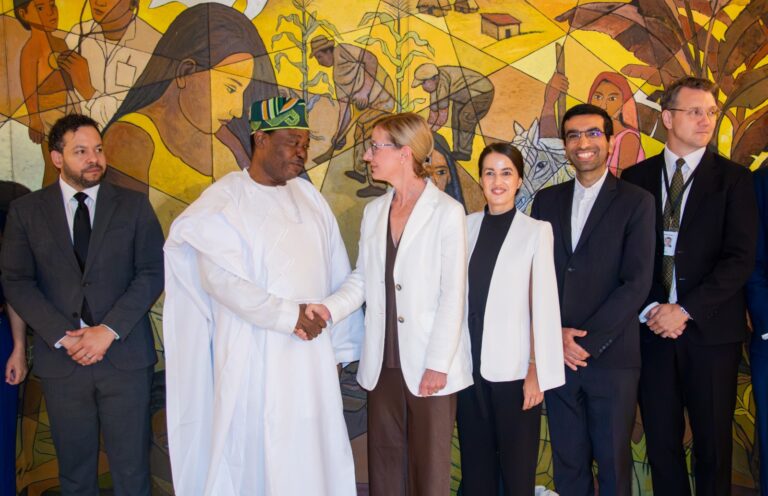
Amb. Jimoh Ibrahim, Permanent Representative of Nigeria to the UN (middle) flanked by some officers of the Permanent Mission of Nigeria to the UN at the official taking over of the Chairmanship of the UN General Assembly Fifth Committee on Budget and Administration.
The Permanent Representative said Nigeria would promote a results-oriented approach that ensures UN expenditures ultimately translate into tangible benefits for the Organisation’s 193 Member States.
“We will insist that the United Nations should impact Member States and not just the Secretariat,” Jimoh said.
“For us, every dollar is important. There must be justification for the utilisation of funds, because every dollar is key to UN reform.”
The Nigerian envoy identified the efficiency of the UN system as a major focus of his chairmanship, stressing the need to continually examine whether institutional structures are delivering optimum value.
“We will look at the heavy nature of the UN Secretariat at the top that does not give enough room for new job creation,” he said.
“Efficiency of the United Nations will be a focus of attention.”
Permanent Representative of Nigeria to the UN and Chair of UN Fifth Committee, Amb. Jimoh Ibrahim (middle) flanked by the immediate past Chair, Amb. Zsuzsanna Horváth, Permanent Representative of Hungary to the UN, and other members of the UN General Assembly Fifth Committee after Jimoh assumed the Chair.
Jimoh said the Committee must examine how administrative structures and expenditure patterns could be better aligned with the priorities and expectations of Member States.
According to him, accountability should go beyond accounting for expenditure to demonstrating what such expenditure has achieved for countries and peoples for whom the United Nations exists.
The Permanent Representative also identified the United Nations Joint Staff Pension Fund, with assets of about 110 billion dollars, as an important area requiring careful attention.
“The approximately 110-billion-dollar staff pension fund will be a focus of attention. It cannot simply be business as usual,” Jimoh said.
He emphasised that the objective would be to promote sound governance, sustainability, transparency and the protection of the interests for which the resources are administered.
Jimoh said Nigeria’s emergence as Chair of the Fifth Committee also carries considerable diplomatic significance for Africa’s most populous country.
“It means a lot for Nigeria. It shows that Nigeria is relevant in the geopolitical system, particularly in the financial architecture of the United Nations system,” he said.
According to the ambassador, the chairmanship gives Nigeria an opportunity to help build consensus among Member States at a time when the UN faces mounting financial pressures and increasing demands for institutional reform.
“Nigeria will ensure that every Member State has a stake in the Budget and Administrative Committee through a strong social-capital network,” Jimoh said.
“We want an inclusive committee in which Member States feel ownership of the process and in which decisions reflect transparency, accountability and collective responsibility.”
He said Nigeria would deploy consultation, dialogue and consensus-building to bridge differences among delegations and advance the collective interests of the UN membership.
The envoy stressed that the chairmanship would be exercised on behalf of the entire membership rather than for narrow national interests.
“Our responsibility is to provide leadership that strengthens confidence in the United Nations and its financial and administrative system,” he said.
“The resources of this Organisation belong, ultimately, to Member States. Therefore, their utilisation must be defensible, transparent and tied to results.”
Jimoh said greater efficiency was particularly critical at a time when the UN is being challenged to accomplish more amid financial constraints and growing global crises.
He stressed that administrative reform should ensure that resources reach areas where they produce the greatest impact rather than being disproportionately absorbed by bureaucracy.
Jimoh took over the Chair of the committee for the 81st session from Amb. Zsuzsanna Horváth, Permanent Representative of Hungary to the UN and chair of the committee for the 80th session.
The Nigerian envoy envoy was elected on June 2 barely six weeks into his role as Nigeria’s UN ambassador.
The Fifth Committee occupies a strategic position within the General Assembly because decisions across peace and security, development, human rights, humanitarian operations and other pillars of the UN system ultimately require financial and administrative support.
Its recommendations consequently have implications for how mandates established by the General Assembly are financed and implemented.
Nigeria’s leadership comes at a critical period of wider discussions over UN reform, institutional effectiveness, financial sustainability and the ability of the multilateral system to respond efficiently to increasingly complex global challenges.
Jimoh pledged that Nigeria would work constructively with all regional groups and Member States throughout its tenure to achieve consensus and advance reforms capable of strengthening confidence in the United Nations.
NAN