

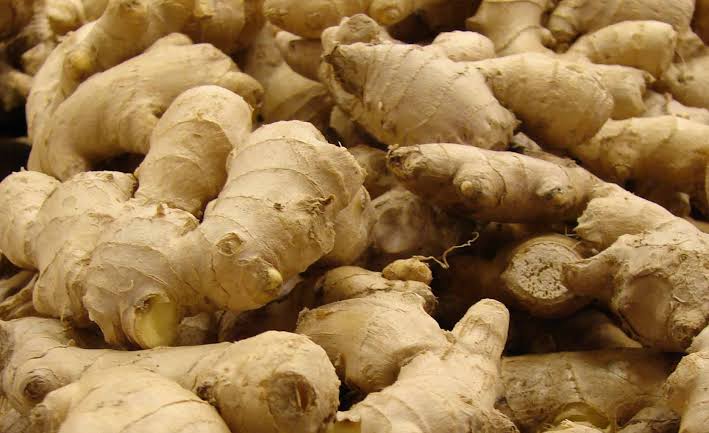
News Investigators/ Traders and consumers in Lagos have lamented the sharp rise in ginger prices, attributing the development to insecurity in major producing communities, dwindling supplies and rising transportation costs.
The respondents, who spoke with the News Agency of Nigeria (NAN) on Sunday, said the situation had made the popular spice increasingly unaffordable for many households.
NAN reports that ginger is widely used in Nigerian homes for cooking, beverages and traditional remedies because of its distinctive flavour and perceived health benefits.
The spice is produced mainly in Kaduna, Nasarawa, Niger and Plateau states before being transported to markets across the country.
However, traders said supplies reaching Lagos markets had declined significantly in recent months, resulting in steep price increases.
NAN reports that data from the National Bureau of Statistics showed that Nigeria’s ginger exports dropped by 74 per cent to N6.28 billion in the first nine months of 2024, compared with N23.76 billion recorded during the corresponding period of 2023.
Industry stakeholders have linked the decline partly to disease outbreaks that affected ginger farms in key producing states, including Kaduna and Kano.
The Minister of State for Agriculture and Food Security, Dr Aliyu Abdullahi, noted that ginger farmers have lost over N12 billion to the epidemic since 2023.
Speaking with NAN, the Public Relations Officer of Oyingbo Market, Mr Ademola Oduyemi, said insecurity in some farming communities had disrupted cultivation and harvesting activities.
According to him, information from suppliers indicates that many farmers can no longer access their farms because of security concerns.
“Some farmers are unable to harvest their crops, while others are reluctant to plant. This has reduced the volume of ginger coming into the market and contributed to the scarcity we are witnessing,” he said.
Oduyemi said the shortage had pushed prices to unprecedented levels.
“A paint bucket of ginger now sells for between N40,000 and N46,000, depending on size and quality.
“Half a paint bucket costs between N22,500 and N23,000, while a derica measurement sells for about N12,000.
“Many retail buyers who cannot afford larger quantities now purchase individual pieces, which sell for about N500 each,” he said.
He added that rising transport costs and growing demand had compounded the supply challenge.
“If farmers can safely return to their farms and production improves, supply will increase and prices may stabilise,” he said.
Also speaking, Mrs Florence Akinfolubi, a ginger trader at Oyingbo Market, said reduced supplies from producing states had continued to affect availability.
“We receive far less ginger than before. Whenever supply drops, prices inevitably rise.
“Transportation costs have also increased considerably. Moving produce from the North to Lagos is more expensive, and that reflects in market prices,” she said.
Another trader, Mr Abdullahi Musa, said growing consumer demand was exerting additional pressure on available supplies.
“More people now buy ginger regularly because of its health benefits.
“Demand keeps increasing, but supply is not keeping pace, and that is driving prices higher,” he said.
At Lawanson Market, a spice dealer, Mrs Iyabo Daleko, said traders were finding it increasingly difficult to sustain their businesses.
“We spend more on purchasing and transporting ginger, yet customers complain whenever prices go up.
“Many buyers now settle for smaller quantities because they can no longer afford what they used to buy,” she said.
Consumers also expressed concern over the persistent increase.
Mrs Janet Madueke described the situation as frustrating.
“A tiny piece of ginger now sells for about N1,000 in the market near my residence in Surulere.
“The price is outrageous, and despite the cost, the quality does not appear to be as good as before,” she said.
Similarly, another consumer, Mrs Funmilayo Ogunleye said the rising cost of ginger was stretching household budgets.
“I use ginger regularly for cooking and preparing drinks.
“The price has almost doubled compared to what I paid earlier this year, so I now buy less and use it more sparingly,” she said.
Mr Adewale Balogun said he had also reduced his purchases because of the escalating cost.
“Ginger is a staple in my home, especially for tea and other drinks.
“These days, what N1,000 used to buy can no longer go far. It is becoming difficult for average families,” he said.
Some residents warned that continued increases in the prices of food items and spices could further worsen the cost-of-living challenges facing many households.
They urged government authorities to strengthen security in farming communities, improve agricultural production, address transportation bottlenecks and enhance food distribution systems to stabilise prices.
According to them, ginger remains an essential household commodity whose availability and affordability should be prioritised.
NAN