

News Investigators/ The Minister of Information and National Orientation, Mohammed Idris, says the removal of fuel subsidy has created fiscal headroom for the Federal Government to pursue developmental projects across the country.
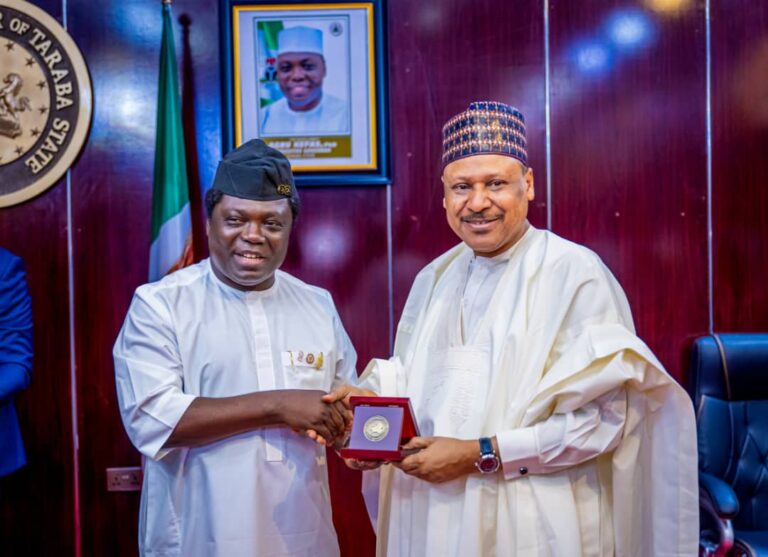
Mr Idris stated this on Thursday when he paid an official visit to Taraba State Governor, Agbu Kefas in Jalingo, on the sidelines of activities marking Taraba’s 35 years of existence.
The theme of the anniversary was “Celebrating 35 Years of Unity, Peace and Progress.”
The minister said the administration of President Bola Tinubu had, since assuming office on May 29, 2023, introduced a number of reforms aimed at repositioning the Nigerian economy.
He listed the removal of fuel subsidy and the unification of the foreign exchange market, among others, as major reforms undertaken by the administration.
Mr Idris said Nigeria was facing one of its toughest economic challenges before Tinubu assumed office on May 29, 2023.
The minister said about 27 of the 36 states in the country were at the time unable to pay the salaries and wages of their workers because of the difficult economic situation.
He added that there was also no provision for the continuation of fuel subsidy beyond June 2023 when the President assumed office.
Mr Idris noted that several individuals who had aspired to lead the country had acknowledged the need to address the subsidy regime.
He said Tinubu took the decision to remove the subsidy immediately after assuming office and had remained committed to the reform in spite of the challenges associated with it.
The minister said the removal of the subsidy had provided the federal and state governments with additional fiscal space to undertake developmental programmes.
He said the resources had made it possible for governments at different levels to embark on infrastructure projects and reposition key sectors of the economy.
Mr Idris said Nigerians could see construction and other development projects taking place in different parts of the country as a result of increased fiscal capacity.
He argued that such projects would have been difficult to undertake without the resources generated through the reforms.
The minister also highlighted the Nigerian Education Loan Fund (NELFUND) as one of the flagship programmes of the Tinubu administration.
He said more than 1.2 million young Nigerians had so far benefited from the scheme, enabling them to remain in school in spite of financial challenges.
According to Mr Idris, the Federal Government has not only provided tuition support for beneficiaries but also introduced stipends to help students remain in school.
He said the programme was designed without political, ethnic, religious or geographical discrimination.
Mr Idris explained that applicants were not required to disclose their political affiliation, ethnicity or religion before accessing the education loan scheme.
He said the objective of the President was to ensure that every young Nigerian who had the credentials and desire to pursue education was given an opportunity to do so.
The minister said the policy was aimed at preventing children from being excluded from education because their parents or guardians could not afford school fees.
He also said the foreign exchange reforms had helped to create greater predictability for businesses operating in the country.
Mr Idris recalled that businesses previously faced difficulties planning because exchange rates could change several times within the same day.
He said the situation had made it difficult for entrepreneurs to predict costs and determine the likely outcomes of their investments.
According to him, the reforms have improved stability and provided businesses with a more predictable environment for planning and investment.
The minister further said international financial institutions had become more willing to engage with Nigeria as a result of reforms undertaken by the administration.
He said Nigeria had also made progress in addressing concerns relating to money laundering, terrorism financing and other illicit financial transactions.
Mr Idris said the country’s removal from the Financial Action Task Force (FATF) grey list had further strengthened its reputation as a destination for legitimate business and investment.
He also noted that Nigeria’s gross domestic product was growing, while headline and food inflation had been trending downward.
The minister said the country’s foreign reserves had risen beyond 50 billion dollars, describing the development as a major achievement.
He said the improved economic environment was also attracting increased interest in Taraba State because of the collaboration between the state and federal government.
Mr Idris acknowledged that security challenges remained in some parts of the country but said the federal government and state governments were working together to improve the safety of citizens.
He said the proposal for state police, which he noted was now supported by the governors, would bring policing closer to the people and enhance the protection of lives and property.
The minister expressed delight at being invited to Taraba to witness the state’s anniversary and commended the administration for its achievements in 35 years.
Responding, Mr Kefas said his administration had continued to enjoy the support and cooperation of the federal government under President Tinubu.
The governor said the President had given his administration the necessary support and free hand to translate federal policies into projects capable of improving the lives of citizens.
Mr Kefas said Taraba had declared free education for primary and secondary school students and had been paying examination fees to reduce the financial burden on parents.
He said the state had also benefited from improved security cooperation with the federal government, adding that the collaboration had contributed to greater stability.
The governor said several projects had been completed, while others were ongoing across the state, adding that the support of the President had contributed significantly to the achievements.
Mr Kefas said his administration had also continued to pay monthly salaries of workers and implemented the minimum wage, noting that the N30,000 minimum wage had not been implemented when he assumed office.
He said his administration had subsequently implemented the minimum wage and pursued other policies aimed at improving the welfare of residents.
The governor said Taraba was working in line with the vision of the President to move the state forward and expressed optimism that the establishment of state police would further enhance security and development.
Mr Kefas congratulated the people of Taraba on the 35th anniversary of the state, adding that his administration remained committed to building on the achievements recorded while preparing the state for a more prosperous future.
NAN