

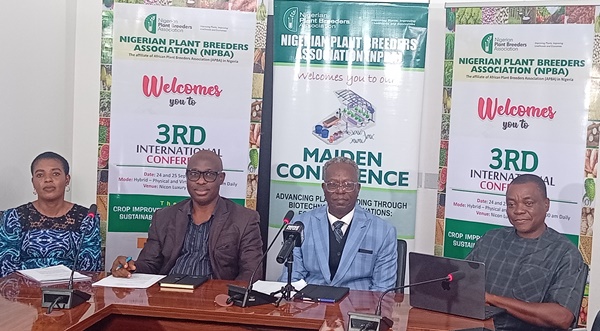
News Investigators/ Victor Adetimirin, the President of Nigerian Plant Breeders Association (NPBA) has called for increased investment in research and scientific innovations in order to reposition the nation’s Agricultural sector and ensure food security.
TheNews Agency of Nigeria (NAN) reports that made the call at a news conference on Saturday in Abuja.
The event was to unveil plans and programmes for the 2026 NPBA Annual Conference scheduled to hold from Sept. 23 to 24 in the Federal Capital Territory (FCT).
According to Prof. Adetimirin, as Nigeria grapples with food insecurity, investment in research and innovative methods of agriculture is needed to increase productivity and food sufficiency.
He noted that Nigeria was facing challenge of feeding its growing population under increasingly difficult conditions, including climate change, emerging pests and diseases and declining soil productivity.
He added that pressure on available farmland, unstable agricultural supply chains and rising production costs threaten sustainable food production.
“Meeting these challenges requires more than expanding the area under cultivation. Nigeria must also improve the productivity, resilience and profitability of its agricultural systems.
“Plant breeding is central to this process,” he said.
Prof. Adetimirin said investment in plant breeding was essential to developing improved crop varieties with higher yields and greater resistance to pests, diseases, drought, heat and other environmental stresses.
According to him, plant breeders played a central role in sustainable agricultural production through the development of improved crop varieties using conventional and modern breeding techniques.
“Investment in plant breeding and crop improvement is not only an investment in science; it is an investment in agricultural productivity, business development, supply-chain stability and national food security,” he said.
“Through conventional breeding, genetics, biotechnology, genomics and other modern tools, we develop improved crop varieties that produce higher yields and resist important pests and diseases,” he said.
The president said stronger collaboration among universities, research institutions, government agencies, seed companies, farmers, financial institutions, agribusinesses and development partners was necessary to turn research into practical solutions.
According to him, the 2026 annual NPBA conference is with the theme, “Leveraging Breeding Innovations and Strategic Partnerships for Agribusiness Investment, Stable Supply Chain and National Food Security in a Changing Climate”.
He said the two-day event would provide a national platform for presenting scientific advances, exchanging ideas, building partnerships and exploring opportunities for transforming research innovations into commercially viable agricultural solutions.
“This is not just a scientific theme. It is a national development agenda that speaks to the question of how Nigeria can use science, innovation, partnerships and investment to build an agricultural sector that is more productive.
“A sector that is more resilient, more competitive and ultimately capable of feeding our growing population and also earn revenue through export,” he said.
Prof. Adetimirin further explained that the conference would offer a platform where different actors in the sector could come together to explore how scientific innovations can be translated into products, enterprises, investments and measurable impacts.
“As we gather in Abuja on 23 and 24 of September, our objective is not simply to celebrate advances in plant breeding.
“It is to address how those advances can be mobilised to create real opportunities for farmers, businesses, investors and the Nigerian people,” he said.
Also speaking, Peter Aikpokpodion, Chairman of the Conference Planning Committee, said improved crop varieties developed through breeding had significantly increased farmers’ yield potential compared with traditional varieties.
According to him, inadequate funding remained a major challenge to plant breeding research, urging stronger public-private partnerships to support research programmes and seed systems.
He said the conference would bring together stakeholders across the agricultural value chain, including researchers, government agencies, private sector operators, banks, investors, seed companies, farmer groups, commodity groups and scholars.
“We are expecting bankers at this conference. Investors will be there, farmers will be there, commodity groups will be there, seed companies will be there and researchers themselves will be there,” Prof. Aikpokpodion said.
He said the conference was designed as a multi-stakeholder platform beyond the academia, with participants expected from both the private and public sectors, research institutions, and international organisations.
Prof. Aikpokpodion said representatives of the African Development Bank and participants from Republic of Benin and South Africa, and other African countries were expected at the conference.
He said the meeting would focus on leveraging breeding innovations and strategic partnerships to move agricultural technologies from research institutions to farmers, processors, markets and other users.
Ijeoma Akaogu, Treasurer, NPBA, said modern breeding technologies could shorten the time required to develop improved crop varieties while undergoing rigorous safety and regulatory assessments.
“We cannot just wait for 15 or 20 years before we get an improved variety, so we use improved technologies to speed up the process,” Akaogu said.
She said technologies such as genetic modification and genome editing underwent rigorous laboratory, field, food-safety and environmental assessments before approval for commercial release.
Mrs Akaogu said improved varieties could increase farmers’ productivity and reduce production costs.
In his remarks, Dr CharlesAmadi, Team Lead, Media and Publicity Sub-Committee of the conference planning committee, said the event would offered an opportunity to present informed conversations around plant breeding.
NAN reports that NPBA is the professional body that brings together plant breeders and other professionals involved in crop improvement, genetics, biotechnology, seed science and related disciplines in Nigeria.
The association provides a platform for scientific exchange, professional development, collaboration, advocacy and the advancement of plant breeding as a critical component of agricultural development and national food security.
NPBA is the official affiliate of the African Plant Breeders Association, the body of plant breeders on the African continent.
NAN