

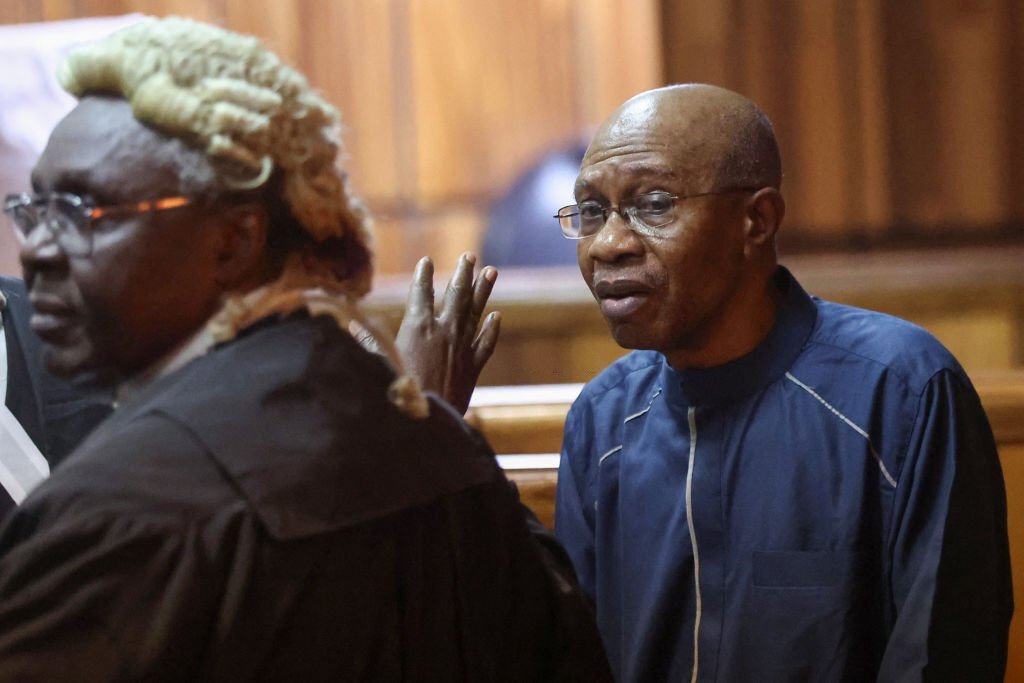
News Investigators/ An Ikeja Special Offences Court has fixed May 4 for ruling in a trial-within-trial involving Henry Omoile, co-defendant with Godwin Emefiele, former Central Bank of Nigeria (CBN) governor.
Omoile is challenging the voluntariness of two statements he made to the Economic and Financial Crimes Commission (EFCC) in the ongoing trial of Emefiele over alleged abuse of office.
Emefiele is standing trial on a 19-count charge bordering on alleged gratification, corrupt demands and abuse of office linked to large financial transactions.
Omoile, his associate, faces three counts relating to alleged unlawful acceptance of gifts while acting as an agent in transactions tied to the CBN.
The charges involve alleged dealings estimated at 4.5 billion dollars and N2.8 billion, which prosecutors said reflected serious breaches of trust and procedure.
On Friday, Justice Rahman Oshodi adjourned the case for ruling after parties adopted final written addresses in the trial-within-trial.
Earlier, Omoile’s counsel, Mr Adeyinka Kotoye (SAN), urged the court to discountenance the prosecution’s submissions.
Kotoye argued that a major missing link was the absence of a video recording of the second defendant while making statements to the EFCC.
He contended that the process did not comply with Sections 9(3) and (4) of the Administration of Criminal Justice Law (ACJL).
He also cited Sections 17(1) and (2) of ACJA.
According to him, where voluntariness is disputed, video recording of interrogation is crucial.
Kotoye relied on Supreme Court authorities and argued that video evidence was the most reliable means of verifying due process compliance.
He said the second defendant testified that EFCC operatives forced him to make two statements with promises of freedom.
“The prosecution must produce the video to show compliance with the process,” Kotoye said.
Emefiele’s lead counsel, Mr Olalekan Ojo (SAN), aligned with Kotoye and urged the court to reject the prosecution’s submissions.
Ojo adopted his written address dated April 16 and relied on its contents.
He cited Section 29(2) of the Evidence Act, which rendered inadmissible statements obtained through oppression, inducement or improper means.
Ojo argued that once voluntariness was challenged, the burden shifted to the prosecution to prove that the statement was freely made.
He maintained that the prosecution failed to discharge that burden and said the circumstances raised doubts over credibility.
He further submitted that only voluntary confessions were admissible under established judicial authorities.
He added that modern criminal procedure recognised safeguards such as video recordings.
Ojo also faulted the prosecution for not challenging allegations of trauma, inducement and lack of proper legal representation.
He argued that such omissions were fatal to the prosecution’s case.
According to him, no valid confession or admissible evidence had been tendered against the second defendant.
He said the burden of proof rested on the prosecution, which must prove allegations beyond reasonable doubt.
EFCC counsel, Mr Rotimi Oyedepo (SAN), urged the court to reject the defence submissions, describing them as an abuse of process.
Oyedepo, Director of Public Prosecutions in the Federal Ministry of Justice, maintained that the second defendant’s statements were voluntarily made.
He argued that counsel to the first defendant lacked basis to challenge admissibility after initially declining objection when the statements were tendered.
He described the later challenge as an abuse of court process.
He maintained that the statements were obtained in substantial compliance with the ACJA.
He added that although not video-recorded, they were made in the presence of the second defendant’s counsel.
Oyedepo further submitted that the contents of the statements undermined the defence claim of coercion.
He said the second defendant expressly refused to implicate Emefiele in any wrongdoing.
According to him, this showed the statements were not made under duress or undue influence.
He added that the statements were obtained in the presence of the defendant’s lawyer, Mr Nnamdi Offia.
“What is done in the open will not be afraid of light,” he said.
He said under cross-examination, the second defendant admitted he did not confess to any offence.
Oyedepo also faulted authorities cited by the defence, arguing they were inapplicable under Lagos State laws.
He urged the court to reject the defence submissions and admit the extra-judicial statements in evidence.
The News Agency of Nigeria (NAN) reports that the trial-within-trial was instituted to determine the voluntariness of Omoile’s statements to EFCC investigators.
Omoile had on Jan. 15 alleged that he was coerced, threatened and promised freedom if he complied with EFCC directives.
He told the court that he eventually made false statements after being assured that he would be released if he cooperated.
NAN