

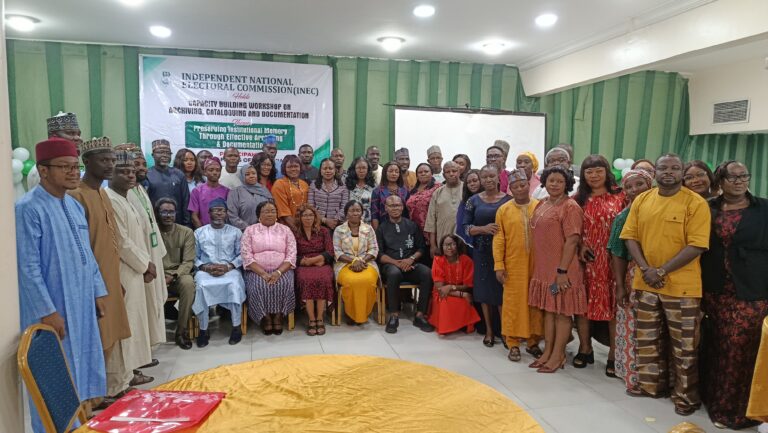
News Investigators/ Independent National Electoral Commission (INEC) has stressed the need for proper archiving, cataloguing and documentation of operational and electoral records ahead of the 2027 general elections.
These, according to the commission, are critical measures for sustaining public trust and institutional credibility.
INEC’s Director of Voter Education (VEP), Victoria Eta-Messi, gave the task on Tuesday in Abuja during a two-day capacity-building workshop for INEC staff members in the Graphics, Library, and Documentation (GLD) division from across the 36 states and the Federal Capital Territory.
The News Agency of Nigeria (NAN) reports that the theme for the workshop organised by the VEP department was “Preserving Institutional Memory Through Effective Archiving and Documentation.”
Mrs Eta-Messi, while describing archiving and documentation as a key aspect of the electoral process, cautioned against the practice where historical electoral materials in state offices were stored improperly, leading to loss of critical institutional knowledge.
She identified the GLD as a “key leg” in the VEP department, entrusted with proper archiving for posterity, for reference and for lesson learning.
“A lot of times, we go to the states and things are in boxes, packed away somewhere and they rot. That does not allow us to do a comparative analysis and to learn from what existed in previous cycles of election.
“So, it is important that we begin to do the right thing; we begin to preserve knowledge and preserve our processes so that we can compare and learn, and consolidate on what existed, and then improve on what we had before then,” she said.
Mrs Eta-Messi said that the training was designed to strengthen the capacity of officers under the GLD division, which she described as the youngest yet vital division in the publicity department.
“GLD is the youngest division in the department, and coincidentally, there is a lot that the division needs to do.
“This is why we are trying to ensure that we build capacity in the respective states so that we begin to do what we are expected to do,” Mrs Eta-Messi said.
She urged PAOs, who double as GLD desk officers in their respective states, to take advantage of the training to be better prepared and positioned to do the work upon return to their various states.
“Let us try to help the department to help the commission to succeed in its archiving and documentation responsibilities,” she said.
Dwelling on the workshop’s overview and objectives, the GLD Deputy Director, Perpetual Aligwara, said that the commission’s credibility depended as much on its memory as on its neutrality.
According to Mrs Aligwara, every election cycle generates decisions, residues and lessons that are critical to the commission’s continuity, hence the need for the workshop ahead of 2027 polls.
She warned that without structured records management, the commission faces severe operational and legal risks.
Mrs Aligwara said that with proper documentation the commission would not only be able to explain its decisions better, but speak with authority.
“Without careful record management, the commission faces a big danger of losing the procedural knowledge of the commission’s activities, such as electoral activities, when staff or commissioners exit at the end of tenure and many others,” she stated.
She highlighted others challenges to include: inconsistent application of guidelines across state and local offices due to undocumented practice and
repeated litigation or public trust risk when the rationale behind past decisions cannot be produced.
Mrs Aligwara cautioned officers against relying on temporary digital platforms or phone storage for critical photo and video records.
She called for the establishment of central, secure archives across all state offices to store election guidelines, result documentations, litigation records and all INEC activities in form of written documents and pictorials.
Mrs Aligwara noted that in spite of the present digital world, people still engaged in reading and sorting out information for research and other things.
“Institutional memory is not a luxury for an electoral management body like INEC.
“It is a safeguard for consistent, transparent and public confidence across election cycles.
A commission that documents its work builds trust that outlasts any single election,” she said.
NAN