

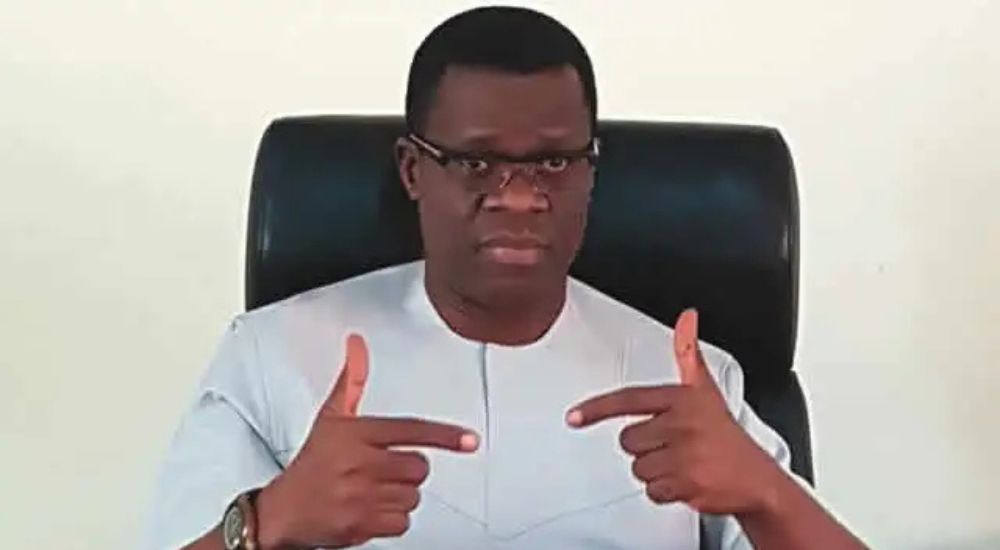
News Investigators/ A former INEC National Commissioner, Mike Igini, has raised concern over some provisions of the Electoral Act 2026, warning they could undermine electoral transparency and public confidence in the conduct of 2027 elections.
Mr Igini spoke on Thursday in Abuja at a stakeholders’ meeting organised by the Civil Society Legislative Advocacy Centre (CISLAC) in partnership with Pan African Strategic and Policy Research Group (PANAFSTRAG).
The News Agency of Nigeria (NAN) reports that the meeting was organised to review the Electoral Act 2026 and its implications for the 2027 elections.
Mr Igini said that while the Electoral Act 2022 strengthened the use of technology in elections through the Biometric Voter Accreditation System (BVAS) and the INEC Result Viewing Portal (IReV), some provisions of the new law appeared to weaken those gains.
According to him, BVAS and IReV were introduced to improve election credibility, reduce voter impersonation and over-voting, and enhance transparency in result management.
He recalled that the technologies were successfully deployed in more than 100 off-season elections before the 2023 general elections.
“The challenge that shattered public trust in 2023 arose during the transmission of presidential election results to the IReV portal.
“The failure to upload presidential election results in real time, while results for senatorial and House of Representatives elections conducted on the same day were uploaded successfully, created a significant trust deficit,” he said.
Mr Igini noted that trust in the electoral process could only be sustained when technology was applied consistently and transparently across all levels of elections.
He expressed particular concern over Section 60(3) of the Electoral Act 2026, which, according to him, effectively weakens the mandatory electronic transmission of election results from polling units.
The former commissioner argued that although the section retained references to electronic transmission, its proviso elevated Form EC8A as the primary source of collation and declaration of results, thereby diminishing the role of electronic transmission.
He also criticised Section 63(2), which permits the counting of ballot papers that do not bear official marks under certain circumstances.
According to him, the provision could create loopholes capable of undermining electoral integrity.
He also raised constitutional concerns over amendments to Section 77, particularly provisions imposing sanctions on political parties for failure to submit membership registers within stipulated timelines and criminalising association with more than one political party.
“These provisions appear inconsistent with Section 40 of the Constitution, which guarantees freedom of association,” he said.
The electoral expert also expressed concern over the removal of provisions that previously allowed election results to be challenged on the grounds that a candidate was not qualified to contest.
He said the change could make it more difficult to challenge elections involving candidates accused of submitting forged credentials or failing to meet constitutional requirements.
To safeguard the integrity of the 2027 elections, he urged CISLAC and other civil society organisations to push for amendments to contentious sections of the Electoral Act 2026.
He also called on INEC to strengthen public confidence in BVAS and IReV through upcoming off-season elections, ensure transparent recruitment of ad hoc staff, improve communication during elections and enforce sanctions against electoral offenders.
“Good laws and procedures, administered without integrity and commitment, will take a country nowhere.
“However, even where laws and procedures are imperfect, their faithful, fair and impartial administration and enforcement can move a country forward,” he said.
Also speaking CISLAC Executive Director, Auwal Rafsanjani, identified Sections 60(b), 63(2), 77, 135, 137 and 138 of the Act as contentious.
Mr Rafsanjani acknowledged efforts to review Nigeria’s electoral framework following lessons from the 2023 elections, but argued that many key concerns raised by citizens were not adequately addressed.
He said the swift passage and signing of the Act had diminished public expectations for more credible elections in 2027.
He urged civil society organisations, lawmakers, election experts and other stakeholders to engage constructively on the disputed provisions, stressing that democracy depends not only on elections but also on the credibility of the laws governing the electoral process.
NAN