
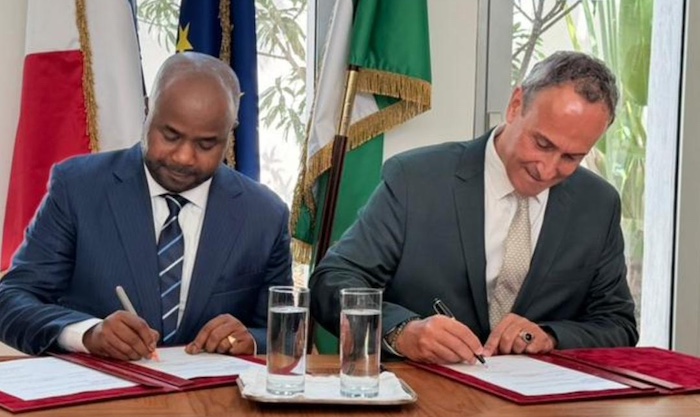
News Investigators/ Some economic and financial experts have allayed the public fear of Nigeria losing its tax data sovereignty, following the Memorandum of Understanding (MoU) it signed with France.
The experts, who in separate interviews with the News Agency of Nigeria (NAN) in Ibadan on Wednesday, said such an agreement was common, yet called for caution.
NAN recalls public concern that the MoU between the Federal Inland Revenue Service (FIRS) and the French tax authorities could expose or cede Nigeria’s tax data to foreign interests.
A Financial Consultant, Tunji Adepeju, said much of the public criticism stemmed from distrust in government, rather than the substance of the agreement itself.
Mr Adepeju explained that the FIRS had clarified that the agreement was not about exchanging or surrendering Nigeria’s tax data, but about technical cooperation, knowledge transfer and capacity building for staff.
According to him, the MoU aligns with globally recognised operational frameworks and focuses on technical assistance, noting that the French tax institutions involved have decades of experience in revenue administration.
“With FIRS increasingly taking over the functions of other revenue-collecting agencies, it cannot remain at the same level.
“Learning from more experienced jurisdictions is necessary,” he said.
Mr Adepeju stated that such agreements usually pass through inter-ministerial committees and extensive consultations, involving legal experts and key stakeholders, before approval.
He stressed that Nigeria would not surrender its sovereignty under the deal.
Mr Adepeju also expressed confidence that local Fintech stakeholders, such as the Nigeria Inter-Bank Settlement System (NIBSS) and major payment companies, would be involved in the implementation.
“Especially as the arrangement is expected to take effect from Jan. 1, 2026,” he said.
Meanwhile, Olugbenga Obatola, a Fellow of the Chartered Institute of Taxation of Nigeria (CITN), said he could not make a definitive assessment without access to the full MoU.
He noted that only excerpts of the agreement had been made public.
Mr Obatola, however, cautioned that relying on another country for tax data gathering and management was a sensitive matter, as tax data reveal a nation’s financial strength and weaknesses.
“On the negative side, it is like opening your financial soul to another country.
“But on the positive side, there is nothing wrong with seeking help from a stronger partner to improve capacity,” he said.
He emphasised that cooperation should be limited to technical assistance, provision of IT infrastructure and information exchange for taxing cross-border economic activities.
Alarudeen Aminu, an Associate Professor of Economics at the University of Ibadan, described tax cooperation agreements as common global practices.
According to Mr Aminu, who is also the Chairman of the Nigerian Economic Society (NES), such agreements are aimed at improving efficiency in tax collection and reducing distortions in the economy.
He noted that many countries enter into tax-related agreements, covering data distribution, technical assistance and institutional reforms, especially where there are significant cross-border investments.
He explained that France has substantial investments in Nigeria, estimated at over 10 billion Euros, thus making clear tax rules and cooperation beneficial to both countries.
“In such agreements, the assisting country will naturally understand how your tax system works, but that does not mean you are handing over control,” he said.
However, Aminu cautioned that Nigeria must be vigilant in managing information shared under the MoU.
He further warned that lapses by local personnel could undermine national interests if sensitive data were disclosed deliberately or inadvertently.
He called for strong internal controls and active involvement of Nigerian institutions and Fintech firms in the execution of the agreement.
This, he said, would ensure that, at the end of the process, Nigeria fully owns and controls its tax systems and data.
NAN