

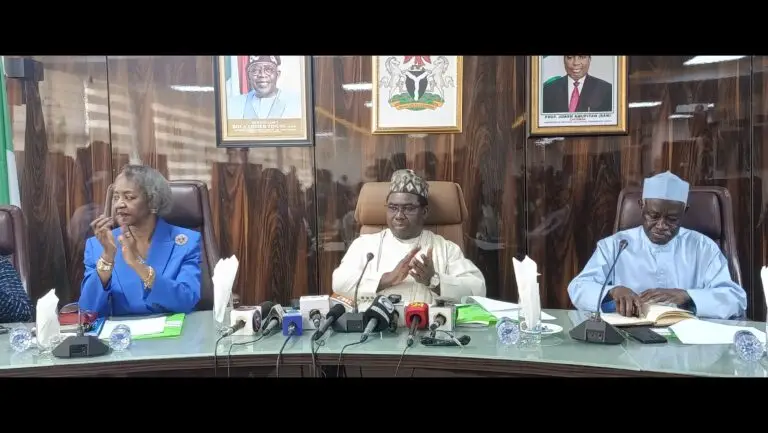
News Investigators/ Independent National Electoral Commission (INEC) on Tuesday unveiled the draft 2026 Regulations and Guidelines for Political Parties, ahead of the 2027 general elections.
The INEC Chairman, Joash Amupitan, did the unveiling at the consultative meeting with leaders of political parties on the review of INEC Regulations and Guidelines for Political Parties in Abuja.
Prof. Amupitan said that the review became necessary following the enactment of the Electoral Act 2026.
According to him, Nigeria cannot navigate a 2027 horizon using a 2022 map.
Prof. Amupitan called on political parties to take special note of Clause 40(4) & (5) of the draft regulation dealing with election expenses of political parties for the management of party primaries and for the conduct of elections.
He said that INEC had concluded a clause-by-clause realignment of its guidelines to ensure that they were not only legally air-tight but operationally in sync with the new Act.
“Our review has been guided by empirical data; specifically, findings from the Political Party Performance Index (PPPI).
“This diagnostic tool, developed with the support of the Westminster Foundation for Democracy (WFD), highlighted a disturbing gap between party constitutions and grassroots realities.
“The newly drafted regulations encompass crucial areas that are central to the operations of political parties in our democratic framework, including registration and merger of political parties.
“We have streamlined the process to ensure that it is more accessible, while maintaining a robust framework that upholds democratic principles,” he said.
On political party operations, prof. Amupitan said that clear guidelines had been instituted to govern the day-to-day functioning of political parties, ensuring compliance with the country’s laws and promoting accountability.
“This aims to sanitise party primaries, which intends to end the era of opaque processes that impose unpopular candidates, fueling voter apathy and a deluge of avoidable litigation.
“We recognise the critical role of primary elections in our political system. Thus, we have outlined procedures that uphold fairness and transparency within political parties,” he said.
Prof. Amupitan added that regulations had also been put in place to ensure that campaign activities were conducted peacefully and respect the rights and dignity of all citizens.
“We have established clear standards regarding the financing of political activities, emphasising the need for transparency and accountability in managing party funds and campaign expenses.
“We have also included provisions that define the circumstances under which a political party may be deregistered, ensuring that the process is just and equitable.
“We have also embedded measurable benchmarks for the participation of women, youth, and persons with disabilities (PWDs),” he said.
The INEC chairman urged political parties not to see the draft regulations as a restriction, but as a safeguard.
In his remarks, the National Chairman of IPAC, Yusuf Dantalle, called on the National Assembly to urgently amend the 2026 Electoral Act to prevent it from jeopardising the 2027 polls.
Mr Dantalle argued that while Nigerians participated in public hearings with high expectations, the final Act represented a regression that inadvertently placed immense pressure on political parties, especially those outside government.
“IPAC firmly demands that the National Assembly, as a matter of urgency, revisits and amends the Electoral Act 2026.
“Specifically, the provision mandating direct primaries must be reconsidered, and the option of indirect primaries restored.
“The choice of candidate selection methods remains an internal affair of political parties,” he said.
The IPAC chairman also described the requirement for parties to submit membership registers—including National Identification Numbers (NIN)—between April 1 and April 21 as “impractical and exclusionary.”
He warned that the provision risked disenfranchising millions of Nigerians who lacked access to NIN registration facilities.
Mr Dantalle also demanded the restoration of mandatory electronic transmission of results to the INEC Results Viewing (IReV) portal immediately after polling unit announcements, without any provisos.
“It is also deeply troubling that the new Electoral Act appears to weaken penalties for vote buying.
“IPAC reiterates its call for the establishment of an Electoral Offences Commission to ensure violators are held accountable,” he added.
Mr Dantalle stated that the council had already appealed to the National Assembly to repeal the Act in the interest of a credible and transparent electoral process.
NAN