
News Investigators Investigators Rwandan High Commissioner to Nigeria, Moses Rugema, has called on the global community to strengthen efforts against genocide ideology.
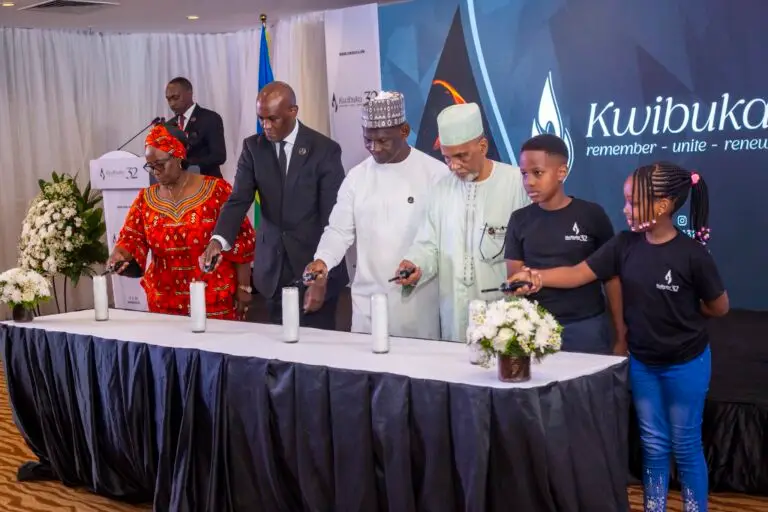
Mr Rugema made the appeal at the commemoration of Kwibuka 32, an annual event held to mark the 1994 genocide against the Tutsi ethnic group during the country’s civil war, on Tuesday in Abuja.
The genocide claimed more than one million lives in 100 days between April 7 and July 4, 1994.
The News Agency of Nigeria (NAN) reports that event was themed: “Remember. Unite. Renew.”
Mr Rugema described Kwibuka as “a moment of reflection for Rwandans, and a call to conscience for the world.”
He stressed that remembrance must go beyond words, urging nations and individuals to confront denial, distortion and divisive narratives, especially in the digital age.
“We honour the victims, the mothers who shielded their children, the fathers who stood helpless, and the young lives never given the chance to flourish.
“To remember is to accept a responsibility not just to grieve, but to act,” he said.
The envoy recalled that the 1994 genocide against the Tutsi was a planned and systematic extermination carried out by the then Hutu extremist government and its militias.
Mr Rugema noted that the genocide targeted Tutsi civilians, as well as moderate Hutu and others who opposed the killings, describing it as one of the gravest crimes against humanity.
He warned that genocide ideology remained a present danger, which is increasingly amplified by emerging technologies, including artificial intelligence.
“These tools, while powerful for progress, are also being misused to manipulate narratives, fuel division and obscure truth.
“There is a need for stronger legal frameworks, education and accountability,” he said.
The ambassador also reflected on the international community’s failure to act decisively at the time, noting that the crisis was initially mischaracterised, delaying intervention.
He, however, recalled that at the United Nations Security Council, a few diplomats spoke out and described the atrocities accurately.
Mr Rugema named Nigeria’s former Permanent Representative, Ibrahim Gambari, alongside Karel Kovanda and Colin Keating among them.
He said the genocide was eventually ended by the Rwandan Patriotic Army (RPA), the armed wing of the Rwandan Patriotic Front (RPF), led by Paul Kagame.
The envoy added that in the aftermath, Rwanda chose unity and reconciliation, establishing a government of national unity, abolishing ethnic identity cards and rebuilding institutions.
According to him, Gacaca courts played a key role in delivering justice and fostering reconciliation, with more than two million cases handled.
“Perpetrators confessed, survivors spoke, and communities began the long process of healing,” he said.
Despite the progress, Mr Rugema cautioned that threats persist in parts of the Great Lakes region, where extremist ideologies continue to fuel violence and displacement.
“Silence in the face of such warnings is complicity,” he said.
He urged the global community to uphold justice, human dignity and accountability, stressing that preventing genocide required collective responsibility.
Also speaking, UN Resident and Humanitarian Coordinator in Nigeria, Mohamed Fall, said Kwibuka 32 was a time to remember victims and recommit to preventing future atrocities.
Mr Fall was represented by the UN Women Country Representative to Nigeria and ECOWAS, Beatrice Eyong,
“We gather today to remember and to reaffirm a shared responsibility. In just 100 days, more than one million people were murdered,” she said.
Mr Fall described the genocide as deliberate and premeditated, driven by propaganda and divisive policies.
“Words paved the way for mass atrocities. Despite clear warning signs, the international community failed to listen and failed to act,” he said.
The UN official warned that hate speech and incitement to violence were spreading rapidly in the digital era.
“We must do more than remember the dead. We must protect the living by defending truth and rejecting narratives that make violence seem acceptable,” she said.
Mrs Eyong called on countries to strengthen legal frameworks, uphold international law and fully implement the Genocide Convention.
NAN reports that the event brought together diplomats, government officials and members of the international community to honour victims, support survivors and reaffirm commitment to the principle of “Never Again.”
NAN