

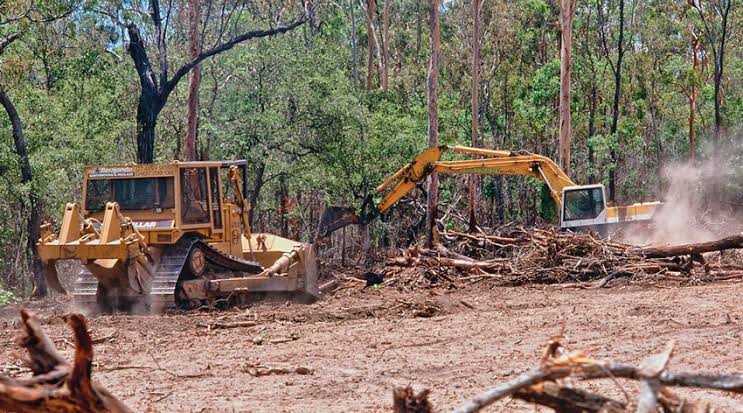
News Investigators/ The Nigerian Conservation Foundation (NCF) has called for urgent action to halt deforestation, noting that Nigeria has lost nearly 90 per cent of its forest cover in three decades.
The foundation made the call in a statement issued on Saturday in Lagos by the Director of Communications, Policy and Advocacy, Kunle Olawoyin, to mark the International Day of Forests, observed every March 21.
Mr Olawoyin said the 2026 theme: “Forests and Economies,” underscored the crucial role forests play in supporting environmental sustainability, livelihoods, and national development.
According to him, Nigeria currently records one of the highest deforestation rates globally, largely driven by illegal logging, agricultural expansion, and urbanisation.
He added that over the past three decades, the country had lost nearly 90 per cent of its forest cover, leaving less than 10 per cent of the original forest landscape intact.
Mr Olawoyin said heavy reliance on fuelwood and charcoal for energy by a significant portion of the population continued to exert pressure on the remaining forest reserves.
He stressed that forests were vital for supporting agriculture, regulating the water system, and providing livelihoods for millions of Nigerians, particularly in rural communities.
He, however, said the sector remained undervalued in national development planning.
He identified illegal logging, weak enforcement of environmental laws, increasing demand for land and energy, and inadequate investment in restoration as major drivers of forest loss.
Mr Olawoyin warned that without urgent and coordinated interventions, the environmental and economic consequences could be severe.
He quoted the Director-General of NCF, Dr Joseph Onoja, as emphasising the importance of forests to human survival and climate stability.
“We all know that forests are vital for life on Earth.” The question remains: Why are we destroying the very systems that sustain us?” he said.
He called for an end to indiscriminate the exploitation of forest resources, urging stakeholders to protect what he described as “the lungs of the planet.”
He noted that the foundation had continued to implement initiatives aimed at reversing forest loss, including the Green Recovery Nigeria Programme, which seeks to restore the country’s forest cover to 25 per cent by 2047.
Mr Olawoyin disclosed that the organisation planted 265,561 trees across various ecosystems in collaboration with partners in 2025.
He added that other interventions included community-based forest management programmes, biodiversity conservation projects, and partnerships with government and the private sector to promote sustainable land use and alternative livelihoods.
He urged governments at all levels to strengthen forest governance, enforce environmental regulation, and increase funding for conservation and restoration efforts.
He also enjoined the private sector to invest in sustainable practices and nature-based solutions, while encouraging individuals and communities to support tree planting and adopt sustainable resource-use practices.
He reaffirmed the foundation’s commitment to working with stakeholders to ensure forests continue to deliver ecological and economic benefits for present and future generations.
NAN