

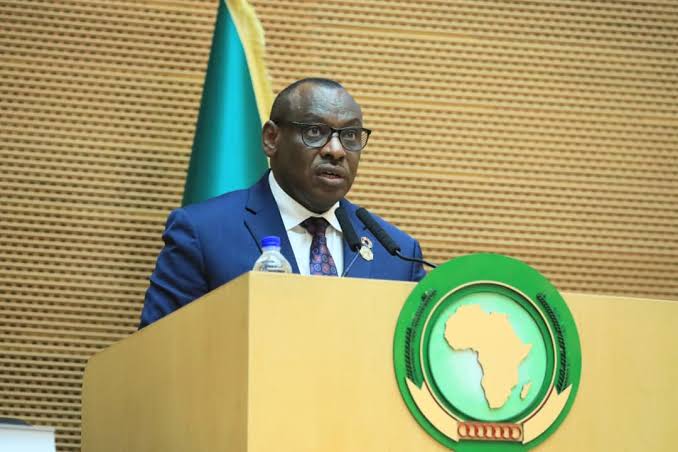
News Investigators/ The Economic Commission for Africa (ECA) says Africa holds more than 1.1 trillion dollars in domestic institutional capital which must be strategically deployed to finance the continent’s transformation.
The Executive Secretary of the ECA, Claver Gatete, said this virtually at the on-going Ninth Africa Business Forum convened by the ECA in Addis Ababa, Ethiopia.
The theme of the event is: “Financing the Future of Africa: Jobs and Innovation for Sustainable Transformation.”
Mr Gatete said although Africa faced infrastructure-financing gaps and loosed billions annually to illicit financial flows; it was not short of capital but lacked mechanisms to connect available funds to bankable projects.
“Africa holds over 1.1 trillion dollars in domestic institutional capital in pension funds, insurance pools and sovereign assets.
“The paradox, therefore, is not a lack of capital, but the lack of mechanisms that connect capital to bankable projects,” he said.
According to him, global capital has become more selective, flowing to markets that offer scale, security and future growth prospects.
He said Africa, with the world’s youngest workforce, rapid urbanisation, expanding digital adoption and emerging consumer markets, was well positioned to become a major engine of global growth.
“That place is Africa. Africa is no longer a continent waiting for transformation; transformation is already underway,” Gatete said.
He cited the African Continental Free Trade Area (AfCFTA) as a major milestone in creating a single market of over 1.5 billion people.
According to him, digital platforms and startup ecosystems are also expanding across the continent.
Mr Gatete, however, said the pace of transformation remained below potential due to infrastructure gaps and weak project preparation frameworks.
He emphasised that millions of young Africans entered the labour market every year and that productive employment for them was critical not only for Africa’s development but also for global economic stability.
“If they find productive employment, Africa becomes the growth frontier of the century. If they do not, instability becomes globalised,” he said.
Mr Gatete proposed four strategic measures to accelerate progress: scaling domestic capital and deploying innovative financing instruments; strengthening credit ratings and capital markets; fully implementing the AfCFTA; and investing in innovation, skills and data systems.
According to the ECA boss, improved tax systems, blended finance, pension funds and sovereign assets can help expand fiscal space and support infrastructure and industrial development.
Mr Gatete then called for stronger credit ratings, enhanced financial transparency and deeper capital markets to lower borrowing costs and channel investment into productive sectors.
He urged full implementation of the AfCFTA to enable regional value chains, large-scale production and job creation across the continent.
On innovation, he stressed the need for expanded STEM education, research and development, and entrepreneurial ecosystems to ensure African youth could compete in the industries of the future.
“The opportunity cost of not investing in Africa will soon exceed the risk of investing in it as the forum was designed to connect investors to bankable projects and track commitments through implementation mechanisms,’’ he said.
Mr Gatete then reaffirmed the ECA’s commitment to working with partners to translate commitments into measurable outcomes that would see jobs created, enterprises scaled and value chains financed.
NAN