
News Investigators/ President Bola Tinubu has declared Nigeria’s renewed support for the South Sudan peace process, advocating for the swift implementation of the revitalised agreement on conflict resolution.
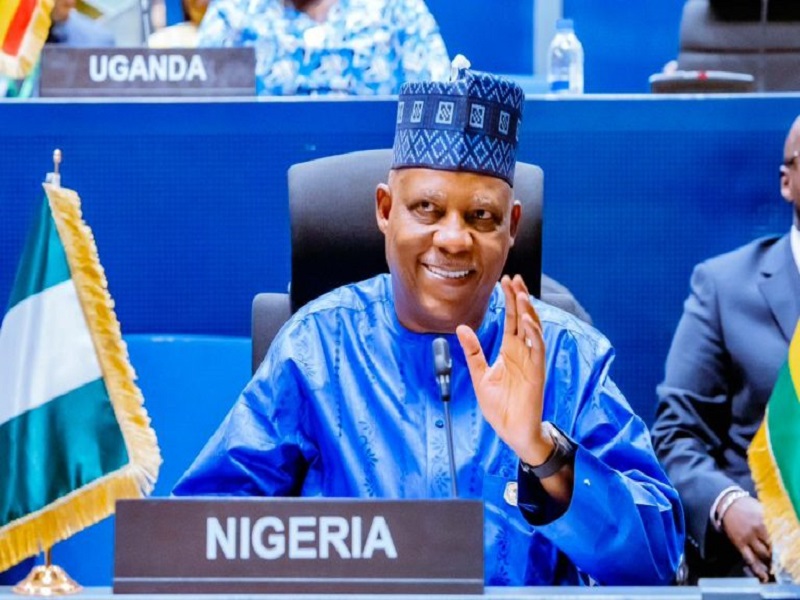
Tinubu, represented by Vice-President Kashim Shettima, stated this at the African Union (AU) High-Level Ad hoc Committee For South Sudan, tagged the C-5 Plus Summit, chaired by President Cyril Ramaphosa of South Africa.
The News Agency of Nigeria (NAN) reports that the event held on the margins of the 39th Ordinary Session of the Assembly of Heads of State and Government of the African Union in Addis Ababa, Ethiopia.
The president also demanded the immediate and unconditional release of the country’s First Vice President, Riek Machar, and other key opposition figures.
” We wish to specifically call on the government to consider the immediate and unconditional release from detention of the Vice President and other key opposition figures.
” It is also imperative to convene an all-inclusive South Sudan national dialogue and reconciliation forum.
” We call on all parties to engage constructively with authorities in the mediation process without preconditions,” he declared.
Tinubu said Nigeria joins other countries in Africa in acknowledging the efforts and desire of the South Sudanese stakeholders and people for peace, sustainable development, and speedy resolution of the conflict.
” We support the lofty ambition of all parties and wish to reiterate our doctrinal commitment to accompany the South Sudanese Transitional Government of Unity as well as the good people of the country to actualise their aspiration for lasting peace and development.
” We cannot allow South Sudan to continue on its current trajectory. Without national unity and elite consensus, not much can be achieved on the transition programme in South Sudan.”
Tinubu urged African leaders to prevail on the country’s stakeholders to “prioritise the conduct of inclusive, peaceful, and transparent national elections.
” This is the only way to build trust and confidence in the country’s future and leadership.”
He said the recent launch of the Regional Partnership for Democracy by Nigeria in collaboration with development partners was part of the country’s contribution to the resolution of the conflict in South Sudan and beyond.
He said the current state of insecurity and political tension in that country was hindering progress on several key transitional fronts, especially in the areas of security sector reforms and constitution-drafting processes.
The Chairman of the AU High-Level Ad Hoc Committee for South Sudan, Ramaphosa, applauded the determination of African leaders in the resolution of the conflict.
He commended President Silva’s presence at the meeting, describing it as a reflection of his personal commitment to resolving the conflict.
He urged parties in the conflict to recommit themselves to the resolution of the lingering issues, he regretted the delayed and slow implementation of the revitalised agreement eight years after it was endorsed by stakeholders.
Ramaphosa commended the efforts of the United Nations, development partners, and other stakeholders in the resolution of the conflict.
He noted that the “C-5 Plus Summit demonstrates the commitment of leaders to finding a lasting solution in the interest of the people of South Sudan.”
He stressed the need for robust consultation with all parties, stating the importance of engaging with the people of South Sudan and giving counsel only where it is needed.
The Chairman, Intergovernmental Authority on Development (IGAD), Ismail Guelleh, said the collective efforts of IGAD, the AU, and other partners in the signing of the revitalised agreement have enabled the implementation of the longest ceasefire agreement.
Guelleh, who is the President of Djibouti, reaffirmed the commitment of IGAD to the resolution of the conflict in South Sudan as enshrined in the framework that integrates the interests of all parties.
The IGAD chairman proposed the appointment of a lead mediator in the conflict to monitor implementation, assess progress, and address emerging challenges on the path to lasting peace and stability.
NAN reports that the revitalised agreement on conflict resolution, signed in September 2018 and brokered by IGAD, aims to end the civil war between President Kiir and Vice President Machar.
It established a Revitalised Transitional Government of National Unity (RTGoNU), focusing on security sector reform, power-sharing, and constitutional development.
Key components and challenges of the agreement include: power-Sharing and Governance with 55 per cent of positions for the Transitional Government of National Unity (TGoNU), 27 per cent for the SPLM/A-IO, and the remainder for other opposition parties.
Others also are Security Arrangements,
In December 2025, parties pledged no further extensions to the transitional period, aiming for a democratic election.
Inspite these efforts, the peace remains fragile, with concerns about the security, humanitarian, and political situation if the deal fails.
NAN