

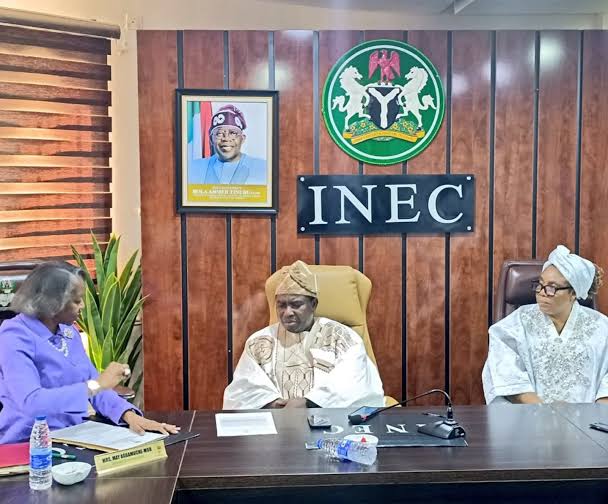
News Investigators/ Independent National Electoral Commission (INEC) has reaffirmed its commitment to deployment of technology for the conduct of the 2027 general elections.
INEC Chairman, Joash Amupitan, gave the commitment at a news conference on the official release of the timetable and schedules of activities for the 2027 general elections on Friday in Abuja.
Prof. Amupitan also clarified that the election budget is N273 billion as against one trillion Naira being rumoured in some quarters.
He said that the Bimodal Voter Accreditation System (BVAS) and the INEC Result Viewing Portal (IReV) remained central to the commission’s operations, as mandated by the Electoral Act 2022.
On plans by the commission against possible glitches in the deployment of technology, Amupitan said that INEC was working tirelessly to improve its internal machinery.
“Nobody is being deceptive; we have built the IReV; we have improved on it and we are improving on our BVAS.
“The debate is going on, but no matter how it ends, we already have our own system to ensure that results are transmitted,” he said.
To restore trust, the INEC chairman said plans were on the way to conduct a mock presidential election to test the robustness of the technology before the next major election cycle.
He debunked claims that he had ruled out technology, noting that BVAS units were already being reconfigured and tested for upcoming election in the FCT.
On election budget, the INEC chairman highlighted the significant cost of conducting polls, particularly regarding ad-hoc staff, citing a resolution by the House of Representatives to increase allowances for NYSC members and the financial implications.
“We were at the National Assembly yesterday (Thursday). My attention was drawn to the resolution of the House of Representatives, that we should increase the amount that we pay to ad-hoc staff, NYSC members.
“By the time they work it out, it came to about N32 billion, because we’ll be using about 450,000 corps members, ” he said.
Unlike what happened in 2023, Amupitan said that INEC had doubled the amount to be paid to corps members and other ad hoc staff in 2027.
“In every polling unit, you also have four polling officials, the presiding officer, you have APO 1, APO 2 and APO 3.
“So by implication, by the time you are increasing the amount that you are doing for NYSC corps members, you also have to do for SPO, for APO 1, APO 2, APO 3. Now multiply 32 billion times four,’’ he said.
Amupitan also listed the cost of training, deployment of security, increase in inflation and foreign exchange among others as some of the factors responsible for increase in cost of elections budget.
Asked if it’s possible to conduct all elections in one day and eliminate off-cycle elections, Amupitan said that such a change would require a constitutional amendment.
He cited Sections 76 and Section 118 of the constitution, which mandate that elections must hold not later than 150 days before an incumbent’s tenure expires.
He explained that off-cycle elections were the “judicial consequences” of past tribunal rulings where governors were removed and their tenures restarted at different times.
Amupitan refuted the reports suggesting that he planned to build hospitals, saying the commission only requested funds for drugs and maintenance of the existing INEC clinics for staff welfare and not for construction of new medical facilities.
NAN