
News Investigators/ A customs expert, Okey Ibeke, says the Federal Government’s vehicle import duty reduction should cushion the Green Tax Surcharge by lowering vehicle import costs.
Mr Ibeke, Principal Consultant, International Trade Advisory Services Ltd., said this in an interview with the News Agency of Nigeria (NAN) on Sunday in Abuja.
He was reacting to the Federal Government’s reduction of import duties on new vehicles from 20 per cent to 10 per cent and on used vehicles from 15 per cent to five per cent.
NAN reports that the Green Tax Surcharge is aimed at promoting environmental sustainability, reducing carbon emissions and encouraging the importation of cleaner vehicles into the country, in line with global environmental standards.
It is part of the Federal Government’s 2026 fiscal policy measures designed to support environmental sustainability goals by encouraging the adoption of cleaner vehicles.
The measure applies additional charges to certain vehicle categories, particularly those with larger engine capacities and higher emissions, while promoting cleaner mobility options.
Mr Ibeke described the reduction in import duties as a positive step, saying it can encourage legitimate vehicle imports and support cleaner transportation.
He, however, said the extent to which Nigerians would benefit from cheaper vehicles would depend on several factors, particularly the exchange rate of the Naira, which remains the biggest driver of vehicle prices.
He added that the Green Tax Surcharge could increase costs for certain higher-engine-capacity vehicles, thereby partly offsetting the benefits of reduced import duties.
“For consumers to feel a meaningful reduction in vehicle prices, the policy should be complemented by exchange rate stability, lower port costs and a more efficient cargo clearance process,” he said.
Similarly, Eugene Nweke, Head of Research at the Sea Empowerment and Research Centre (SEREC), said environmental fiscal measures must be carefully balanced with trade facilitation, industrial competitiveness and investor confidence.
Mr Nweke spoke through the SEREC’s Green Tax Policy bulletin.
He said that fiscal policies that significantly alter import costs without adequate notice could undermine commercial certainty, distort existing contractual obligations and reduce investor confidence in Nigeria’s trade environment.
He said that importers often conclude international transactions months before cargoes arrive at Nigerian ports, involving contracts, freight arrangements, insurance and customs planning.
According to him, a successful environmental taxation system should encourage cleaner technologies rather than being perceived mainly as another revenue-generating measure.
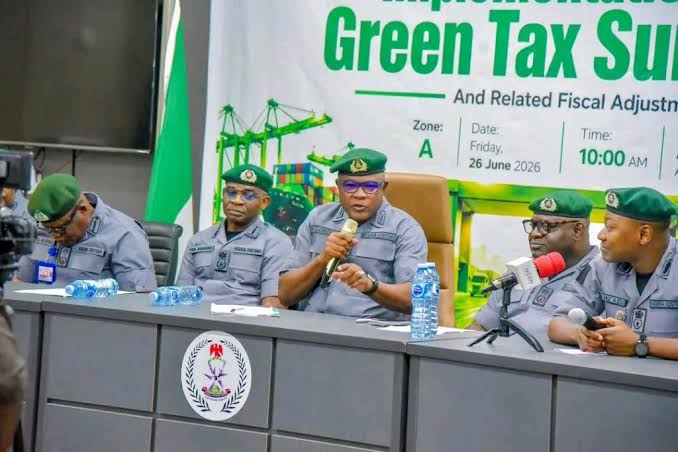
The Nigeria Customs Service (NCS) had recently sensitised stakeholders on the implementation of the Green Tax Surcharge and related fiscal adjustments scheduled to take effect on July 1, 2026, to ensure a smooth rollout.
NAN