
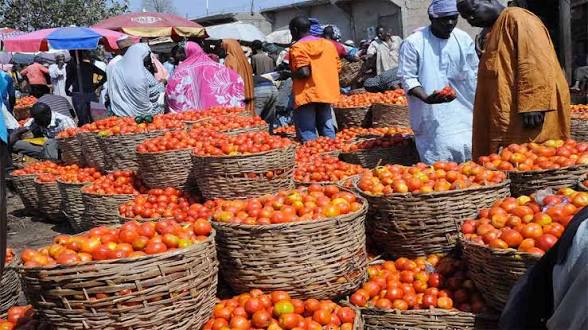
News Investigators/ The drop in pepper prices has brought some relief to traders and buyers in Lagos markets, but the high cost of tomatoes continues to weigh on traders’ sales and consumers’ purchasing power.
Traders and consumers who spoke with the News Agency of Nigeria (NAN) in separate interview in Lagos described how changing prices had affected sales, household spending and the quantities of produce they could afford.
They cited seasonal availability and transportation costs among the factors influencing the market.
Malam Mohammed, a tomato seller at Costain Bus Stop, said he sourced his produce from Mile 12 Market, where prices varied according to variety, size and place of origin.
He said a paint of tomatoes, which sold for N6,000 in August and September, now cost N7,000, while a basket had risen from between N35,000 and N40,000 to between N45,000 and N65,000.
Mohammed explained that the high cost of tomatoes made it difficult for traders to maximise profits, adding that some customers complained about the sizes and quantities they received for the prices paid.
“This business is not a straight business,” he said.
He said the complaints had caused him to lose some customers, prompting him to reduce the quantity of tomatoes he purchased at a time to avoid losses from spoilage.
Mohammed also said a large bag of pepper currently sold for between N30,000 and N40,000, although he could not recall its exact price in August and September because of fluctuations.
Mrs Rukayat Sherif, another trader at Costain Bus Stop, said she bought tomatoes and pepper from Mile 12 Market because she trusted the source.
She said a basket of Ghana tomatoes currently sold for between N40,000 and N45,000, compared with N50,000 and above in August and September.
Sherif added that a paint of tomatoes now cost N7,000, against between N4,000 and N5,000 in September.
She said a small bag of pepper, which sold for between N30,000 and N35,000 in August and September, now cost between N20,000 and N25,000.
Sherif noted that five pieces of tomatoes sold for N500, while pepper was also available for N500 in small rubber plates containing a generous quantity.
She attributed the price changes partly to seasonal availability and transportation costs, explaining that some tomatoes damaged during transportation the previous week had been sold at reduced prices to prevent further deterioration.
She expressed hope that tomato prices would fall to more affordable levels, adding that lower prices would improve sales and reduce customers’ complaints.
Mrs Regina Owho, a tomato seller at Suru Market, Suru-Alaba, said large baskets of tomatoes currently sold for about N50,000, while smaller baskets cost between N35,000 and N45,000.
Owho recalled that a basket sold for about N40,000 in August and September, although prices fluctuated during that period.
She said the frequent changes made it difficult for traders to predict their purchasing costs, adding that the basket she bought on the day of the interview cost N40,000.
Mrs Mary Chigozie, a resident of Vaughan Street, Costain, said she spent between N2,000 and N5,000 daily on tomatoes and pepper but had reduced the quantities used in cooking because of the high cost of tomatoes.
She said small quantities of tomatoes that previously sold for N200 or N300 now cost N500 or N1,000.
Chigozie explained that she sometimes combined pepper with tomato paste or prepared red-oil stew when fresh tomatoes became too expensive.
She expressed concern that prices could rise further during the December festive period and urged the government to support and protect farmers.
On pepper, Mrs Rukayat Rasheeb, a trader at Olaogun Street, Abule-Nla Junction, Costain, said a bag currently sold for between N45,000 and N60,000, the same price range recorded in August and September.
She, however, observed that pepper was now more plentiful than during the earlier period.
Rasheeb explained that prices generally declined when pepper was in season and increased when it became scarce.
She expressed optimism that prices could fall further, while noting that transportation and loading expenses added to traders’ costs.
Mr Okoro Ebubechi, who also sells pepper at Olaogun Street, Abule-Nla Junction, said he currently bought a small basket for N20,000, compared with between N30,000 and N40,000 in September.
He attributed the reduction to increased availability during the current season, adding that transportation expenses influenced the prices charged by traders.
Ebubechi said customers were buying larger quantities because pepper had become more affordable.
He added that he sold pepper in different quantities, including portions worth N500, to accommodate buyers with varying budgets.
He expected prices to rise again in December if pepper became less available.
Mrs Odunayo Igwe, a pepper trader at Ilogbo Mosque, Apapa Road, said a bag currently sold for N30,000, the same price recorded in September.
She explained that although the price had remained unchanged, pepper was now more plentiful than in September, when supplies were lower.
Igwe also identified transportation costs as a factor affecting selling prices and expressed hope that prices would decline further.
Mrs Patience Niju, a pepper seller at Suru Market, Suru-Alaba, said she currently bought a small bag for N25,000 and a larger bag for N40,000.
She added that a small bag of shombo cost N20,000, while a larger one sold for N30,000.
Niju said the prices were unchanged from August and September, but the bags contained more pepper in October.
She welcomed the increased quantity, saying it encouraged customers to buy more and helped her sales move faster.
Mrs Teni David, a civil servant residing in Iyana Ipaja, said N200 to N500 could now buy more pepper than in August and September, when the same quantity cost between N1,000 and N1,500.
She said the increased availability had enabled her to buy larger quantities for household consumption.
David attributed the seasonal glut partly to limited preservation facilities, explaining that large quantities of pepper entered the market as the produce ripened, prompting traders to sell quickly before it lost its freshness.
She called on the government to establish more processing centres where farmers and traders could preserve and package pepper during periods of abundance.
According to her, such facilities would help reduce waste and maintain supplies during the off-season.
David warned that prices could rise again when the current season ended.
Ms Mary Udonwa, another pepper consumer, said the produce had become more affordable, allowing households to buy larger quantities.
She said she currently spent between N500 and N1,500 on pepper, depending on her needs.
Udonwa explained that high prices in August and September had forced her to reduce the amount used in cooking, sometimes relying on small quantities or ground pepper when fresh pepper became expensive.
She attributed the current reduction to increased market supply and suggested that some sellers might be lowering prices to avoid losses from spoilage.
Udonwa also expected pepper prices to rise during the Christmas and New Year festivities.
NAN