
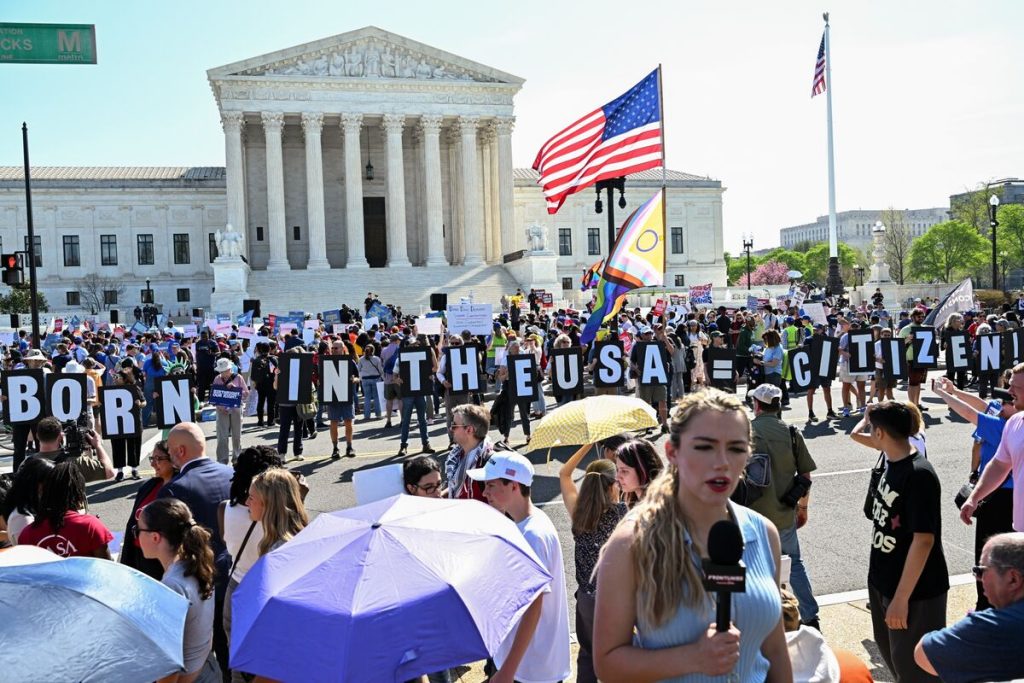
News Investigators/ The U.S. Supreme Court will on Tuesday rule on whether to let President Donald Trump restrict birthright citizenship in the United States.
The topic has been one of the top priorities in his crackdown on immigration in a case involving a right that had long been woven into the fabric of American society.
A lower court blocked Trump’s executive order directing U.S. agencies not to recognise the citizenship of children born in the United States if neither parent is an American citizen or legal permanent resident, also called a “green card” holder.
Today’s hearing is the final day of rulings for the court’s current term, which began in October.
Challengers to Trump’s order argued that it violates language in the U.S. Constitution’s 14th Amendment that confers citizenship to those born in the United States who is subject to the jurisdiction thereof.
Trump, who has repeatedly tested the limits of presidential power in domestic and foreign policy, issued the order in 2025 on his first day back in office as part of a suite of policies to crack down on legal and illegal immigration.
Critics have accused the Republican president of racial and religious discrimination in his approach to immigration.
The Supreme Court weighs in on what it means to be an American citizen just ahead of the July 4 holiday when the United States marks the 250th anniversary of its founding.
Ahead of the ruling, some experts had estimated that Trump’s directive could affect the legal status of as many as 250,000 babies born each year and could require the families of millions more to prove the citizenship status of their newborns.
The legal challenge to Trump’s directive considered by the Supreme Court, which has a 6-3 conservative majority, involved a class-action lawsuit filed in New Hampshire by parents and children whose citizenship was threatened by the directive.
The 14th Amendment has long been interpreted as guaranteeing citizenship for babies born in the United States, with only narrow exceptions such as the children of foreign diplomats or members of an enemy occupying force.
The provision at issue, known as the Citizenship Clause, states: `”All persons born or naturalised in the United States, and subject to the jurisdiction thereof, are citizens of the United States and of the state wherein they reside.”
The administration interprets “subject to the jurisdiction thereof” to mean that birth in the U.S. does not automatically grant citizenship.
This policy would exclude children born to undocumented immigrants as well as those born to foreign nationals on temporary visas, such as students or workers.
Citizenship is granted only to the children of those whose primary allegiance is to the United States, including citizens and permanent residents, the administration has argued.
It said such allegiance is established through lawful domicile, which lawyers for the administration define as lawful, permanent residence within a nation, with intent to remain.
When the Supreme Court considered the case on April 1, Trump made history as the first sitting president to attend arguments before the top U.S. judicial body, though he left midway through, not long after the lawyer arguing against the administration had begun.
Reuters/NAN