
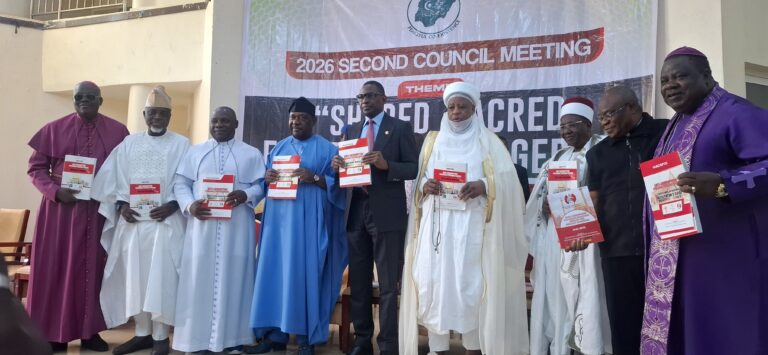
News Investigators/ President, Christian Association of Nigeria (CAN), Archbishop Daniel Okoh, says the suffering of any Nigerian, irrespective of faith, should concern every citizen.
Okoh stated this on Wednesday in Abuja at a meeting of the Nigeria Inter-Religious Council (NIREC), with the theme: “Shared Sacred Flourishing in Nigeria”.
He said shared flourishing required Christians and Muslims to move beyond mere tolerance to practical cooperation for the common good.
He explained that shared sacred flourishing does not mean Christians and Muslims must abandon or compromise their distinctive beliefs, but that values from their encounter with the sacred should contribute to national development.
“Our wellbeing is connected to the wellbeing of our neighbour. We flourish when the dignity of others is protected, when the vulnerable are cared for, when justice is upheld.
“A flourishing Nigeria cannot be measured only by economic growth or infrastructure. It must also be measured by the security of our people, the dignity accorded to every citizen and the opportunities available to our young people,” he said.
Okoh stressed the need for Christians and Muslims to affirm the sacredness of human life.
“The suffering of a Christian should concern a Muslim, just as the suffering of a Muslim should concern a Christian.
“When any Nigerian is killed, displaced, kidnapped or deprived of dignity, our common humanity demands that we care,” he said.
Quoting Jeremiah 29:7, Okoh urged religious communities to seek the peace of the nation, saying Nigeria’s challenges of insecurity, poverty, unemployment and communal tensions required shared responsibility.
He pledged CAN’s commitment to constructive engagement with NIREC and the Muslim community to build a nation where religious diversity became a source of strength.
Earlier, the Executive Secretary of NIREC, Prof. Cornelius Omonokhua, said the council had been sustained for 27 years through shared commitment by political and religious leaders.
Omonokhua thanked President Bola Tinubu and the Secretary to the Government of the Federation (SGF), Sen. George Akume, for sustaining government support for NIREC since 1999.
He condemned the weaponisation of religion for selfish interests, warning that conflict profiteers could plunge the country into a full-blown religious war.
Omonokhua, who presided over his last meeting as executive secretary following the expiration of his tenure, said the council had resolved to condemn statements that contradicted peace and human dignity.
He said the council would remain non-partisan, commending the EFCC Interfaith Anti-Corruption Advisory Committee for publishing the second edition of the Anti-Corruption Preaching and Teaching Manual.
According to him, the manual will help address corruption in religious institutions.
“Religious corruption is priest-craft, just as corruption that destroys human life is witchcraft,” Omonokhua said.
He urged EFCC to go beyond the manual by arresting pastors and imams who preached hate or used churches and mosques for political campaigns.
Omonokhua prayed that the incoming executive secretary would have the courage, humility and patience to sustain NIREC as a platform for conflict prevention and transformation.
NAN