
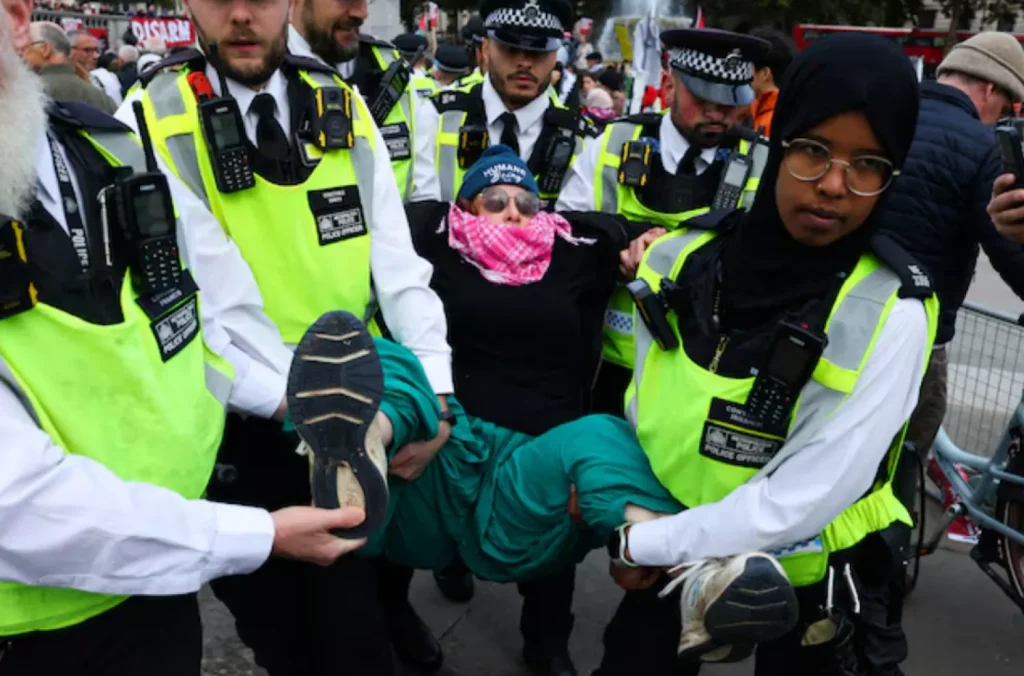
News Investigators/ Two pro-Palestine campaigners found guilty in the UK of breaching protest conditions said they will appeal against their convictions, criticising the “absurdity” of the case.
Benjamin Jamal, 62, director of the Palestine Solidarity Campaign, and Christopher Nineham, 63, vice chairman of the Stop the War Coalition, were both accused of failing to comply with a condition that required attendees of a protest on Jan. 18 last year to stay on Whitehall in central London in a static rally.
On Wednesday, Jamal and Nineham were found guilty after a trial at Westminster Magistrates’ Court.
Jamal was also convicted of two counts of inciting other protesters to breach police conditions.
Speaking outside the court, Nineham called the pair’s convictions a “shocking decision” and a “huge setback for civil liberties in this country,” as he addressed dozens of supporters and members of the press.
He said: “The issue was that the Palestine movement was banned from marching anywhere near the BBC on January 18, 2025.”
“What made it worse was that we were conditioned not to leave Whitehall – in other words, we were not allowed to march at all in the vicinity of a major establishment institution.”
“This is clearly part of an ongoing criminalisation of the Palestine movement, in which people protesting against a genocide are being targeted by a British establishment that is colluding with it.”
He added: “This case, in fact, should never have been brought because, as numerous videos show, the police ushered us through their lines on the day.”
“It is extraordinary, but we are being criminalised.”
“We have been convicted for following police advice. Such is the surreality, such is the absurdity of this.”
Also speaking outside, Jamal said of the trial: “Consider these two basic facts – six days were allocated for this case, the judge allowed the prosecution to take four days to make their case, and did not allow any additional time for defence submission.”
He added: “We will not allow this to distract us from the fundamental reasons why so many people have been coming to the streets for the last two-and-a-half years.”
“We know the decisions like today are designed to repress support for the Palestinian struggle for liberation, and our campaign to end all UK complicity in Israel’s ongoing genocide, but it will not succeed.”
“This cause remains more important than ever.”
Pro-Palestine protesters targeting the BBC had been planning to gather outside the BBC Broadcasting House in Portland Place before marching to Whitehall on the day in question.
The Metropolitan Police first imposed conditions blocking the march from gathering near a synagogue in Great Portland Street amid concerns it would risk the safety of the Jewish community.
The force later banned the protesters from marching as police and organisers did not agree on a route, the trial previously heard.
Commander Adam Slonecki, who was in charge of the policing of the protest, had cited concerns that national demonstrations “had a severely adverse impact on a significant portion of the Jewish community who had become fearful of attending the synagogues during the protest,” prosecutors said.
In a meeting with police on January 8, Jamal said his group were willing to speak to police and find compromises but would not yield to what he called “unacceptable political pressure by people who have got a pernicious agenda,” the court heard.
In a recording of a speech Jamal made to the thousands of protesters on Whitehall, played to the court, he said: “This week the police tried to impose upon us a route for a march which the Board had approved of Deputies of British Jews.”
“We, the Palestine Solidarity Movement, decide where we protest, not the Board of Deputies, not the Chief Rabbi, not the Community Security Trust, not any Zionist group that has supported Israel’s genocide and its 76 years of apartheid.”
“Our intention today was to march to the BBC. We wanted to do so because of its complicity, through the bias of its reporting, a bias confirmed in a recent investigation.”
Jamal said a delegation of the leaders of the six groups which organised the march would walk towards the BBC, carrying flowers which they intended to place at the corporation’s Portland Place headquarters, the court heard.”
Crowds began to follow Jamal and others’ lead, prosecutors said, and footage played to the court showed people walking towards a police cordon, which “eventually buckled under the pressure of large numbers of people moving forward.”
At Wednesday’s hearing, the judge handed Nineham a 12-month conditional discharge and Jamal an 18-month conditional discharge.
Both were ordered to pay £7,500 ($10,000) each towards the prosecution’s costs and a £26 victim surcharge, the full amount due in 12 months.
Defending, Mark Summers KC told the hearing that Jamal and Nineham had “given their lives to voluntary service” and “are not in a position to pay anything.”
He told District Judge Daniel Sternberg that any amount they were ordered to pay would be “met with donations from the supporting public.”
During the hearing, the public gallery was full of the defendants’ supporters, including former Labour leader Jeremy Corbyn, some of whom clapped as they left the court.
After the verdicts, a spokesperson for Campaign Against Antisemitism said: “The convicted criminals Ben Jamal and Chris Nineham have made Londoners’ lives a misery for years with their constant marches.”
“They have changed nothing at all, thousands of miles away in the Middle East.
Instead, they have disfigured our city centres into no-go zones for most ordinary people and especially for British Jews.”