
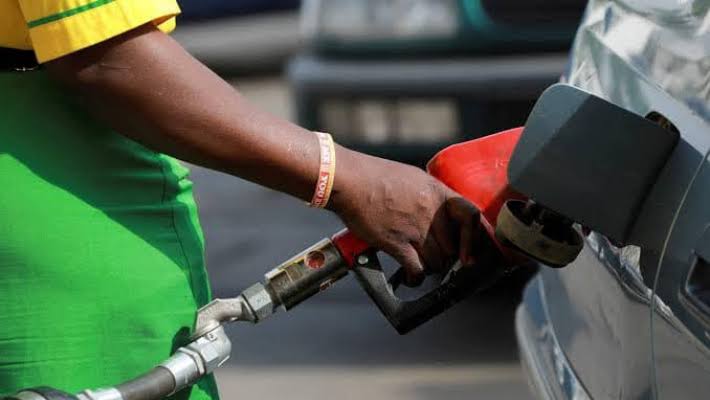
News Investigators/ An economist, Kenneth Ife, says the latest increase in Dangote Refinery’s petrol gantry price will raise transport and business costs and further weaken household purchasing power.
Prof. Ife, who is also the President, Institute of Professional Economists and Policy Management (IPEPM), said this in an interview with the News Agency of Nigeria (NAN) on Sunday in Lagos.
He said the increase would also put pressure on food prices and inflation as higher energy costs spread across the economy.
NAN reports that on Sept. 12, Dangote Refinery increased its petrol gantry price from N1,265 to N1,350 per litre, its fourth increase since Aug. 21.
The cumulative increase has raised the refinery’s gantry price by N185, or 15.9 per cent, in 22 days.
Ife said petrol prices could rise further if international crude prices remained elevated amid disruptions to global oil supplies.
He said the price of Bonny Light had risen sharply to 112 dollars per barrel before dropping to 108 dollars.
According to him, crude prices can rise further if tensions around major oil-producing countries and key shipping routes intensify.
He said any further escalation of tensions in the Middle East could exert additional pressure on crude and refined petroleum product prices.
Prof. Ife said recent attacks on Saudi energy infrastructure and disruptions around major shipping routes had heightened concerns over global oil supplies.
He said higher petrol prices would directly reduce household purchasing power through increased transportation and energy costs.
“The petrol price increase transmits directly to shrinkage in household purchasing power,” he said.
Ife said higher transport costs would also push up food prices and worsen energy and food insecurity.
“Cost-push inflation will be aided by the rising input cost,” he said.
The economist said higher costs of imported goods and industrial raw materials would further increase the cost of doing business.
He added that the development could reduce the competitiveness of Nigerian businesses in regional and global markets.
Ife urged the Federal Government not to return to petrol subsidies but to adopt measures that would reduce domestic fuel costs.
He called for full implementation of the Petroleum Industry Act (PIA) and stronger domestic crude supply to local refineries.
“The government can get Nigerian National Petroleum Company Ltd. to supply the full complement of crude required by local refining capacities,” he said.
“Under the PIA, domestic crude supply operates on a willing-supplier, willing-buyer basis, with the regulator empowered to establish a Domestic Crude Supply Obligation,” he added.
Ife also urged the government to accelerate the deployment of Compressed Natural Gas (CNG) as an alternative to petrol in the transport sector.
He proposed partnerships with filling station operators to expand CNG infrastructure and vehicle conversion.
“The government can rapidly accelerate the CNG gas expansion and capacity utilisation by taking CNG to the mass market,” he said.
Ife said wider CNG adoption could reduce dependence on petrol and help lower energy costs for households and businesses.
He said the government could pursue the measures while allowing market forces to determine petrol prices.
NAN recalls that the Presidential Initiative on CNG and Electric Vehicles currently reports more than 400 certified conversion centres and over 90 CNG refuelling stations nationwide.
The initiative aims at expanding CNG infrastructure and reducing transportation costs following the removal of petrol subsidies.
Checks by NAN correspondent in parts of Lagos on Sept. 20 showed petrol selling for between N1,400 and N1,500 per litre at some filling stations.
NAN