
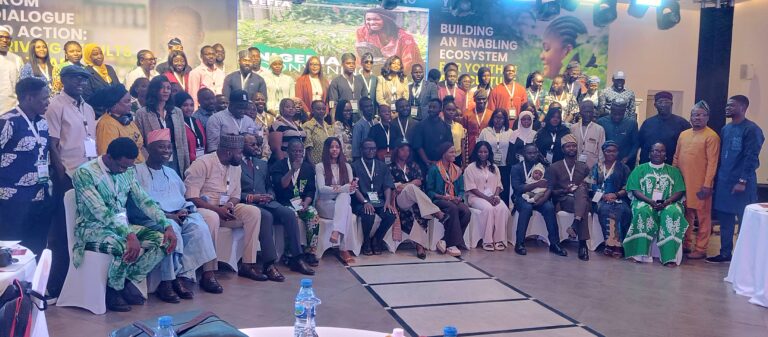
News Investigators/ Nigerian youth have called for greater access to finance, markets and post-harvest infrastructure to enable them take a stronger role in Nigeria’s food economy.
They made the call at the Youth Entrepreneurship for the Future of Food and Agriculture (YEFFA) Nigeria Youth Convening on Youth and Food Systems Transformation in Abuja on Wednesday.
The convening, hosted by the Alliance for a Green Revolution in Africa (AGRA) in collaboration with the Mastercard Foundation, had the theme: “From Dialogue to Action.”
The News Agency of Nigeria (NAN) reports that YEFFA is a six-year partnership between AGRA and the Mastercard Foundation, running from 2023 to 2029.
The programme targets 10 million young people and seeks to support 1.5 million to transition into dignified work, with at least 50 per cent being young women.
Rufus Idris, Country Director, AGRA Nigeria, said the narrative of young people as “leaders of tomorrow” should be replaced with concrete opportunities for them to lead today.
Mr Idris said Nigeria’s farmers were, on average, between 50 and 60 years old, while more than 70 per cent of the population was below 30.
He said the country’s future food security therefore depended on building viable youth-led enterprises across the food system.
“My father grew up being told he was the leader of tomorrow, and I heard the same in school. But tomorrow is here.
“You are the leaders of today. Agribusiness is no longer about hoes and cutlasses; it is about data, innovation, technology and global connections.
“Africa’s food economy will soon be worth one trillion dollars. The question is how much of that market our young people will command,” Idris said.
Dr Ayodele Olaleye, Programme Lead, Market Systems Development, Mastercard Foundation, said programmes targeting young people should be designed and led with their active participation.
According to him, the foundation’s philosophy was “nothing for youth without youth”.
“As we say, you cannot shave a man’s head in his absence. Programmes for young people must be designed with them and led by them at every stage,” Olaleye said.
He urged the youth to look beyond their immediate locations and speak for young people facing similar challenges across the country.
“You are here to speak for the young woman in rural Kano, the young man in Benue and the young person in Lagos who needs dignified, fulfilling work,” he said.
NAN reports that young participants at the convening identified three major constraints to youth agribusiness; access to youth-friendly finance, reliable routes to market and post-harvest infrastructure.
Baliqees Salaudeen, an agripreneur and Regional Coordinator, African Youth Initiative on Climate Change (AYICC), called for shared processing facilities and aggregation hubs.
Salaudeen said young processors faced difficulties meeting certified standards when operating from inadequate facilities.
“Young people are told to move beyond production into processing, but you cannot process to certified standards from your parents’ backyard.
“We need shared post-harvest facilities and aggregation hubs, built to certified standards so that young processors do not each carry the cost of heavy equipment.
“Farmers carry the cost of seed, labour and risk. They deserve to be profitable,” she said.
Mr Tobi Olanrewaju, Founder and Agribusiness Leader, said emerging agripreneurs faced volatile prices, limited access to youth-designed finance and weak ecosystem support.
“When you produce at scale without the means to store or process, the aggregator sets your price.
“Financial institutions and development partners should design patient, youth-sensitive finance and agricultural insurance that protects young people’s investments, not only those of large companies,” he said.
Ifeoluwa Tryphena, Founder, Slate Systems Lab Ltd., said agricultural data in Nigeria remained fragmented, making it difficult for banks, insurers and policymakers to make informed decisions.
Tryphena urged financial institutions, insurers and policymakers to integrate farm-level, market and financial data to help de-risk the food value chain.
NAN