
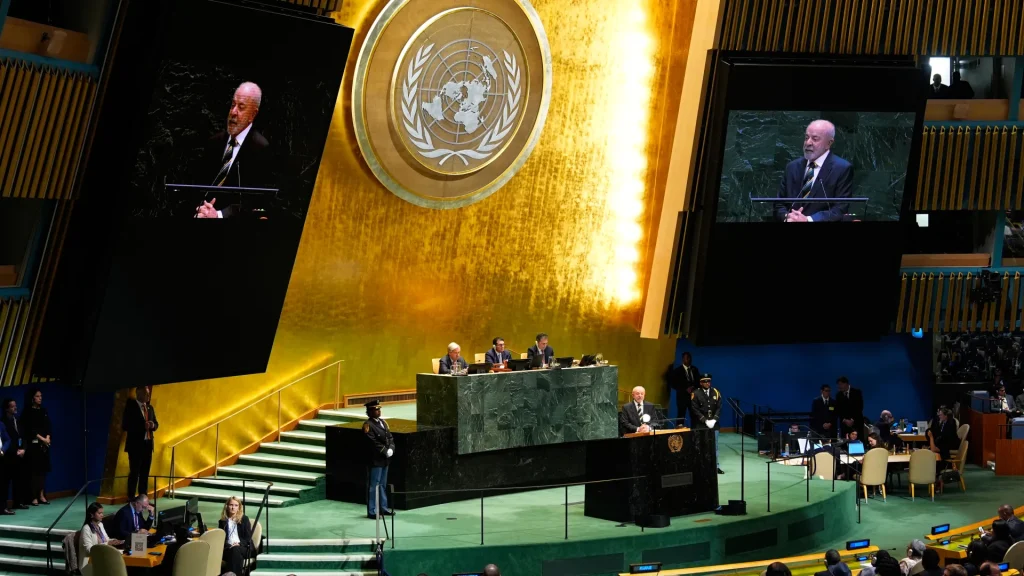
News Investigators/ Nigeria has warned against the selective application of universal jurisdiction, urging the United Nations to establish safeguards preventing powerful countries from exploiting international criminal justice mechanisms.
The warning came during Nigeria’s national intervention at the plenary meeting of the UN General Assembly’s Sixth Committee on Thursday at the UN headquarters in New York.
The committee was considering the scope and application of universal jurisdiction, a legal principle allowing certain serious international crimes to be prosecuted beyond national borders.
Nigeria reaffirmed its commitment to combating impunity but insisted that universal jurisdiction must remain an exceptional mechanism exercised within clearly defined international legal limits.
The Nigerian representative, Mr Emmanuel Nweke, said the principle should be invoked only as a last resort, particularly where countries directly connected to alleged crimes cannot prosecute them.
The delegation warned that stronger countries must not use universal jurisdiction to impose their domestic legal systems on weaker nations.
It expressed concern about the selective or politically motivated application of the principle, particularly in cases involving African officials.
According to Nigeria, such practices undermine the legitimacy of international criminal justice and weaken confidence in cooperation between sovereign states.
The delegation recalled concerns that prompted African countries to seek the inclusion of universal jurisdiction on the General Assembly’s agenda.
It maintained that the unresolved questions surrounding the principle’s scope and application required internationally agreed safeguards.
Nigeria identified several conditions it considered necessary to prevent abuse while preserving accountability for serious international crimes.
First, it proposed restricting universal jurisdiction to the gravest crimes whose international character is clearly established by treaties or customary international law.
It argued that individual countries should not unilaterally expand the categories of offences subject to the principle.
Second, Nigeria proposed that a third country should exercise jurisdiction only where the territorial state or country of nationality is unable or unwilling to prosecute.
The delegation also called for prior consultation with the country directly connected to the alleged offence.
Third, it maintained that an accused person should be present within the prosecuting country’s territory before universal jurisdiction is exercised.
Nigeria further opposed trials conducted in the absence of accused persons and advocated safeguards against politically motivated prosecutions.
It proposed that decisions to initiate proceedings should rest with the highest prosecutorial authorities, subject to due process and fair-trial guarantees.
The delegation also emphasised the importance of distinguishing universal jurisdiction from extradition obligations and the jurisdiction of international courts.
Nigeria cited its Constitution, Geneva Conventions Act, terrorism legislation and mutual legal assistance arrangements as components of its domestic accountability framework.
As a party to the Rome Statute, Nigeria reaffirmed its support for complementarity, under which national authorities retain primary responsibility for investigating and prosecuting crimes.
Nigeria emphasised that combating impunity must remain consistent with sovereign equality, international cooperation and respect for established legal procedures. (NAN)