
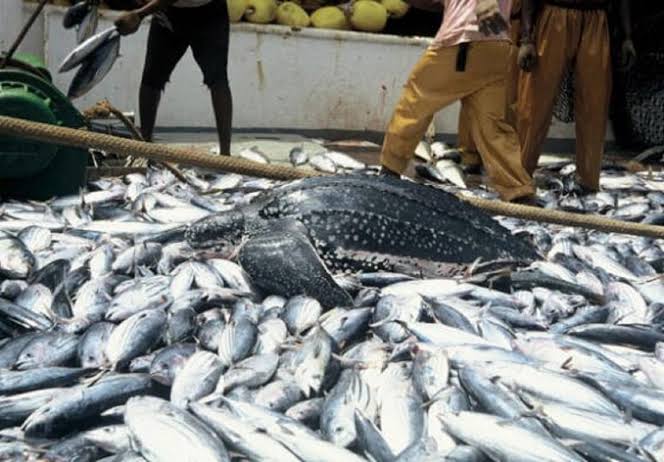
News Investigators/ The Minister of Marine and Blue Economy, Adegboyega Oyetola, says Nigeria has recorded 1.4 million metric tons of local fish production, marking a significant boost to the country’s fisheries sector.
Mr Oyetola said this on Wednesday in Abuja while speaking at the 4th Quarter 2025 Citizens/Stakeholders’ Engagement Meeting of the ministry with the theme; “Positioning Nigerian Marine and Blue Economy for Investment, Innovation and Expansion.’’
The minister said that local fish production had risen from 1.1 million to 1.4 million metric tons, reflecting efforts to boost domestic output, reduce imports, and enhance food security.
“I am pleased to report that local fish production has increased from 1.1 million metric tons to 1.4 million metric tons so far this year.
“The growth recorded in the fisheries and aquaculture subsector reflects targeted interventions by the Federal Government aimed at strengthening local capacity, improving coordination, deploying appropriate technologies, and enhancing sectoral planning.
“In the area of fisheries and aquaculture, we are working deliberately and with unique agency to boost local fish production, reduce our dependence on imports, and strengthen food security,” he said.
Mr Oyetola said that while the current production level remained below Nigeria’s annual consumption estimate of 3.6 million metric tons, the progress achieved demonstrated growing momentum in the sector.
This, he said, was a clear pathway toward self-sufficiency.
He disclosed that plans were underway to accelerate the growth through engagements with relevant financial institutions to provide single-digit interest loans to fish farmers nationwide.
Mr Oyetola said that the plan was to improve access to affordable finance, empower artisanal and industrial operators, boost productivity, and support efforts to curb illegal, unreported, and unregulated fishing in Nigeria.
He reaffirmed the federal government’s commitment to repositioning fisheries and aquaculture as key drivers of economic diversification, job creation, and food security under the Renewed Hope Agenda of President Bola Tinubu.
He also assured stakeholders that the ministry would continue to deepen reforms, strengthen institutions, and create an enabling environment for sustained private sector participation across the marine and blue economy value chain.
Dr Pius Akutah, Executive Secretary of the Nigerian Shippers Council (NSC), underscored the importance of stakeholder participation, including the Infrastructure Concession Regulatory Commission (ICRC) in boosting and advancing the sector.
According to him, the involvement of the ICRC is a strategic move aimed at deepening Public-Private Partnerships (PPP), noting that such collaborations are critical to attracting investment and accelerating growth.
He reaffirmed the council’s commitment to advancing sustainable infrastructure development through effective Public Private Partnership frameworks.
On his part, the Managing Director of the Nigerian Ports Authority (NPA), Dr Abubakar Dantsoho, disclosed that the authority had surpassed its 2025 revenue target of N1.2 trillion and recorded an 18.9 per cent increase in container traffic.
He attributed the feat to the support and leadership of the minister and the ministry.
Dr Dayo Mobereola, the Managing-Director of the Nigerian Maritime Administration and Safety Agency (NIMASA) also revealed growth and progress in its agency.
The Fisheries Cooperative Federation of Nigeria also disclosed increase in membership registration, licensing and certification.
Highlight of the event was the launch of the ministry’s Enterprise Content Management System (ECMS).
NAN