
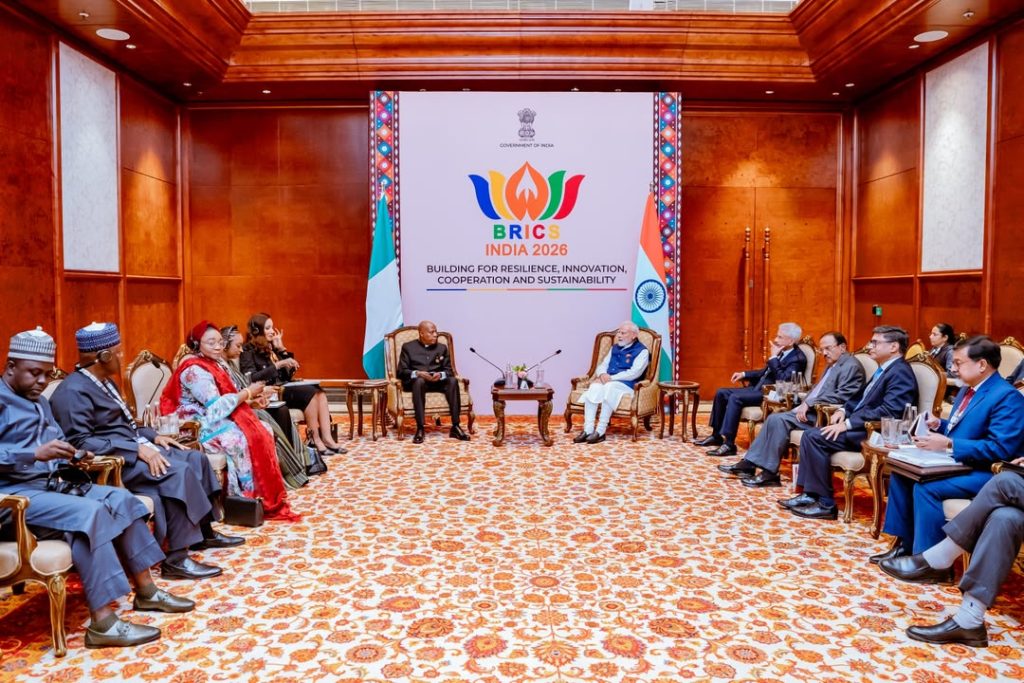
News Investigators/ Nigeria and India have agreed to deepen their strategic economic relationship, with India seeking renewed purchases of Nigerian crude oil.
The commitment followed a bilateral meeting between Vice President Kashim Shettima and Indian Prime Minister Narendra Modi in New Delhi.
The meeting was held on the sidelines of the recently concluded BRICS Leaders’ Summit.
The two countries are seeking to rebuild bilateral trade towards its previous peak of nearly $15 billion.
The News Agency of Nigeria (NAN) reports that bilateral trade reached $14.95 billion in the 2021–2022 financial year before declining sharply following reduced Indian purchases of Nigerian crude.
The trade value fell to $7.13 billion in 2024–2025 but recovered to about $9 billion in 2025–2026.
The Indian High Commissioner to Nigeria, Abhishek Singh, disclosed the latest trade figures.
Modi made a case for renewed Indian purchases of Nigerian crude, saying stronger energy ties could restore bilateral commercial exchanges.
He also expressed appreciation for Nigeria’s hospitality towards the sizeable Indian community living and doing business in the country.
Shettima said Nigeria would consider India’s request within broader efforts by President Bola Tinubu’s administration to attract investment.
He said the administration was pursuing strategic partnerships capable of expanding Nigeria’s productive capacity and strengthening domestic industries.
Shettima identified pharmaceuticals, defence, digital technology and creative industries as priority areas for expanded Nigerian-Indian cooperation.
He stressed the need for partnerships that create jobs, transfer skills and unlock opportunities for Nigeria’s large youth population.
“The Tinubu administration is particularly interested in moving Nigeria’s relationship with India beyond the traditional exchange of commodities,” Shettima said.
He said the focus was on investments supporting domestic production and value addition across strategic sectors of the economy.
Shettima said the President wanted international partnerships to deliver investment, technology transfer, industrial growth and tangible economic opportunities for Nigerians.
The vice president said stronger economic ties should therefore translate into greater productive capacity rather than remain centred on commodity exchanges.
The two leaders also discussed expanded cooperation in renewable and clean energy, power, healthcare, capacity building and financial technology.
They further explored opportunities in other emerging sectors, reflecting the broadening scope of Nigeria-India economic relations.
Both leaders agreed that stronger private-sector engagement would be central to the next phase of bilateral relations.
They identified industries where Indian companies have considerable expertise and Nigerian demand remains strong as areas for deeper collaboration.
Discussions also covered fintech and digital technology, building on both countries’ expanding digital economies and previous agreements on digital public infrastructure.
Meanwhile, Minister of Women Affairs, Imaan Sulaiman-Ibrahim, said Nigeria was drawing lessons from India’s women-led self-help group model.
She said the lessons would strengthen financial inclusion and grassroots enterprise through the Nigeria for Women Programme Scale-Up.
According to her, the programme will use Women Affinity Groups to connect women with finance, skills and markets.
Sulaiman-Ibrahim said the initiative formed part of the Federal Government’s broader drive to increase women’s participation in productive economic activity.
She added that the programme would strengthen social protection and interventions against sexual and gender-based violence.
“Women’s economic empowerment is fundamental to our ambition of building a $1 trillion economy.
“We must deliberately bring millions more Nigerian women into productive economic activity,” the minister said.
The renewed engagement signals efforts by both countries to reverse the decline in trade and build a broader investment-driven partnership.
NAN