
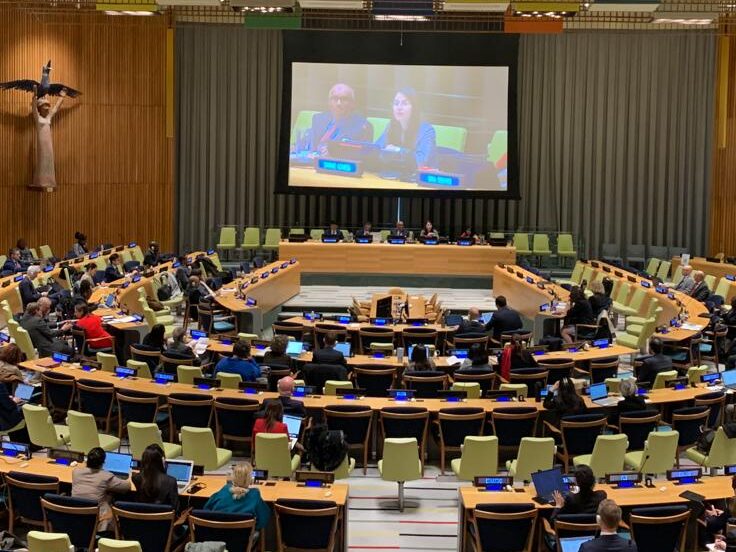
News Investigators/ Nigeria has called for stronger international disaster-response arrangements that protect national sovereignty while guaranteeing financial assistance, technology transfer and early-warning capabilities.
The country outlined its priorities during the General Assembly’s Sixth Committee negotiations on a proposed international convention protecting people affected by disasters.
Speaking on behalf of Nigeria, its representative, Mr Emmanuel Nweke insisted that international disaster assistance must respect the authority and consent of affected countries.
The delegation said the proposed convention should clearly establish the responsibilities of governments, international organisations and other humanitarian actors.
Nigeria maintained that affected states must retain primary responsibility for directing, coordinating and supervising disaster relief operations within their territories.
It specifically supported retaining provisions of the draft convention recognising national authority and requiring consent before external assistance is provided.
The delegation argued that these safeguards were necessary to prevent humanitarian emergencies from being exploited for political purposes.
However, Nigeria emphasised that respect for sovereignty must be accompanied by effective international cooperation and predictable humanitarian assistance.
It supported proposals by the African Group to strengthen provisions concerning financial assistance, capacity-building, technology transfer and technical expertise.
The country also advocated greater international investment in early-warning systems capable of reducing casualties and economic losses.
Nigeria specifically identified artificial intelligence as an emerging technology that could strengthen disaster forecasting, preparedness and anticipatory humanitarian action.
It urged governments to combine technological innovation with community knowledge and established national disaster-management systems.
The delegation also identified delays in transporting relief materials, clearing imported humanitarian supplies and issuing visas to emergency personnel as obstacles requiring attention.
Nigeria said the convention should establish practical arrangements facilitating international assistance while respecting domestic laws and national priorities.
Explaining its interest, the delegation recalled that devastating floods in 2022 affected more than 4.4 million Nigerians across 34 states.
It said the disaster displaced more than 1.4 million people, demonstrating the enormous humanitarian and economic consequences of inadequate disaster preparedness.
Nigeria also cited displacement affecting more than two million people in the Lake Chad Basin, where insecurity compounds environmental degradation and food insecurity.
The delegation identified oil pollution in the Niger Delta as another example of environmental damage with serious humanitarian consequences.
It advocated stronger recognition of African regional mechanisms, including ECOWAS disaster-management arrangements, the African Union’s humanitarian framework and the Kampala Convention.
Nigeria also urged negotiators to establish safeguards protecting vulnerable populations against exploitation, discrimination and abuse during humanitarian operations.
It reaffirmed its commitment to negotiating a convention capable of improving international cooperation before, during and after disasters.
NAN