
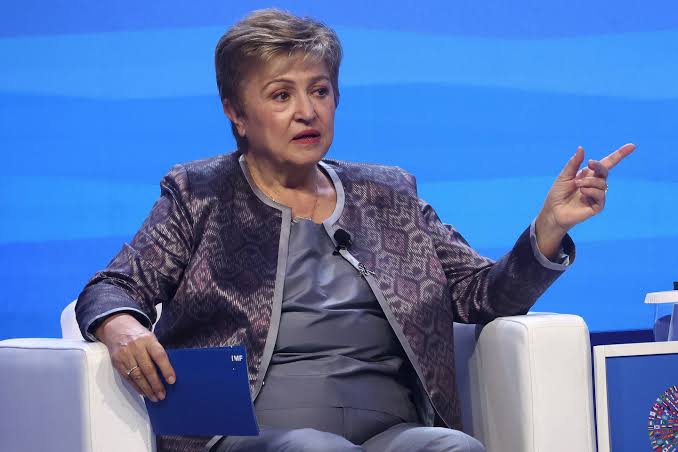
News Investigators/ The International Monetary Fund (IMF) and industry leaders have called for responsible artificial intelligence (AI) adoption, stronger safety standards and increased investment in workforce training.
They say this to ensure that the technology benefits businesses, workers and economies worldwide.
The leaders made the call during a panel discussion on “AI and the Global Economy: From Risk to opportunity” at the IMF/ World Bank Annual Meetings in Bangkok on Friday.
The speakers agreed that AI was transforming the global economy but cautioned that its benefits would depend on how governments, businesses and workers managed the associated risks and opportunities.
IMF Managing Director, Kristalina Georgieva, described AI as a fast-moving and transformative technology capable of boosting economic growth, particularly in countries and economies well integrated into the global digital ecosystem.
Georgieva, however, warned that the technology could disrupt labour markets and create risks for financial stability if appropriate safeguards were not established.
She stressed the need for an ethical foundation and effective guardrails to guide AI development and deployment, noting that global efforts to address the associated risks were not progressing quickly enough.
The IMF boss called for stronger international coordination to ensure that the technology was developed and deployed responsibly.
Dr Tobias Meyer, Chief Executive Officer, DHL, who offered a business perspective on AI adoption, said the technology was increasingly important to global trade and supply chain efficiency.
Meyer, however, cautioned companies against excessive spending on information technology projects without clearly defined business objectives.
According to him, businesses should identify specific, high-volume processes where AI systems, particularly agentic AI capable of carrying out tasks with limited human intervention, can deliver measurable operational improvements.
Meyer said the logistics industry required more than advanced reasoning capabilities, stressing the importance of physical connectivity, operational context and an understanding of real-world processes.
He maintained that AI investments should be driven by practical business needs rather than the pursuit of technology for its own sake.
Anthropic Co-Founder, Jack Clark, emphasised the concept of creative destruction, explaining that organisations would need to rethink and rebuild their operations to take full advantage of emerging AI capabilities.
Anthropic is an AI and safety research company, known for building the Claude AI assistant.
Clark advocated common international safety standards to guide AI development, comparing the need for such safeguards with established testing requirements for children’s toys.
He urged AI companies to share employment-related data to help policymakers understand the technology’s impact on jobs and develop appropriate responses.
Clark said access to reliable information about changing employment patterns would be important in shaping policies to manage the transition.
Tiff Macklem, Governor, Bank of Canada, Bank of Canada, said AI was already contributing to investment and gross domestic product (GDP) growth but noted that its broader economic value would depend on how widely the technology was adopted across industries.
Macklem explained that widespread diffusion of AI could generate greater productivity gains and extend its benefits beyond technology-focused companies.
He acknowledged that technological advances had historically created more jobs than they destroyed, but stressed that the transition could still impose significant costs on workers and communities.
Macklem called on governments and businesses to invest proactively in training and skills development to help workers adapt to changing job requirements.
He also warned that failure to manage the transition effectively could fuel public dissatisfaction and populist sentiment.
Ayesha Khanna, Co-Founder/ CEO of Addo, a global AI solutions company, highlighted the difficulty many organisations faced in moving beyond individual productivity improvements to achieve broader operational transformation through AI.
Khanna noted that tools such as AI copilots could help employees perform tasks more efficiently, but argued that businesses needed to redesign their operations to realise more substantial productivity gains.
She called on governments to take proactive and measurable steps to support AI adoption while protecting workers from the disruption associated with technological change.
She cited Singapore’s approach to supporting training and business transformation as an example of how public policy could help companies and employees adapt to emerging technologies.
Khanna said governments should consider targeted subsidies for training and other support measures to enable workers to acquire relevant skills and help businesses integrate AI into their operations.
The panel’s discussions highlighted the importance of balancing
AI-driven economic growth with employment protection, responsible innovation and financial stability.
The speakers underscored that technological advancement alone would not guarantee widespread prosperity, stressing the need for coordinated policies, business investment and continuous workforce development.
They maintained that governments, companies and international institutions would need to work together to ensure that AI’s economic benefits were broadly shared while addressing the risks associated with its rapid development.
NAN