
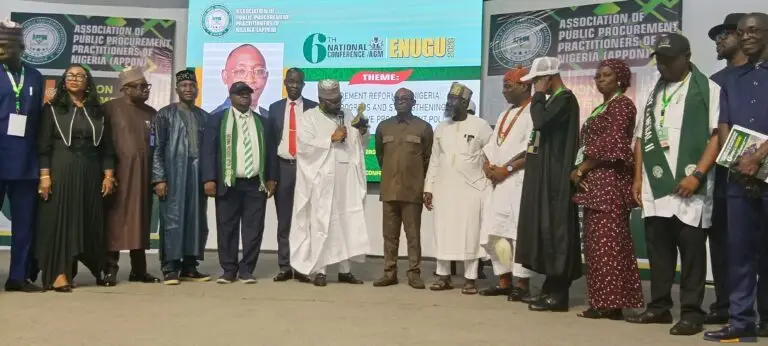
News Investigators/ The Bureau of Public Procurement (BPP) says the Federal Government’s affirmative procurement has increased participation of Small Medium Enterprises (SMEs) in public sector contracting.
The Director-General of the Bureau, Adedokun Adebowale, stated this at the 6th National Conference and Annual General Meeting of the Association of Public Procurement Practitioners of Nigeria (APPON), held at the International Conference Centre, Enugu.
The conference, which runs from June 2 to June 6, is themed: “Procurement Reforms in Nigeria: Evaluating Progress and Strengthening SMEs through Affirmative Procurement Policies.”
The DG said that the policy was a catalyst for inclusive economic growth which had strengthened the SMEs.
According to him, the policy aligns with President Bola Tinubu’s economic agenda aimed at empowering SMEs, youth-led enterprises, women-owned businesses, veterans and other vulnerable groups through greater access to government contracts.
“If there is anything government is doing today, it is how to strengthen small and medium-scale enterprises.
“The affirmative procurement agenda is designed to take development closer to the people by creating procurement opportunities that SMEs can undertake with minimal barriers,” he said.
Mr Adebowale noted that many young entrepreneurs possess the capacity to execute small-scale projects and provide innovative technological solutions but often lacked access to public sector opportunities due to stringent procurement requirements.
“We have over 70 per cent youth in this country. There are projects worth N10 million or N15 million that startups and SMEs can effectively execute.
“The objective is to create a pool of projects reserved for these groups without the cumbersome documentation often required for large infrastructure contracts,” he said.
The BPP boss described public procurement as a strategic tool for industrial development, innovation, job creation and national economic transformation.
He said procurement reforms had significantly improved transparency, accountability, competitiveness and professionalism in the public sector.
Mr Adebowale noted that government was deepening the reforms through policy adjustments, institutional strengthening and digitalisation.
According to him, procurement thresholds have been reviewed to reflect prevailing economic realities and reduce bureaucratic bottlenecks while maintaining transparency and accountability.
Mr Adebowale also warned procurement officers against violating provisions of the Public Procurement Act, stressing that sanctions would be imposed on officials found engaging in contract splitting, bid rigging, conflict of interest and other procurement-related offences.
In his remarks, APPON National President, Emem Kanico, described the conference as timely, noting that it came at a critical stage in Nigeria’s procurement reform journey.
Mr Kanico said the conference theme reflected ongoing efforts to reposition public procurement as a strategic instrument for national development, industrial growth and economic sustainability.
He highlighted the implementation of the Nigeria First Policy by the Federal Government as one of the most significant developments in the country’s procurement landscape.
According to him, the policy is designed to promote indigenous capacity, local content development and economic self-reliance by prioritising Nigerian products, services and expertise in public procurement.
Mr Kanico reaffirmed APPON’s commitment to supporting the implementation of the policy through advocacy, professional guidance, monitoring and stakeholder engagement.
Also speaking, Ehimoni Ibiyomi, Director-General and Chairman of the Forum of Directors-General of Public Procurement Agencies in the 36 states, said SMEs remained largely excluded from meaningful participation in public procurement in spite of their critical contribution to economic growth and employment.
He noted that countries such as South Africa, Canada, the United States, Brazil, Malaysia and Kenya had successfully deployed affirmative procurement policies to support indigenous enterprises and vulnerable groups.
Mr Ibiyomi called for deliberate measures to strengthen SME participation through reserved procurement opportunities, capacity-building programmes, digital procurement platforms and improved access to procurement financing.
Earlier, Chairman of the Central Planning Committee of the conference, Dr Raphael Amalaha, said the event provided a platform for knowledge sharing, professional networking, policy dialogue and collaboration among procurement stakeholders.
“We are particularly pleased with the focus on empowering SMEs, recognising their vital role in economic growth, employment creation and national development,” Amalaha said.
NAN