
News Investigators/ The Federal Government is to establish civilian de-mining teams comprising retired military personnel, other security veterans, and civilians, including youths and medical professionals, to tackle threats of Improvised Explosive Devices (IEDs).
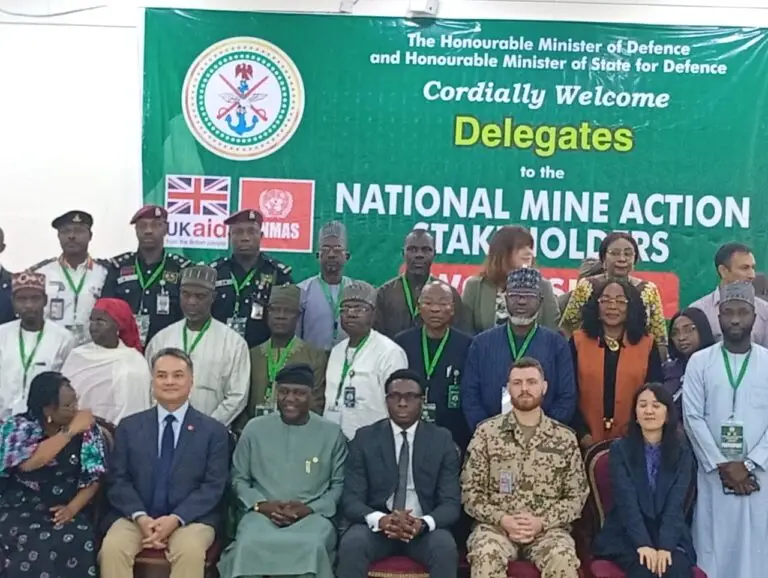
The Minister of Defence, Christopher Musa, made this disclosure on Tuesday at the National Mine Action Stakeholders Workshop held in Abuja.
Mr Musa explained that the workshop provides a platform for stakeholders to collectively develop a comprehensive draft mine action bill and define national implementation measures aligned with the Ottawa Convention on the Prohibition of Anti-Personnel Mines.
The minister said the threat posed by anti-personnel mines and IEDs remains a serious humanitarian and security concern.
He highlighted that the proposed model, once operational, offers a practical scenario for knowledge transfer.
“A retired combat engineer working alongside a young civilian trainee can pass on critical field experience, ensuring sustainability of expertise.
“At the same time, the inclusion of civilians fosters trust within affected communities, encouraging them to come forward for assistance and recruitment,” he said.
Mr Musa pointed out that countries that have successfully cleared mined territories have combined community engagement with advanced protection technologies, “an approach we must adapt to our local context.”
He also advocated for mine clearance education, noting that even a simple awareness campaign in a village could mean the difference between life and death.
“When communities understand the risks and know how to respond, clearance operations can be significantly improved.
“Ultimately, our collective effort must restore hope and normalcy.
“We must envision a Nigeria where children can walk to school without fear, where farmers can safely return to their land, and where communities can rebuild without the legal threat of explosive remnants of war,” he added.
The Minister observed that in recent years, non-state actors, particularly in insurgency-affected areas, have deployed improvised mines that continue to endanger lives even after active hostilities have subsided.
He lamented that ordinary citizens, including farmers and children, face life-threatening dangers.
According to him, the farmer who simply wishes to cultivate his land can trigger an explosive device.
“Similarly, children walking to school or playing in open fields unknowingly face grave risks, as highlighted in recent videos. These are not distant possibilities—they are everyday realities for our citizens,” he said.
Mr Musa emphasised that in response to these realities, Nigeria acceded to the Ottawa Convention and established the National Mine Action Centre (NMAC) to coordinate humanitarian demining and relieve the armed forces of purely civilian-focused clearance responsibilities.
He explained that the NMAC is mandated to accredit mine action operators, monitor and ensure quality in clearance operations, develop standard operating procedures, and deliver explosive risk education.
The Centre also supports capacity building for security institutions in IED clearance and maintains a national data management system for mine action.
In his goodwill message, the UNMAS representative, Edwin Faigmane, reiterated the UN’s commitment to support Nigeria in achieving Article 5 of the Anti-Personnel Mine Ban Convention.
He said the UN, along with the British and Japanese governments, has been training Nigeria’s police and NSCDC to conduct search-and-destroy operations for IEDs.
“Right now, we have trained enough officers forming two search teams and two DOD/IED disposal teams from the civil defence and police.
“Once the equipment arrives, we can commence operations,” he said.
Also speaking, the ECOWAS representative, Abayomi Adeomi, said the workshop reflects a strong national commitment to addressing one of the region’s most pressing humanitarian and security challenges.
He observed that the West African region is witnessing an alarming proliferation of explosive hazards, including mines, unexploded ordnance, and improvised war devices, which continue to kill civilians, displace communities, disrupt livelihoods, and impede post-conflict recovery and development.
“The increasing use of improvised war devices, otherwise known as IEDs, by non-state actors in asymmetric conflicts has significantly altered the security landscape in our region.
“Beyond the immediate impact, explosive hazards have long-term effects. They contaminate farmland, limit access to infrastructure, obstruct mining activities, and delay construction efforts.
“Addressing this is not just a security priority—it is a fundamental development and humanitarian imperative,” he said.
Mr Adeomi said ECOWAS is committed to supporting member states, including Nigeria, to achieve a mine-free region.
NAN