
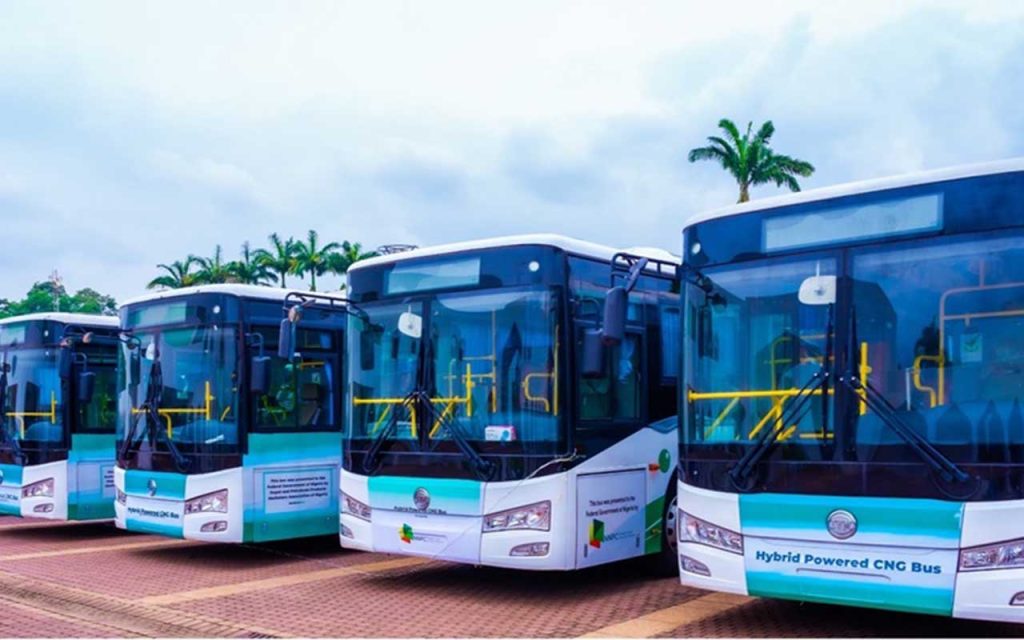
News Investigators/ Many residents of the Federal Capital Territory (FCT), have called on the Federal Government to provide more Compressed Natural Gas (CNG) buses to ameliorate transportation challenges in the territory.
The residents spoke with the News Agency of Nigeria (NAN) in Abuja on Sunday.
They said although the government fulfilled its promise to provide CNG buses, the number currently in operation was insufficient to meet commuters’ needs.
The call followsed government’s efforts under the Presidential Compressed Natural Gas Initiative (Pi-CNG), inaugurated in October 2023 to promote cleaner, cheaper public transport and reduce commuters’ travel costs.
The initiative has delivered CNG buses, including four 50-seater hybrid buses to the FCT Administration.
Under Pi-CNG, government and private sector partners aim to deploy thousands of CNG buses, tricycles and conversion kits nationwide, backed by tax waivers and safety regulations intended to accelerate adoption.
A civil servant, Mrs Grace Samuel, said the limited number of buses had not sufficiently eased pressure on public transport nor served the growing number of passengers across major routes.
According to Samuel, many passengers are often times compelled to wait long hours before boarding.
“Most times, the buses are not available and you may wait for hours before one begins boarding. government needs to provide more buses,” she said.
Another commuter, Mr Ibrahim Musa, said the intervention had yielded limited relief, as fares charged by the CNG buses were not significantly different from those of conventional commercial vehicles.
“We expected the fares to be much lower, but on some routes, the difference is minimal. That is why many people feel the impact has not been substantial,” he said.
However, some residents acknowledged that the initiative was a step in the right direction but urged authorities to strengthen monitoring and ensure fare compliance.
Mrs Jacinta Nwankwo, a nurse working in Apo, said she had not seen any of the promised busses along her route.
Nwankwo said,” I drive through Garki to Apo Resettlement Areaevery day to and from work but I rarely see the CNG buses.
“Although, I sometimes see some of the CNG busses parked around Area 1, picking passengers going towards Mararaba axis.
“Though there are none of the buses designated to pick passengers going towards the Apo Resettlement Area where I work and many other routes within the FCT.
“The buses are not enough, else they would have been deployed to all areas. So the government should do something about it please and most especially, ensure it is affordable to Nigerians.”
Similarly a motorist, Mr Jacob Agbo appealed to the government to expand the fleet, improve route coverage and enforce regulated pricing.
Agbo said if this was done, it would ensure the programme achieved its intended objective of easing transportation costs for residents.
Mr Gideon Onah, a transport and energy expert said the Pi-CNG programme had made progress, including expansion of CNG conversion centres from just a few to more than 140 nationwide.
Onah, however, emphasised that wider infrastructure and fleet scale-up are still needed to achieve lasting cost relief for residents.
He said: ” the government must prioritise rapid deployment of buses and refueling stations to make the programme truly effective.
“If the buses are too few and the network of CNG stations is limited, the impact on fares and commuter experience will remain modest.”
Mr Johnson Orakwe, an energy expert said the absence of wide public awareness and safety assurance campaigns had slowed adoption and left some commuters skeptical about CNG advantages.
“While CNG can be cheaper than petrol, the impact on fares depends on overall service availability, frequency, and operator pricing decisions, not just fuel type,” he said.
NAN