By Justina Raphael
How The Controversy Started
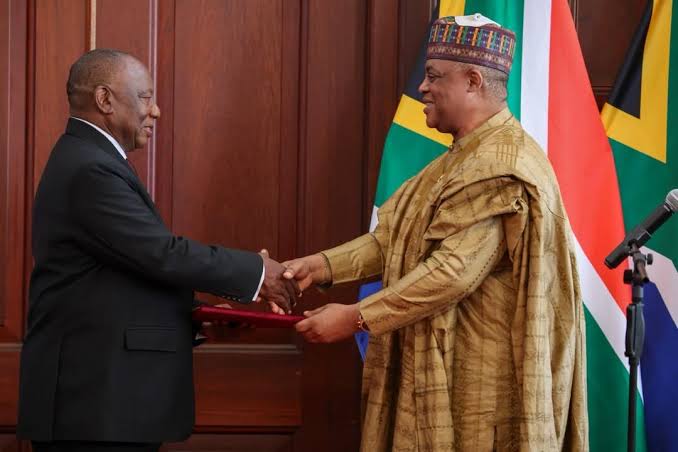
On 13 November 2026, Fani-Kayode presented his letters of credence to South African President Cyril Ramaphosa at the Sefako M. Makgatho Presidential Guest House in Tshwane, alongside other ambassadors and high commissioners.
Fani-Kayode was reportedly the last diplomat to make his presentation. However, during the ceremony, the South African Presidency’s livestream appeared to experience an interruption, cutting away before viewers could hear his address.
He subsequently alleged that his speech had been deliberately excluded and described the incident as an unacceptable slight against Nigeria.
According to Fani-Kayode, he raised the matter directly with President Ramaphosa during the photo session. He said the President took him to officials, questioned them and directed that the matter be addressed.
The following day, South African Presidency spokesperson Vincent Magwenya challenged Fani-Kayode’s account, describing his approach as inappropriate and characterising the incident as a minor operational misunderstanding. The Presidency later uploaded a separate video of Fani-Kayode’s speech.
The Nigerian High Commission subsequently pushed back, maintaining that Ramaphosa had personally intervened and directed officials to resolve the matter.
Was Femi Fani-Kayode Démarched?
On 17 November, DIRCO Director-General Zane Dangor met with Fani-Kayode. South African officials reportedly raised concerns about the events surrounding the credentials ceremony and the High Commissioner’s subsequent public comments. DIRCO also referred to Article 41 of the Vienna Convention on Diplomatic Relations, emphasising the importance of established diplomatic channels.
An important detail is that the Nigerian High Commission had also sent a notice requesting a meeting with South African authorities. On that same day, the South African side also sent an email inviting Fani-Kayode to meet with its officials. Therefore, the engagement should not be presented simply as though South Africa summoned him to receive a reprimand. Both sides had communicated about a meeting.
There is also a curious difference in how the engagement has been described. While SABC and other media reports referred to it as a démarche, DIRCO’s own published account did not explicitly describe the meeting as a démarche or a reprimand.
The Nigerian High Commission maintained that the meeting was cordial and constructive, insisting that Fani-Kayode was neither reprimanded nor issued a warning. The mission also said he raised concerns about the safety and treatment of Nigerians in South Africa.
A démarche, pronounced “day-MARSH”, is a formal diplomatic communication through which one government conveys concerns, objections, protests or requests to another. It does not automatically mean a reprimand, a criminal accusation or proof that a diplomat has broken the law.
The discrepancy between DIRCO’s wording, media descriptions and Nigeria’s account raises legitimate questions. Was the language of a reprimand being amplified to manage the diplomatic fallout? Could this be an attempt at diplomatic damage control by the South Africans? While a coordinated damage-control effort has not been established, the differing accounts deserve clarification.
Did Fani-Kayode Break Any Law?
South Africa invoked Article 41 of the 1961 Vienna Convention on Diplomatic Relations, which requires diplomats to respect the laws of the receiving country, avoid interfering in its internal affairs and conduct official business through established diplomatic channels.
However, invoking Article 41 does not automatically establish a violation.
Fani-Kayode’s public complaint about the ceremony does not, by itself, prove that he interfered in South Africa’s internal affairs. Similarly, merely posting a diplomatic grievance on social media does not automatically establish a breach. The nature and purpose of the communication matter.
There could be a question of diplomatic protocol if official business was conducted outside established channels, particularly under Article 41(2). But that would require examining the specific conduct and circumstances.
My assessment, based on the publicly reported facts available as at 18 November 2026, is that Fani-Kayode’s approach may have been diplomatically questionable, but there is insufficient evidence to conclude that he conclusively violated the Vienna Convention.
We must be careful not to confuse diplomatic etiquette with international law. South Africa has the right to expect foreign diplomats to respect its procedures. Equally, Fani-Kayode has the right to defend Nigeria’s dignity and protest what he considers unfair treatment. The manner and channel of that protest, however, remain important.
One question deserves consideration: If a foreign government treats an ambassador or his country unfairly, should that ambassador remain silent simply because he is expected to observe diplomatic protocol?
Certainly not. He can protest firmly, but he must also exercise diplomatic responsibility.
The Bigger Picture
South African Foreign Minister Ronald Lamola subsequently told SABC that the matter was closed, while reiterating the importance of diplomatic protocols.
This controversy must also be understood against the backdrop of recurring tensions between Nigeria and South Africa, particularly concerning the safety and treatment of Nigerians living in South Africa.
Both countries have legitimate interests. South Africa is entitled to expect foreign diplomats to respect its diplomatic procedures. Nigeria, equally, is entitled to raise concerns when it believes its representative or national dignity has been treated improperly.
Ultimately, the public deserves clarity about what happened during the ceremony, the communications exchanged before the meeting and what was actually discussed between Fani-Kayode and DIRCO.
A diplomatic disagreement is not automatically a legal violation. A démarche is not necessarily a reprimand, and a reprimand is not proof of wrongdoing.
The facts, rather than competing headlines and political interpretations, should determine the narrative.
Démarche Or Diplomatic Damage Control By The South Africans: The Unanswered Questions ln Fani-Kayode–South Africa Row