
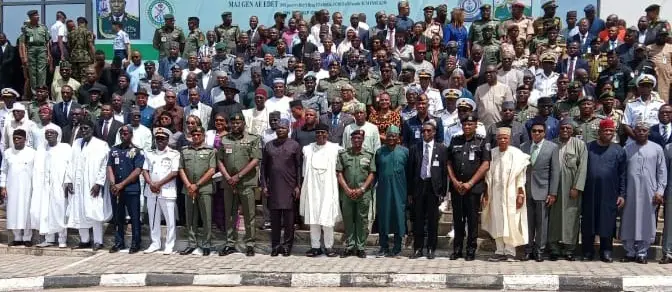
News Investigators/ The Minister of Defence, Christopher Musa, has emphasised the importance of a unified and coherent doctrinal framework in addressing the country’s complex security challenges.
Mr Musa made this known, while declaring open the Chief of Defence Staff inaugural lecture for the newly established Joint Doctrine and Warfare Centre in Abuja.
The News Agency of Nigeria (NAN) reports that the lecture is titled: “Evolving Armed forces of Nigeria Doctrine to meet Security Challenges in a Multi-domain and Joint Environment”.
The minister noted that the nation’s security environment was complex and evolving, with asymmetric threats, transnational criminal networks, and terrorism.
Mr Musa said the establishment of the Joint Doctrine and Warfare Centre reflected the Armed Forces of Nigeria’s commitment to strengthening national defence architecture through doctrine-driven operations.
He noted that no security service could operate in isolation, and that jointness was key to achieving operational success.
“In today’s complex and evolving security environment, characterised by asymmetric threats, transnational criminal networks, terrorism and emerging multi-domain challenges, the need for a unified, coherent and responsive doctrinal framework has become more critical than ever.
“I’m sure we can all attest to this, following what is going on in the world. Now robots, machines and drones are taking centre stage in warfare.
“How do we correlate this together to what we are doing? How prepared are we? When human beings start fighting robots? What happens?” The minister asked.
According to him, Nigeria’s current security environment further exemplifies that no security service can operate in isolation, adding that it is of great interest to see other paramilitary agencies at the event.
“It is important that we must work together as a nation. The Army secures the ground, the Navy guards our waterways, and the Air Force provides the indispensable air power.
“Other security agencies also play their vital role, including the citizens, who somehow are the fluid in which the terrorists, the bandits, the criminals flow in.
“However, the synergy that turns this individual strength into a single overwhelming force is found in jointness,” Mr Musa said.
The minister noted that the joint doctrine and warfare centre signified Nigeria’s determination to institutionalising “the way we think, plan, and fight as a unified force.”
Mr Musa noted that the Joint Doctrine and Warfare Centre would foster an environment of continuous learning, critical thinking, and inter-service dialogue.
He emphasised that effective joint doctrine serves as the intellectual foundation upon which interoperability, coordination, and operational success are built.
The minister commended President Bola Tinubu for his support to the Armed Forces of Nigeria and his commitment to strengthening national security architecture.
He commended the Chief of Defense Staff for his vision and leadership in sustaining and enhancing the operationalisation of the Joint Doctrine and Warfare Centre.
Mr Musa appealed to Nigerians to appreciate and support the armed forces and other security agencies for their sacrifices.
He emphasised that together Nigerians were stronger and could overcome the country’s security challenges.
The Chief of Defence Staff, Gen. Olufemi Oluyede, in his presentation also corroborated the minister on the need for a joint doctrine to address the country’s security challenges.
Oluyede noted that the country faced a series of challenges and needed a unified approach to secure.
He assured that the defence leadership would drive the joint doctrine initiative to make it robust and effective.
While highlighting the importance of border security, which he said was a key area that required attention, he stressed the need to enhance the competencies of all security agencies and services to achieve jointness.
The defence chief noted that the concept of jointness was not new, but it required a structured approach to make it effective.
He cited the example of the super-component deployed in the Northeast, which was evaluated and showed the need for joint operations.
Oluyede emphasised the importance of Operation Safe Corridor, a rehabilitation programme for repentant terrorists, and appealed for support from the National Assembly.
He noted that procurement was a challenge and advocated for joint procurement and indigenous production of defence equipment.
Oluyede underscored the need to change the perception of doctrine from an academic exercise to a practical tool for operations.
He noted that finance was a challenge, but the Commander-in-Chief had given approval for some initiatives.
The Director-General of the Joint Doctrine and Warfare Centre, Maj.-Gen Effiong Edet, highlighted the centre’s efforts to develop and promote joint doctrine for multi-domain operations.
Edet noted that the centre was established to coordinate and formulate joint doctrines that underpin interoperability in the Armed Forces of Nigeria.
The director-general said the centre’s founding mission was to enable the Army, Navy, and Air Force to plan, train, and fight as one divisible joint force.
Edet noted that Nigeria’s threats had evolved beyond traditional domains, citing the deployment of weaponized drones and violent incidents, emphasising that doctrine development was a strategic defense imperative, not an academic luxury.
According to him, the centre is working to strengthen efforts to move from doctrine discussion to doctrine delivery and adoption.
Edet highlighted the centre’s achievements, including fine-tuning its structure, establishing functional departments, and visiting defence headquarters and war colleges.
He noted that the centre had also collaborated with think tanks, regional partners, and international organizations.
The director-general mentioned that a four-day capacity building and regional doctrine workshop was held, drawing participation from several West African countries.
He said the centre would present a joint defence doctrine and selection roadmap for the Air Force of Nigeria.
NAN