
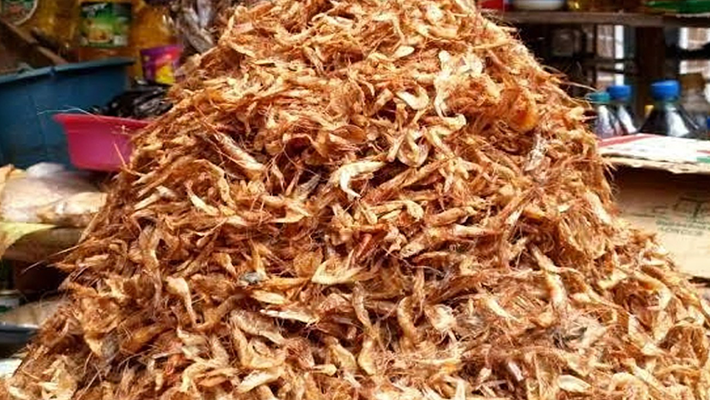
News Investigators/ Rising crayfish prices in Lagos are putting pressure on household budgets and affecting traders, as persistent scarcity and high transportation costs continue to drive up prices across major markets.
A market survey by the News Agency of Nigeria (NAN) on Friday showed that consumers and traders alike were struggling to cope with the sustained increase in the cost of the popular food ingredient.
NAN reports that crayfish remains a staple in many Nigerian homes because of its distinctive flavour in soups and traditional dishes.
However, limited supply from riverine communities in Bayelsa, Rivers and Cross River, coupled with rising logistics costs, has kept prices high since 2025.
At Oyingbo Market, traders said supply had remained inconsistent for months, forcing many sellers to increase prices and reduce stock.
A trader, Mrs Busayo Oladimeji, said the irregular supply of crayfish from producing areas was affecting both availability and quality.
“Sometimes, the quantity we receive cannot even meet customer demand.
“When supply is low, prices will definitely rise, and during the off-season, the crayfish is not usually as fresh as what we get during peak periods,” she said.
Oladimeji added that transportation costs had worsened the situation.
“The cost of moving goods from the South-South to Lagos has increased because of fuel and logistics challenges.
“A paint bucket now sells between N12,500 and N14,000, and prices can still change at any time,” she said.
NAN reports that in 2025, a paint bucket of crayfish sold for between N4,000 and N5,000 before rising sharply to between N12,500 and N14,000.
A full bag, which previously sold for about N40,000, now sells for between N75,000 and N80,000, while a derica cup has increased from about N1,000 to as much as N4,000 in some markets.
A wholesaler, Mr Chukwudi Eze, blamed the activities of middlemen for the persistent increase in retail prices.
“Before the crayfish gets to us, it passes through several hands, and everybody adds profit.
“By the time it reaches the final consumer, the price becomes much higher,” he said.
Eze said fluctuating prices and fear of spoilage had also forced some traders to reduce the quantity they purchase.
At Lawanson Market, another trader, Mrs Ebere Chiapko, said quality also played a major role in determining prices.
“I sell Oron crayfish, and a paint bucket goes for N16,500 because the quality is better.
“You cannot get original Oron crayfish for less than N15,000,” she said.
She warned buyers against traders using undersized paint buckets, popularly known as “magic buckets”, to shortchange customers.
On the consumer side, residents said the continuous increase in crayfish prices was making meal planning more difficult.
An entrepreneur, Mrs Fumilayo Davies, said feeding expenses had become unpredictable.
“One week you buy crayfish, and the next week the price has gone up again.
“It is becoming difficult for families to properly plan their food budget,” she said.
Another resident, Mrs Ebele Okafor, said she had resorted to bulk buying whenever prices dropped during the harvest season.
“When prices are lower, I buy in large quantities and store them in my freezer.
“That helps me manage whenever prices increase again,” she said.
Similarly, Mrs Tiwatope Ariyo, a resident of Surulere, said she had reduced her crayfish consumption because of the high cost.
“I now use it sparingly and combine it with other ingredients to make it last longer.
“But honestly, nothing gives food that same taste like crayfish,” she said.
NAN