
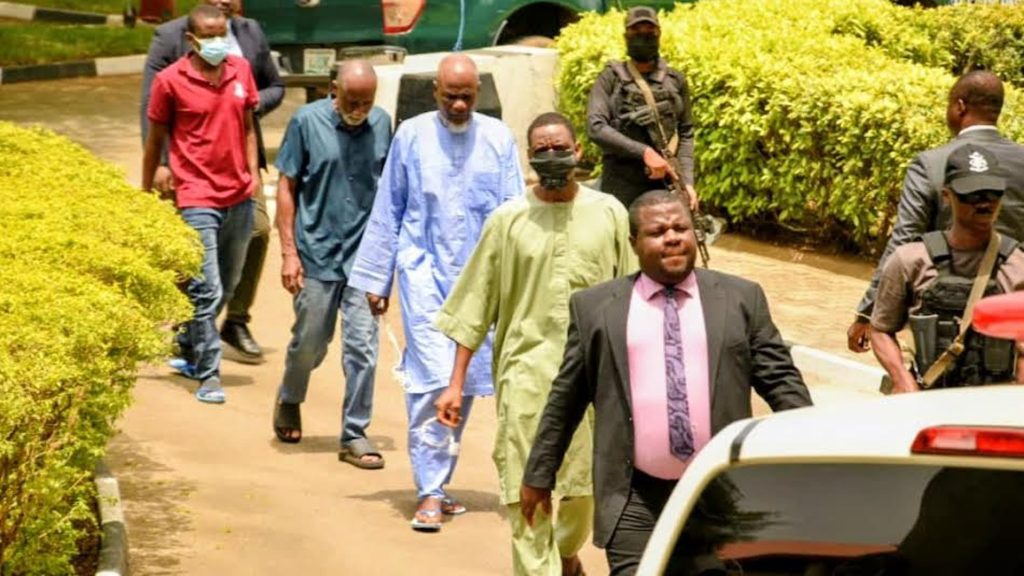
News Investigators/ The Federal High Court in Abuja on Thursday admitted all evidence tendered by the Federal Government against six suspected coup plotters.
Justice Joyce Abdulmalik, in a ruling after a trial-within-trial, agreed with the prosecution’s arguments that, from the audio visual recordings of the extra-judicial statements the defendants made, there was no evidence of torture or oppression as claimed by them.
The judge, who discountenanced all objections of doubts and claims of involuntariness in the recording of the confessional statements, said that from the video recordings, the defendants appeared calm and unruffled.
The judge disagreed with the submissions of the defence that a lawyer must be present while taking the confessional statement of defendants in line with the Administration of Criminal Justice Act (ACJA), 2015.
Citing provisions of the Evidence Act, 2011 and a previous Supreme Court decision to back her ruling, Justice Abdulmalik held that, contrary to the defence arguments, where an audio visual recording of a statement is made by a defendant, and it is proven that there was no element of involuntariness in its making despite lawyer’s absence, such statement will be admissible in evidence in trial.
According to the judge, in criminal trial, the Evidence Act takes precedence over ACJA.
“I discountenance all objections of doubt. Therefore, all the audio visual recordings were voluntarily recorded and I found no involuntariness in the exercise,” she declared.
The judge, who dismissed the argument of prolonged custody raised by the defence lawyers, also rejected the 6th defendant’s claim that there was no interpreter at the time as his confession was recorded in Hausa Language.
She also noted that the audio visual recordings of 1st prosecution witness (PW-1) to PW-4 tallied as there was no evidence of torture in the taking of the defendants’ statements.
“The defendants failed to substantiate the allegations of oppression,” she ruled.
Justice Abdulmalik consequently admitted in evidence all the defendants’ extra-judicial statements, including the audio-visual recording, the certificates of compliance, flash drives, external drive from Special Investigation Panel, and the accompanying certificate of compliance. She marked them as exhibits accordingly.
The judge adjourned the matter until Dec. 7 and Dec. 10 at 12 noon, for continuation of trial.
The News Agency of Nigeria (NAN) reports that the judge had, on Sept. 30, adjourned for ruling after counsel for the prosecution, Maryam Okorie, and lawyers to the defendants adopted their final written addresses and presented their arguments for and against the application.
The Federal Government, through the Office of the Attorney-General of Federation (AGF), had, on April 22, arraigned the six defendants on 13-count charge.
The charge, marked: FHC/ABJ/CR/206/2026, was filed on April 20 by the Director, Public Prosecutions of the Federation, Rotimi Oyedepo, SAN.
The defendants are retired Maj.-Gen. Mohammed Gana, retired Navy Capt. Erasmus Victor, Insp Ahmed Ibrahim, Zekeri Umoru, Bukar Goni and Abdulkadir Sani as 1st to 6th defendants respectively.
The former Minister of State for Petroleum Resources, Timipre Sylva, who is alleged to be part of the act, is listed as being at large.
The defendants were accused of offences ranging from treason and terrorism to failure to disclose security intelligence and money laundering linked to terrorism financing.
Justice Abdulmalik had, on May 11, ordered the trial-within-trial after defence lawyers objected to the admissibility of the statements and video recordings the prosecution sought to tender.
They argued that the statements were not made voluntarily.
The objection was after the prosecution had called four witnesses.
The 4th prosecution witness (PW-4), an army officer identified by the codename “AAA” for security reasons, is yet to be discharged from the witness box.
The PW-4 tendered video recordings of the defendants’ interrogations before the trial-within-trial began.
The Federal Government, however, closed its case in the trial-within-trial on 23 June, after which the defendants began opening their defence on 25 June.
Following the conclusion of their defence, the judge fixed Sept. 30 for the adoption of their written addresses.
It would be recalled that Zekeri Umoru, the 4th defendant, on May 20, told the court that discussions were held on switching off electricity supply to the Presidential Villa, Abuja, to aid the alleged coup.
Umoru, a Julius Berger Nigeria Plc employee in the Maintenance Department at the Presidential Villa, spoke in a video evidence played before Justice Abdulmalik.
The defendant said he warned that such an action would immediately trigger investigations and the detention of workers on duty if such action was carried out.
He alleged that Col. Mohammed Ma’aji, the alleged coup mastermind, offered him money, through Insp Ahmed Ibrahim, the 3rd defendant, to recruit between 18 and 19 persons working inside the Villa.
Umoru said those to recruit include soldiers, officials of the Department of State Services (DSS) and Julius Berger staff.
He also told the investigators that Ma’aji allegedly said he wanted access into the Presidential Villa and could achieve it “with force,” even if those recruited from inside decline to cooperate.
The 4th defendant stated this, in the video, while being questioned by some members of the Special Investigative Panel (SIP) that first investigated the case.
Also, Sheikh Sani Abdulkadir, an Islamic cleric and the 6th defendant in the ongoing trial, said in the video evidence that he warned the co-suspects that the plan would fail and that they would eventually be exposed.
Abdulkadir, a Zaria-based Imam, said he was informed about the plot and recruited to pray against the leakage of information about the activities of those behind it.
NAN