
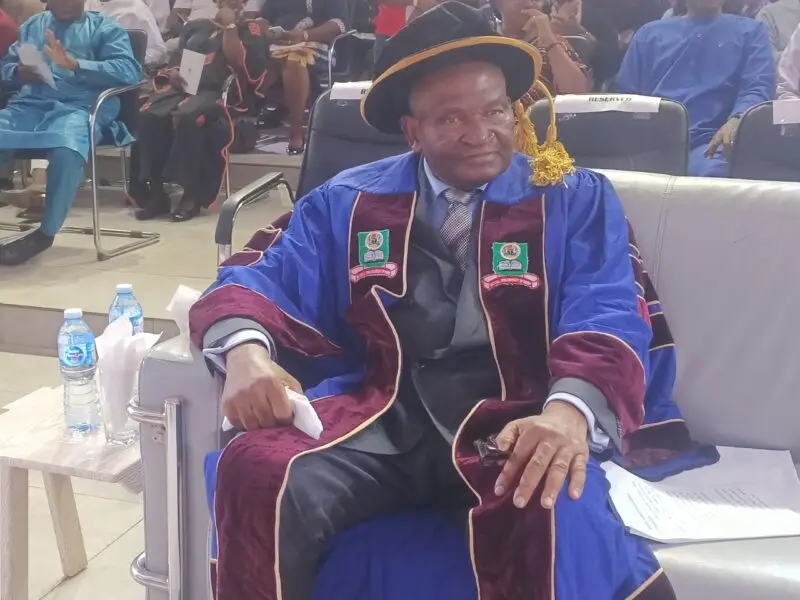
News Investigators/ A former Attorney-General of the Federation, Kanu Agabi, has called for the establishment of a ‘National Integration Commission’ to help propose and implement measures for national integration.
Mr Agabi made the call while delivering a convocation lecture at the National Open University of Nigeria (NOUN) in Abuja.
He said the country would not tackle corruption effectively without first addressing the appointment of incompetent people to high offices.
The News Agency of Nigeria (NAN) reports that the lecture with the theme: “Nigeria Against Corruption,” served as a prelude to the convocation which saw the institution award various qualifications to 24,575 graduands.
“Appointment of incompetent people into high offices has been aggravated by lack of national integration, and the establishment of a National Integration Commission will address disunity and insecurity,” Mr Agabi said.
He noted that the nation was not sufficiently integrated and as such would continue to have security and corruption challenges.
Mr Agabi also called for urgent reforms in Nigeria’s education system, stressing that the fight against corruption must begin with the kind of values imparted to young people.
He said sweeping reforms were needed in the country’s education system and governance structure, stressing that the fight against corruption must be rooted in self-reliance, ethical leadership and institutional integrity.
“The current system promotes elitism and alienates graduates from their communities; universities must combine intellectual training with practical skills to make students productive and relevant to national development.
“Nigeria’s lack of self-reliance is closely tied to its educational deficiencies, while overdependence on foreign goods and blind commitment to globalisation have weakened the nation’s economic base,” he said.
According to him, a country with little to export has no justification for keeping its borders open to imported goods it can produce locally, as true self-reliance requires sacrifice and discipline rather than consumption of foreign luxuries.
Mr Agabi also traced Nigeria’s governance challenges to a history of military interventions, which he said entrenched a culture of dictatorship and normalised the use of force in acquiring power.
He noted that the legacy of unconstitutional rule had influenced present-day political behaviour, including electoral malpractice, as politicians continue to adopt “inferior methods” to gain office.
He also decried the erosion of traditional values, particularly the decline of the village system, which he described as a critical cultural institution that once fostered morality, accountability and self-reliance.
He said the breakdown of that structure had contributed to the rise of urban slums and social vices, adding that Nigeria must rediscover and teach the values that sustained earlier generations.
On governance, Mr Agabi highlighted persistent conflicts between the executive and legislative arms, warning that the failure to observe the principle of separation of powers had contributed to corruption.
He criticised the overreach of legislatures through oversight functions, arguing that lawmaking bodies should not encroach on executive responsibilities such as implementation, investigation and prosecution.
According to him, both executive and legislative excesses pose risks to democracy, stressing that each arm of government must operate within constitutional limits to ensure accountability and good governance.
Mr Agabi reiterated the need for free and fair elections and reduction in the high stakes of political office.
He also called for a review of the immunity clause protecting top public office holders, maintaining that no individual should be above the law.
In spite of the challenges, Mr Agabi expressed optimism about Nigeria’s future, urging citizens and leaders alike to embrace sacrifice, self-reliance and moral responsibility as pathways to national renewal.
NAN