
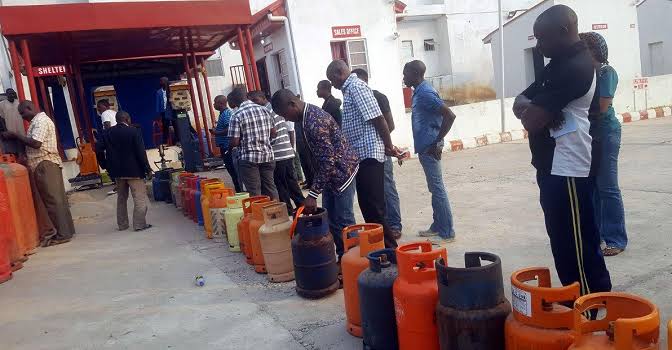
News Investigators/ Residents of FCT have expressed relief over the slight reduction in the price of cooking gas, urging that the downward trend be sustained to ease the burden on households.
The residents, who spoke with the News Agency of Nigeria (NAN) in Abuja on Sunday, said a continued decline in prices would improve access to clean cooking fuel and reduce pressure on family incomes.
NAN reports that cooking gas is currently selling for between N1,498 and N1,650 per kg across the FCT, depending on the location and retail outlet, although some roadside vendors still sell as high as N1,850 per kg.
The development follows months of price increases across the country, during which cooking gas also known as Liquefied Petroleum Gas (LPG) was sold for as high as N2,000 per kg.
This increased the cost of refilling a 5kg cylinder to about N10,000 and a 12.5kg cylinder to about N25,000.
NAN reports that the high prices have forced many households to reduce their consumption or resort to alternative cooking fuels, such as charcoal and firewood.
Mrs Bidemi Ajao, a civil servant, described the reduction as a welcome development.
“I refilled my cylinder on Saturday at N1,498 per kg at NIPCO compared to a few weeks ago when I refilled at N1,650 per kg.
“It may not be a huge drop, but it is a relief for families already struggling with the high cost of living. I plead with the government to sustain this decrease,” she said.
Mrs Joyce Asuquo, a public servant, said the reduction should be sustained to encourage more households to continue using cooking gas.
“Many people switched to charcoal because of the high cost of gas. If prices continue to fall, more families will return to using cooking gas, which is cleaner and safer,” she said.
Mr Joseph Bassey, a businessman, said lower cooking gas prices would enable families to redirect part of their income to other essential needs.
“Every little reduction counts. We hope the government and marketers will ensure prices become more stable and affordable,” he said.
Also speaking, Mr Ahmed Attah, a civil servant, urged that the price reduction should be reflected across all retail outlets in the FCT.
“Some gas outlets have reduced their prices, but others are still selling at very high rates. We want the reduction to be felt everywhere in the city,” he said.
Mrs Victoria Cheta, a teacher, said the price reduction was commendable, but it was not significant enough considering the prevailing cost of living in the country.
“Nigerians are still struggling with low purchasing power, our income is not sufficient to meet our daily needs. The cost of transportation, food, healthcare, education, and rent has all gone up.
“ The government must commit to its Renewed Hope Agenda and ease the sufferings of Nigerians. Making cooking gas very affordable to as low as N500 per kg will be a step in the right direction,” she said.
A manager at one of the retail outlets, Khalifa Abdul told NAN that prices were expected to decline further in the coming weeks as supply improves.
According to him, improved product availability will help moderate prices across the retail market.
Experts had attributed the recent surge in LPG prices to geo-political tensions in the Middle East, high transportation costs and infrastructure gaps within the domestic supply chain.
NAN recalls that in response to rising cooking gas prices, the Federal Government on June 22 directed a clampdown on marketers engaged in the hoarding or diversion of LPG.
The Minister of State for Petroleum Resources (Gas), Mr Ekperikpe Ekpo, issued the directive during an emergency stakeholders’ engagement on rising LPG prices after deliberations with regulators, producers, marketers and other industry players.
Ekpo directed the Nigerian Midstream and Downstream Petroleum Regulatory Authority (NMDPRA), other regulators and security agencies to intensify market surveillance, investigate product hoarding and diversion, and sanction operators found manipulating the market.
He said the Federal Government remained committed to increasing domestic supply, reducing reliance on imports and ensuring that locally produced LPG was prioritised for domestic consumption.
The minister added that the government was exploring a local LPG blending initiative involving the Nigeria LNG Ltd., local producers and the Port Harcourt plant operator to reduce logistics costs, improve supply reliability and support more stable prices.
The NMDPRA at the meeting also identified global supply disruptions and price volatility arising from the Israel-Iran conflict as major factors driving LPG prices upward.
The authority further attributed the situation to inadequate domestication of local LPG production, low import volumes, non-cost-reflective pricing by some wholesalers and retailers, poor distribution infrastructure and logistics challenges.
NAN