
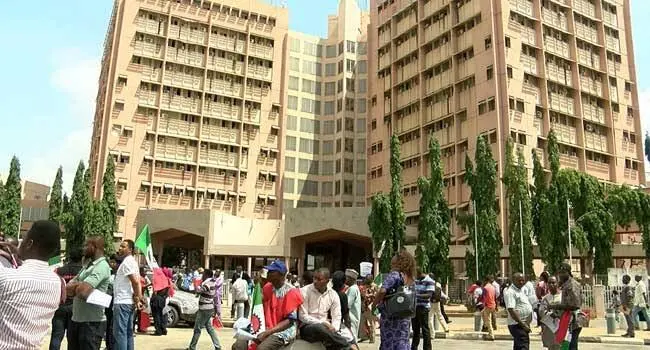
News Investigators/ Many Federal Government workers have continued to express concern about the high-income taxes that are being deducted deducted from their salaries monthly through the Pay as You Earn (PAYE) model.
The civil servants, who spoke to the News Agency of Nigeria (NAN) on Sunday in Abuja, said that it was frustrating given the country’s current economic situation.
They demanded an immediate reduction in the PAYE tax deducted from their monthly salaries.
They said that the huge amount of tax deducted from their monthly salaries had reduced their purchasing power due to the increasing prices of goods and services.
Mrs Erica Eniola, a civil servant, urged the Federal Government to revisit the issue of income tax, which had placed a huge burden on the finances of civil servants.
She said that the new minimum wage had not substantially improved the monthly earnings of government workers, yet the taxes remain high.
“Imagine a level 15 officer with a monthly salary of less than N400, 000 paying almost about N60, 000 tax. It is alarming.
“In spite of huge taxes deducted from salaries on a monthly basis, the government workers still pay Value Added Tax (VAT), and other forms of taxes on certain goods and services, making it multiple taxation.”
Mr Ibrahim Abbas, a pharmacist, complained that policies of the Federal Government appeared to be designed against federal civil servants.
Abbas said that the idea of deducting income tax from the monthly salaries of health workers and still taxing their call allowances was unfair.
He urged the Federal Government to urgently revisit the issue of taxes civil servants pay and also initiate policies to improve their welfare.
“I do not even see any reason to justify the high tax regime that we are subjected to in recent times.
“While we were expecting improvement in our welfare, every policy from removal of fuel subsidy to floating of the Naira appears to be against government workers.
“The Federal Government will need to take a second look at this issue of high taxes,” he said.
Mr Aliu Sule complained that there was no infrastructure on ground to justify the huge taxes being deducted from salaries of civil servants.
“We still provide most necessities for ourselves. From security to electricity and water, we devise ways to provide all these for our- selves, so there is no justification to increase our taxes,” he said.
Meanwhile, the Federal Government has begun a six-week review of Nigeria’s tax reforms to address implementation gaps, ambiguities and unintended consequences.
The exercise will review key areas of the tax regime, including VAT thresholds, withholding tax, capital gains treatment and multiple taxation, with recommendations expected to form part of the Finance Bill 2027.
The Minister of Finance and Coordinating Minister of the Economy, Taiwo Oyedele, said this in Abuja recently, while inaugurating the Technical Subcommittee on Fiscal Policy and Tax Reforms.
Oyedele, who is also the Chairman, Presidential Fiscal Policy and Tax Reforms Committee, said the implementation of the new laws had exposed areas requiring clarification, refinement and further reforms.
According to him, the real test begins when the law meets the economy, as businesses interpret it, administrators implement it, investors respond to it, and citizens experience it.
“Implementation inevitably reveals areas requiring clarification, refinement or further reform,” he said.
Oyedele said the government was moving from fundamental reforms to continuous improvement, stressing that the latest exercise was not intended to reverse the 2025 reforms but to address problems identified during implementation.
Also, public servants under the aegis of the Joint National Public Service Negotiating Council (JNPSNC) began a three-day warning strike on Friday.
They urged the Federal Government to slash the price of petrol to N500 and approve a new wage award for workers.
In a statement, Gbenga Olowoyo, the National Secretary of (JNPSNC), said the council had mobilised workers to embark on the industrial action because President Bola Tinubu failed to announce a drastic cut in petrol price.
Olowoyo, who is also the General Secretary of the Nigeria Civil Service Union (NCSU, said that Tinubu also failed to announce a new national minimum wage in his Independence Day speech.
“The critical issues requiring urgent attention are reduction of fuel price to N500 per litre, and approval of a wage award for Nigerian workers to cushion the effects of the prevailing harsh economic conditions.” he said.
NAN