
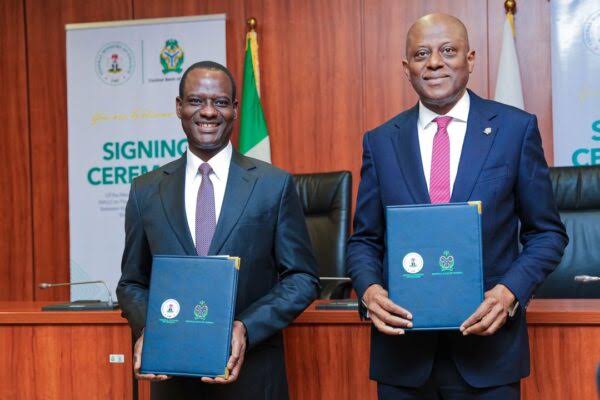
News Investigators/ The Central of Nigeria (CBN) and the Federal Ministry of Finance, on Friday in Abuja signed a Memorandum of Understanding (MoU) to improve Fiscal-Monetary Policy Coordination.
The Governor the CBN, Olayemi Cardoso, said that the occasion marked a significant milestone in Nigeria’s pursuit of stronger macroeconomic management, lasting economic stability, and sustainable prosperity for all Nigerians.
According to Mr Cardoso, beyond the signing of a document, it represents a shared commitment to deepening collaboration in the interests of Nigeria’s economy and the Nigerian people.
“Fiscal and monetary policies remain two important and confidential instruments for the management of a modern economy.
“Fiscal policy influences economic activity through government expenditure, taxation, and borrowing decisions, monetary policy promotes price stability and financial system soundness through the management of liquidity, interest rates, and monetary conditions.
“When these policies work together in harmony, their combined impact is far greater than their individual efforts,” he said.
Mr Cardoso said that MoU did not create a new relationship between both institutions.
According to him, the CBN and the Federal Ministry of Finance have worked together for decades in addressing critical macroeconomic issues.
This he said included inflation management, debt sustainability, budget financing, exchange rate stability, economic reform programmes, and responses to domestic and global shocks.
“That long-standing partnership has served our country well, helping Nigeria navigate periods of both talent and opportunity. What distinguishes today’s event is the formal institutionalisation of that collaboration.
“This memorandum provides for a structured framework for regular consultation, information exchange, and policy coordination,” he said.
Mr Cardoso said that the MoU would strengthen collaboration in critical areas such as government cash management, debt issuance planning, liquidity forecasting, macroeconomic analysis, and periodic policy consultations.
He said that it would, thus, enhance policy coherence and the effectiveness of economic management.
“It transforms a relationship built on practise into one anchored by clear processes and enduring institutional commitments.
“By establishing predictable mechanisms for engagement, the framework will improve the ability to respond effectively to emerging economic challenges.
“The timing of this agreement is particularly noteworthy, as the CBN advances its transition towards an inflation-targeting framework.
“Across the world, the success of inflation targeting is known to rest not only on the effectiveness of monetary policy, but also on the existence of a supportive fiscall environment.
“The MoU will also provide the foundation for developing the operational framework that will guide its implementation,” he said.
The Minister of Finance and Coordinating Minister of the Economy, Taiwo Oyedele, said the MoU represented the determination to institutionalise coordination between fiscal and monetary policies.
According to Mr Oyedele, the coordination is not presented as a function of personalities, but by design, supported by clear structure, data, and accountability.
“Good economic management requires independent institutions, but independence does not mean isolation.
“Fiscal and monetary authorities have distinct mandates, but we serve the same economy.
“Government borrowing affects liquidity and interest rates. Monetary policy affects the government’s financing costs. Tariffs and exchange rates affect prices and revenue.
“Spending affects demand. agricultural quality affects food inflation. So, our mandates are distinct, but our outcomes are interconnected,” he said.
The minister said that both the CBN and the finance ministry were institutionalising coordination.
“We are not starting from scratch. We already have the economic management team, the National Economic Council, and linkages between the ministry and the apex bank.”
Muhammad Abdullahi, the Deputy Governor, Corporate Services of the CBN, said that the MoU marked a significant step in the long-standing partnership between both institutions.
Mr Abdullahi said that the ministry of finance and the CBN had worked closely over the years.
He said that the agreement now provided a clearer, more structured, and durable basis for sustainable development.
“At its heart is a simple and increasingly important principle.
” Fiscal and monetary policy have distinct mandates and instruments, but they operate within the same economy and most often respond to the same shocks.
“There could hardly be a more timely illustration than the developments currently unfolding in the Middle East.
Disruptions to critical energy and shipping routes can affect oil prices, greater insurance costs, global inflation expectations, and international financing conditions.
“For Nigeria, the effects can move in different directions at the same time. As an oil-producing country, higher food prices may improve export earnings, government revenues, and foreign exchange inflows,” he said.
He, however, said that higher energy, greater insurance costs could also feed into domestic prices while renewed global inflationary pressures could affect interest rates, capital flows, and financing conditions.
“In other words, one external shock can arrive simultaneously at the doors of fiscal and monetary policy.
“The fiscal authorities must assess the implications for revenue, expenditure, financing, and debt. The monetary authorities must assess the implications for inflation, liquidity, foreign exchange reserves, and financial conditions,” he said.
NAN