
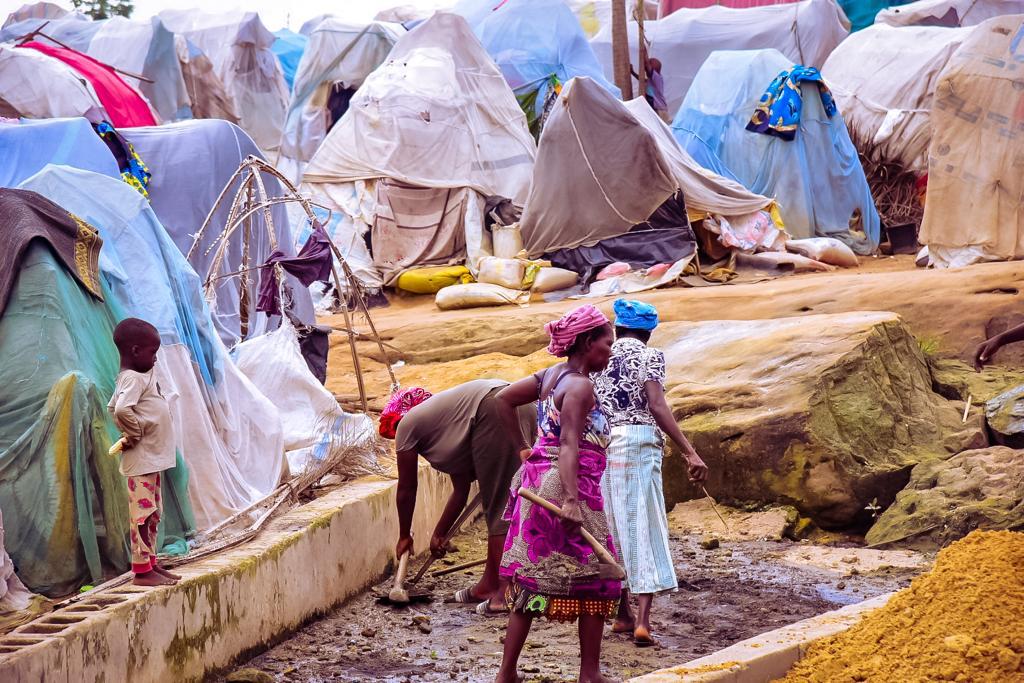
News Investigators/ Internally Displaced Persons (IDPs) in Benue have decried irregular food distribution, poor shelter, inadequate healthcare and limited livelihood opportunities in camps.
They said the challenges persisted in spite of interventions by government and humanitarian organisations.
A camp leader, who spoke to journalists anonymously on Sunday at one of the camps, said some displaced persons had gone more than five months without food assistance, leaving many struggling to meet their basic needs.
The source said the prolonged gaps in food distribution had heightened concerns among residents, who depended largely on government support, humanitarian organisations and individual donations.
According to the camp leader, recent food distributions by the Benue State Emergency Management Agency (SEMA) were insufficient to meet the needs of the displaced population.
He also identified deteriorating tents, inadequate sanitation facilities and shortages of essential medicines as major challenges confronting residents.
He said the camp clinic, established with support from the UN Children’s Fund (UNICEF), faced drug shortages, sometimes forcing patients to seek treatment elsewhere.
The source, however, commended the UN Population Fund (UNFPA) for supporting maternal healthcare and assisting pregnant and breastfeeding women.
He called for sustainable livelihood programmes, noting that skills-acquisition training had limited benefits without equipment, start-up capital and other practical support.
The camp leader said the major aspiration of displaced persons was to return safely to their ancestral communities, but persistent insecurity continued to prevent many from returning home permanently.
He also expressed concern about perceived disparities in humanitarian assistance among camps, calling for more equitable access to food, healthcare, protection and other interventions.
On protection, he said some cases of sexual and gender-based violence might go unreported because victims feared stigma or were reluctant to disclose their experiences.
He said camp security personnel and volunteers monitored activities and referred reported incidents to relevant authorities, including the police.
At the International Market IDP Camp in Makurdi, which accommodates survivors of the June 13, 2025 attack on Yelwata community, residents also face shortages of basic amenities.
The camp currently lacks a clinic and school, among other essential facilities, although a market operates within the settlement.
Responding to the concerns, the Executive Secretary of SEMA, James Iorpuu, said the agency continued to provide food, healthcare, education, protection and resettlement support despite financial and logistical constraints.
Mr Iorpuu said the agency’s food distribution capacity had declined in September, with fewer than 2,000 bags of rice available for distribution, compared with its usual monthly allocation of more than 4,000 bags.
He said SEMA provided assistance to IDPs monthly but acknowledged that the interventions did not meet all their needs.
Mr Iorpuu added that the agency’s interventions extended beyond food distribution, disclosing that it spent more than N160 million on snakebite treatment and related hospital expenses for displaced persons between March and September.
He also said SEMA had trained 248 community reporters to provide timely information on security incidents and protection concerns in IDP camps and host communities.
On education, Mr Iorpuu said 163 displaced children had enrolled in schools through an education-related intervention, with the agency providing mobilisation and transportation support.
He disputed claims that a planned protest by IDPs was driven by food shortages, alleging that some individuals had encouraged the demonstration over restrictions on visits to the camps.
Mr Iorpuu added that SEMA had relocated displaced persons occupying school buildings in Naka to a designated settlement area to improve their living conditions and ease pressure on educational facilities.
On resettlement, he said the agency was working with humanitarian partners, including the UN High Commissioner for Refugees (UNHCR), to provide settlement facilities and healthcare infrastructure.
He said about 110 displaced persons had been moved to an area identified as Akile, where they were expected to receive shelter and engage in farming to rebuild their livelihoods.
Mr Iorpuu further said about 288 hectares of land had reportedly been provided by the state government for resettlement.
According to him, the initiatives were intended to decongest camps, promote self-reliance and facilitate the eventual return of displaced persons to their ancestral communities when security conditions permitted.
The News Agency of Nigeria (NAN) reports that the UNHCR estimates that Benue is home to at least 500,000 internally displaced persons, out of Nigeria’s 3.68 million displaced population as of Oct. 1.
NAN