
By Abdullahi Mohammed, News Agency of Nigeria (NAN)
As of early 2026, the number of Internally Displaced Persons (IDPs) in Nigeria is estimated at 3.5 million to 4.5 million.
This displacement is primarily driven by conflict, banditry, climate-related disasters and Boko Haram attacks in the North-Central, North-West and North-East with Borno having more than 127,000 refugees in Cameroon.
However, available statistics early this year also indicate that more than 70,000 former refugees of Borno origin in Cameroon have returned to their communities thanks to the efforts of Gov. Babagana Zulum, the Federal Government and the United Nations High Commissioner for Refugees (UNHCR).
While the UN Refugee Agency points out that repatriation must be voluntary to be legitimate, the UNHCR recognises the assessment of such volunteering as an ‘overriding priority’.
In Dec. 8, 2025, the Zulum-led administration made a pledge at Minawao Refugee Camp in Cameroon to assist the refugees currently at the camps on voluntary conditions to return to Nigeria in a safe and dignified way.
Unfortunately, a number of them turned down Zulum’s gesture; only 3,123 elected to return to Nigeria voluntarily, out of more than 50,000.
Those that returned were assisted in cash and kind by the governor, the Federal Government and the UNHCR Cameroon as well as the UNHCR Nigeria.
The repatriation was spearheaded by the technical working group, a group that came into being under the tripartite agreement between Nigeria, Cameroon and the UNHCR.
The repatriation from Cameroon to Nigeria started from Jan. 27 to Feb. 5, in five batches.
Rudacogora Monique, the Head of Sub-Office of the UNHCR in Maroua, Cameroon confirmed that all the 3,123 refugees had made their decision to be repatriated voluntarily without any duress whatsoever.
Mr Lawan Wakilbe, the Chairman of Borno’s Sub-Committee on Repatriation, and a member of the technical working group, said the exercise was the fourth time repatriation had been carried out under the state-coordinated arrangements since 2020.
He said that those who had been repatriated since 2020 from Cameroon to Banki in their hundreds had already been stabilised.
According to him, they are living in peace and harmony with assured food security, potable water, good schools and better healthcare services, among other basic amenities provided by the state government.
Abdullahi Dan Jatau, an All Progressives Congress (APC) chieftain in Gwoza, also corroborated Wakilbe’s claims.
Jatau said the population of returnees from nine communities in Gwoza had been engaged in farming activities while enjoying other basic amenities such as schools and healthcare services, among others.
“The 3,123 returnees were also supported by the Federal Government’s officials in the same manner with food items and building materials, while the UNHCR Cameroon gave each returnee 200 dollars cash gifts in addition to the provision of fuel for the whole vehicles that transported the returnees including the attached official vehicles from Cameroon to Nigeria.”
Zulum, through Wakilbe’s subcommittee also provided more than 2,000 emergency accommodations to individuals who returned to various communities around Bama.
The committee also provided 452 units of two-bedroom houses built by the UNHCR Nigeria for the returnees in Banki which were occupied by the 450 households comprising 2,772 returnees, among other logistics support by the UN Refugee Agency in Nigeria worth N60 million.
In addition, a N100, 000 cash gift was given to each head of household, while the governor’s wife gave an additional N20, 000 cash gift each.
Observers said all these were possible because Zulum was seriously concerned about the stability of his people who fled to Cameroon from Central and Southern Borno and had willingly returned home after surviving the Boko Haram’s attacks of 2014.
“Of the 486 households, 22 of them who have no accommodation were also given N500, 000 cash gifts to each to rent a house and N50, 000 cash gifts for each of their wives by the state government.
“All those returning to Gwoza who don’t have houses, the governor has given N500,000 to every household’s head and N50,000 to their wives in addition to the returning package that the Federal Government has given.”
Wakilbe, while addressing the returnees in Pulka, Banki and Bama, admitted that “certain things were in the hands of God,” insisting that “there is tranquillity in the locations where the returnees were resettled.”
Surprisingly, one of the returnees, who had a wrong notion against the repatriation arrangements from the beginning, was speechless after seeing all the promises fulfilled by Zulum on arrival at Pulka.
Dawa Adam-Ibrahim, a middle-aged man, from the Atagara community in Eastern Gwoza, admitted that the repatriation was indeed conducted in the best interest of the returnees.
“Honestly, I am happy; this is not what I expected. I was assuming it was just a deception but when everything unfolded, I realised that the tripartite agreement has been fulfilled in such a manner that I am happy with it and satisfied.
“As a refugee, people must be repatriated back to their country voluntarily in a way that the government of their country of origin, the host country and the UNHCR would now come together to make a tripartite agreement to ensure the safety and dignity of the return of the refugees.
“I have seen clearly that there is no sign of deception. However, I must point out certain lapses; we should not have hidden what occurred. In the future, those who come after us must ensure these gaps are filled.”
Adam-Ibrahim, who was also appointed the camp leader on arrival at Pulka had further confession.
“We preferred identity over exile. Do you know why? Because identity is everything; it is where we belong. We are Nigerians. Despite everything that has happened since our arrival yesterday, we have only been served food twice,” he said
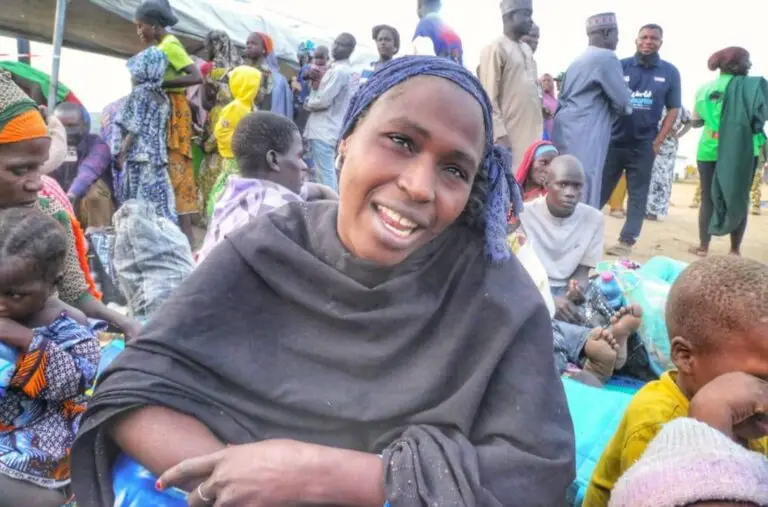
The tribute and prayers of an old woman, Mary Luka, who was overwhelmed by Zulum, the Federal Governments and UNHCR’s generosity, also touched many hearts.
Luka’s emotional words and prayers for Nigeria’s peace and tranquillity, shortly after being repatriated from Cameroon at Pulka, was a clear demonstration of how the repatriation initiative is healing the wounds in the returnees’ hearts.
The woman and many other returnees, who landed in Pulka after living in Minawao camps in Maroua, Cameroon, for over a decade were overjoyed with Zulum’s generous support with N550,000 cash gifts to each of the 75 households from Gwoza who voluntarily returned home finally in search of stability.
The old woman, who spoke on behalf of the excited crowd of returnees, prayed to God for the political leadership at all levels in the country to stand firmly in the fight against terrorism and for Nigeria’s growth and development.
“And for us, who were convinced to return to our ancestral home together with our children, and for the children to know their origin, we remain grateful to all of you” she said.
Easter Kulma, 40, and a mother of 10, who has been living in Minawao Refugee Camps for 11 years where she had four of her children, just like many others, expressed mixed feelings about the repatriation.
“Our wish is that the Nigerian government should intensify efforts toward tackling Nigeria’s challenges for the citizens to be lively.
“I visited the country recently, and up till now the country is not as lively as it was.
“So, we just came back to our country to stay with our people not because the situation is inconvenient for all of us,” she said.
“Everyone knows that Nigeria is still not too well, peace-wise; that’s our fear. Let’s send these people back to Nigeria, and from there we will be able to assess the situation,” she added.
Similarly, a cross-section of Refugees, also shared Hajiya Ally’s sentiment despite admitting that life in the camp has been very harsh.
They listed food -insecurity, scarcity of water, and earning through hard labour, among others, but still felt staying in Cameroon was safer, ignoring the generous investment package put in place by the technical working group for their stability on return.
Bitrus Magarwai, 56 and Abubakar Ali, 42, claimed there were more than 30,000 people from Kunduga and about 40,000 from Bama Marte, Mafa, Gwoza and Ganborun Gala currently at the camps in Cameroon.
The refugees, especially those who are from Gwoza and its environs clearly demonstrated their unwillingness to return, saying accessing farmlands, schools, healthcare services and potable water may be difficult in their various communities behind Gwoza mountain.
The Emir of Gwoza, Ahmed Idris Timta, debunked the above claim.
Timta said he sent special delegates to them from the palace more than four times to convince them to return with no result.
Nevertheless, Wakilbe told the UNHCR Cameroon that the Zulum administration was still willing to repatriate the Gwoza refugees as many as 6,000 as long as they were willing to return.
“Even if they are 6,000, we are ready this time around to pick all of them. But only 306 from Gwoza have indicated interest in coming; we are going with that.
“And with peace, tranquility and security support you have seen here, God-willing, they will tell a lot of stories and you will find out that many more will want to come,” the commissioner said.
Observers say the refusal of refugees from Gwoza and other communities in Minawao to return could be one of the state’s dilemmas in the fourth repatriation operation.
It is worth noting that Midjiyawa Bakari, the Governor of Cameroon’s Far-North Region, also expressed his happiness for the returnees and commended the Borno Government for sustaining the longstanding and cordial bilateral relationship.
Bakari said the cooperation between the two countries had been instrumental in ensuring the protection, welfare, and orderly return of the displaced persons across the border.
In all, stakeholders say Zulum’s repatriation drive is laudable and sensitive, but more efforts should be made towards rebuilding infrastructure, providing farming opportunities and reassuring the returnees of their safety.