
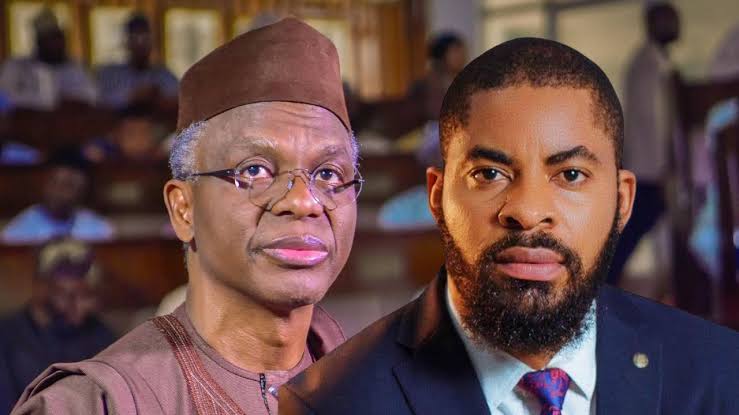
News Investigators/ A Human rights lawyer, Deji Adeyanju, on Monday testified in the ongoing trial of former Kaduna State Governor, Nasir El-Rufai, charged with alleged breach of national security.
Mr Adeyanju gave his testimony as 2nd prosecution witness (PW-2) before Justice Joyce Abdulmalik of the Federal High Court in Abuja while being led in evidence by Oluwole Aladedoye, SAN, Department of State Services (DSS)’ counsel.
The News Agency of Nigeria (NAN) reports that the DSS sued Mr El-Rufai after he claimed during a Tv interview that he intercepted a telephone conversation involving the the National Security Adviser (NSA), Mr Nuhu Ribadu.
The ex-governor had alleged that the conversation, on the telephone, revealed instructions to security operatives to arrest him.
He linked the alleged directive to an incident at the Nnamdi Azikiwe International Airport on Feb. 12 after his return from Cairo, Egypt.
When the case was called on Monday, Mr Adeyanju, who stepped into the witness box, presented the subpoena through which he was summoned to testify in the case.
Mr Aladedoye then applied to tender the letter of subpoena as evidence.
After Mr El-Rufai’s lawyer, Paul Erokoro, SAN, did not object the application, Justice Abdulmalik admitted it in evidence and marked it as “Exhibit G.”
Testifying, Mr Adeyanju recalled that on Feb. 12, reports emerged that Mr El-Rufai was either going to be arrested or invited by security agencies.
He said that before the television interview that led to the charges, he had publicly urged the former governor to present himself for investigation, insisting that the matter was not politically motivated.
The PW-2 told the court that the television station invited him to the programme on Feb. 13, the same day Mr El-Rufai granted the interview that formed the basis of the charges.
“I went to Arise, and Mr El-Rufai was also on the show.
“My segment came after his. During his interview, I listened to him speak on many issues, and I countered many of the things he said because they were not true or were half-truths,” he said.
The lawyer then applied for the interview recording which Mr El-Rufai granted for it to be played in open court.
The court granted the application, and the same video earlier played during the testimony of the PW-1 was replayed.
After the video was replayed, Mr Adeyanju confirmed that it reflected what he “witnessed on 13 February.”
The prosecution then sought to tender Mr Adeyanju’s own recorded interview with the same anchor, Charles Aniagolu, alongside a certificate of compliance.
The court admitted the flash drive and the certificate of compliance and marked them as “Exhibits H” and “H1,” after Mr El-Rufai’s lawyer raised no objection.
The Arise Tv interview with Mr Adeyanju was also played in court after the application to the effect.
In the video, the anchor, Anyagolu, asked Mr Adeyanju whether he believed the government truly intended to arrest Mr El-Rufai.
Responding, Mr Adeyanju said the DSS would have arrested him at the airport if that was their intention.
He also referred to a claim that the Independent Corrupt Practices and Other Related Offences Commission (ICPC) was already investigating Mr El-Rufai at the time.
Responding to questions on whether the ex-governor had said he would honour an EFCC invitation, Mr Adeyanju, in the video, maintained that he did not believe an airport arrest was likely.
“I don’t think so, knowing the kind of person that he is,” he said.
He explained that the DSS only met Mr El-Rufai at the airport because he was already on a watch list.
“So once your name is there, the first thing is to confiscate the passport,” he said in the video recording.
He added that no one was being persecuted.
The witness insisted that any assessment of persecution should be compared with events during Mr El-Rufai’s time as governor.
He also said Mr El-Rufai should be investigated for alleged corruption and that such investigation should precede prosecution.
“So he can defend himself in court,” he said.
He further said in the video that “the oppressor of yesterday cannot suddenly become the hero of today,” while referencing demolition of properties belonging to political opponents during Mr El-Rufai’s tenure.
He said Mr El-Rufai is an ardent violator of human rights, adding that he “showed no remorse,” and described Mr El-Rufai’s current situation as “karma.”
After the video ended, Mr Adeyanju explained in court what transpired following his interview with the television station.
He said he later received information from the DSS instructing him to appear at their office.
He said he complied and later “reluctantly made a statement.”
According to him, I confirmed that Mr El-Rufai said that someone tapped and gave him the information.
“I put all that into writing,” he said.
He was shown his statement, marked as “Exhibit E,” which he confirmed.
During cross-examination, the defence lawyer, Mr Erokoro, asked whether Mr Adeyanju heard Mr El-Rufai saying in the video that he tapped a phone call.
The witness responded that Mr El-Rufai said “we listened to their calls.”
Responding to another question from Erokoro, the PW-2 said, “If someone says a call was hacked, I will report it because I do not know how it was hacked,” he said.
The lawyer then suggested that if a person speaks on speaker phone and others hear it, it does not amount to tapping.
The prosecution objected to part of the questioning, but the defence relied on Section 7 of the Evidence Act, arguing that the questions were relevant to explaining the witness’s testimony.
The witness said that if he was present when a phone conversation was played on speaker, he would not have lied about it.
He said he did not know whether the NSA made calls in a way that others could hear, adding that it was not his concern.
Erokoro put it to the witness whether he would be surprised if the NSA was asked which of his devices was hacked and also suggested that the NSA might not be able to identify the device involved.
But Mr Adeyanju said he had no opinion on the matter.
He added that he only appeared in court because he had been summoned and had “no choice.”
Judge Abdulmalik then adjourned the matter until June 23 for continuation of trial.
NAN