
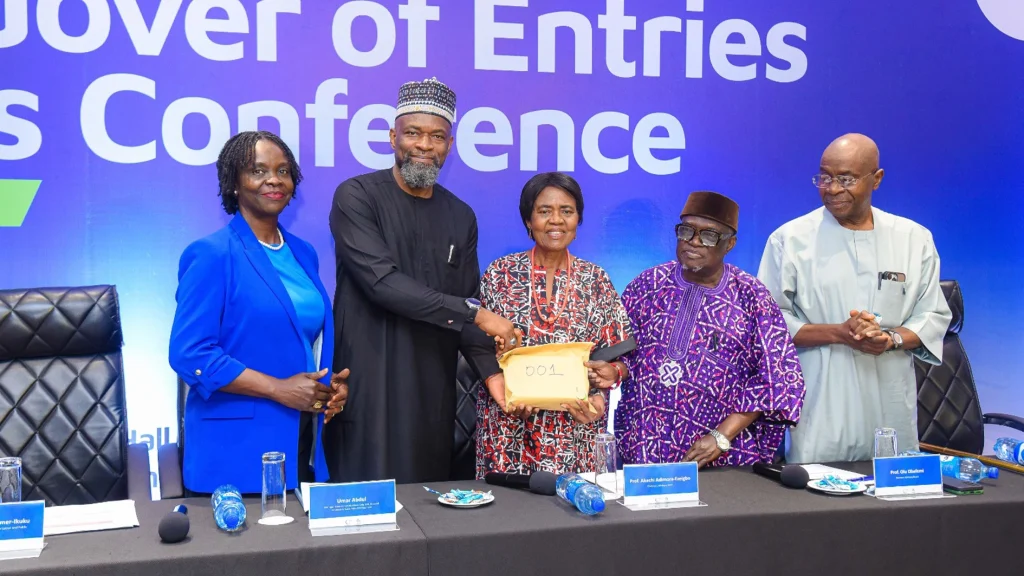
News Investigators/ Demand for books by the three poets shortlisted for the $100,000 2026 NLNG Nigeria Prize for Literature has surged since the announcement.
The poets told the News Agency of Nigeria (NAN) that the recognition has expanded readership while placing poetry and its questions about Nigeria, identity, faith and society before a wider audience, one voice before another.
The poets are: Tares Oburumu, author of Flora’s Love Colony; James Eze, author of Unbind Me Now and Ogaga Ifowodo, author of Why Does God Need a Gun?
The three books emerged from an initial longlist of 11 entries in the 2026 poetry category.
Eze said the increased attention demonstrated the wider impact of the prize on Nigerian literature and how it was already taking his work beyond Nigeria.
He cited a PhD student from Makerere University, Uganda, who contacted him after seeing his television appearance and asked where she could get his collection.
“The themes in the book align with her research topic on the upheavals and political displacement across Africa,” he said.
Eze said the shortlist had also brought literature into wider public attention, including among people who were not ordinarily interested in books.
“You find interest in the literary culture shooting skywards.
“So a lot of people are paying attention to literature now. Many people are reading,” he said.
He said the recognition had brought goodwill messages and changed how people viewed him, although he did not write Unbind Me Now to win the prize.
“If there were no rewards, I would still write because for me it is not really about writing for any prize.
“The prize, the NLNG prize, what it represents for me goes beyond me. I’m happy that writers are celebrated in Nigeria,” he said.
Unbind Me Now, containing 71 poems, explored outrage, disappointment and disenchantment with Nigeria’s contemporary realities.
Describing the collection as a poetry of reckoning and witness, Eze used fire as a recurring motif to address insecurity, violence, displacement and frustration.
The collection was written between 2020 and 2025, with the manuscript completed in December 2025.
Oburumu’s Flora’s Love Colony traced Nigeria’s history from the pre-colonial period through slavery and colonialism to the post-colonial era.
He said poetry enabled him to present extensive historical information without lengthy narration, while exploring identity and decolonisation.
“With poetry, I was able to put the information bit by bit in one poem and another without trying to be verbose, without trying to over-narrate the whole story,” he said.
Oburumu said the collection was inspired by his interest in the history surrounding Nigeria’s name and the need to help Nigerians understand their past.
He said he did not write it with the prize in mind but its recognition had widened the potential audience for his work.
“Being on the list means that you are reaching to a wider audience, a global audience and that means that you are going to touch more lives than you have already done,” he said.
Oburumu recalled a reader in Sudan who told him that one of his poems had helped him abandon thoughts of suicide during a difficult period.
“I am more inclined to that when what you are writing saves someone, touches a life; that is greater than prizes,” he said.
Ifowodo’s Why Does God Need a Gun? examined religious belief, fanaticism and the consequences of using faith to justify the dehumanisation of others.
“It’s a poetic reflection on the question of belief, religious belief and what that means for the way we see the other who does not share that belief,” he said.
The collection used Leah Sharibu as a composite figure representing girls abducted from schools, exploring faith, fear, forced conversion, freedom and victimhood.
“I want to make the reader share every moment of her anxieties, of her fears, of her hopes,” he said.
Ifowodo said the book also examined religious extremism, violence and displacement beyond Nigeria, while questioning claims made in the name of God.
“When there’s no peace, there can’t be development, there can’t be progress.
“What you have is war, strife, conflict,” he said.
He said he could not determine why judges selected his book but assumed they found it meritorious, aesthetically pleasing enough, and engaging enough to shortlist it.
NAN also reports that the Nigeria Prize for Literature began in 2004 and covers prose fiction, poetry, drama and children’s literature.
The 2026 edition, focused on poetry, attracted 223 entries before the longlist was reduced to 11 and subsequently three shortlisted books.
NAN